
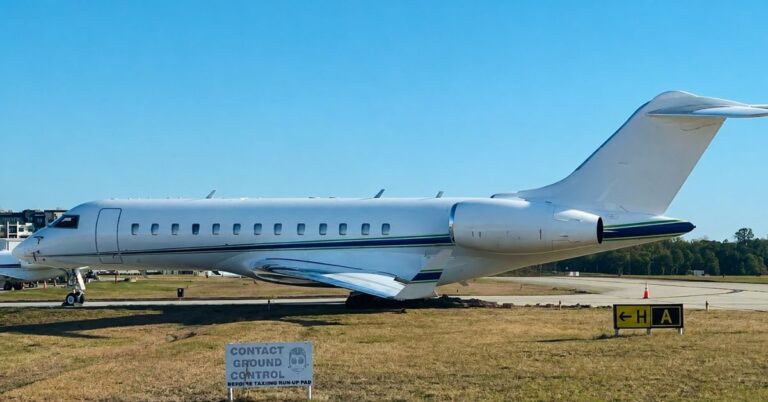
Runway Incursions in the US: What Pilots Can Learn from KPDK
Recent FAA data shows that targeted changes to airport geometry can significantly reduce runway incursions. At DeKalb-Peachtree Airport, the combination of closely spaced parallel runways, crossing surfaces and diverse traffic provides a useful operational example for private jet pilots.
Reviewed by Kevin Singh, Founder · Fact-checked against Icarus Jet fleet and airport operations data · Last updated 10 September 2026
The guide
DeKalb-Peachtree (KPDK), about 15 miles north-northeast of Hartsfield-Jackson, mixes jets with roughly ten flight schools and helicopters; county guidance says it has the highest US runway incursion rate. Parallel runways 3L/21R and 3R/21L have staggered thresholds, and 16/34 crosses both. FAA hot spots: missed turns onto Taxiway A, crews expecting 3R not holding short of 3L, and aircraft exiting at Taxiway G entering 3L/21R. At night, Buford Highway can resemble 3R/21L.
A runway incursion may take place during one of the simplest stages of the flight process: taxiing.
The aircraft usually moves slowly, but the environment around it may be very complex. Multiple taxiways, closely spaced runways, unusual layout, change of frequency, and rapid issuance of instructions may combine into creating situations when even a minor navigational error may put the aircraft in a potentially dangerous place.
The Federal Aviation Administration (FAA) has been working for many years on identifying airports where runway incursions keep happening while assessing whether airport geometry has anything to do with it. The Runway Incursion Mitigation (RIM) program implemented by the agency analyses data on runway incursions along with using geographic information systems to identify the locations posing risks to pilots.
The latest results show that the changes do make a difference. However, infrastructure alone cannot solve all the problems. Pilots need to be able to assess potential risks and be prepared for them even before starting to taxi.
Few airports illustrate that better than DeKalb-Peachtree Airport (KPDK) in Georgia.
Why KPDK deserves attention before taxi
Located approximately 15 miles north-northeast of Hartsfield-Jackson Atlanta International Airport, KPDK handles a large number of corporate and general aviation jet traffic. Roughly ten flight schools and significant helicopter activity also operate out of KPDK, which means that business jets regularly use airport facilities in the presence of different types of aircraft operated by pilots with varying experience.
The unique airport geometry poses an additional challenge.
KPDK features two closely spaced parallel runways, 3L/21R and 3R/21L, with staggered thresholds. Runway 16/34 crosses both runways. Taxiways run adjacent to and between these runways, connecting aircraft with ramps located mostly in the western and northern parts of the airport.
DeKalb County does not underestimate the danger. The airport operations guidance indicates that PDK has the highest rate of runway incursions among U.S. airports and warns pilots to use extreme caution when taxiing. The guidance includes specific recommendations on reading Runway Safety Action Team materials and FAA safety videos prior to arriving at KPDK.
As far as private jet pilots are concerned, the question is not only whether there were runway incursions at KPDK or not. The real question is what kind of risks the airport poses to pilots and what the crews can learn from them.
Three hot spots, three operational lessons
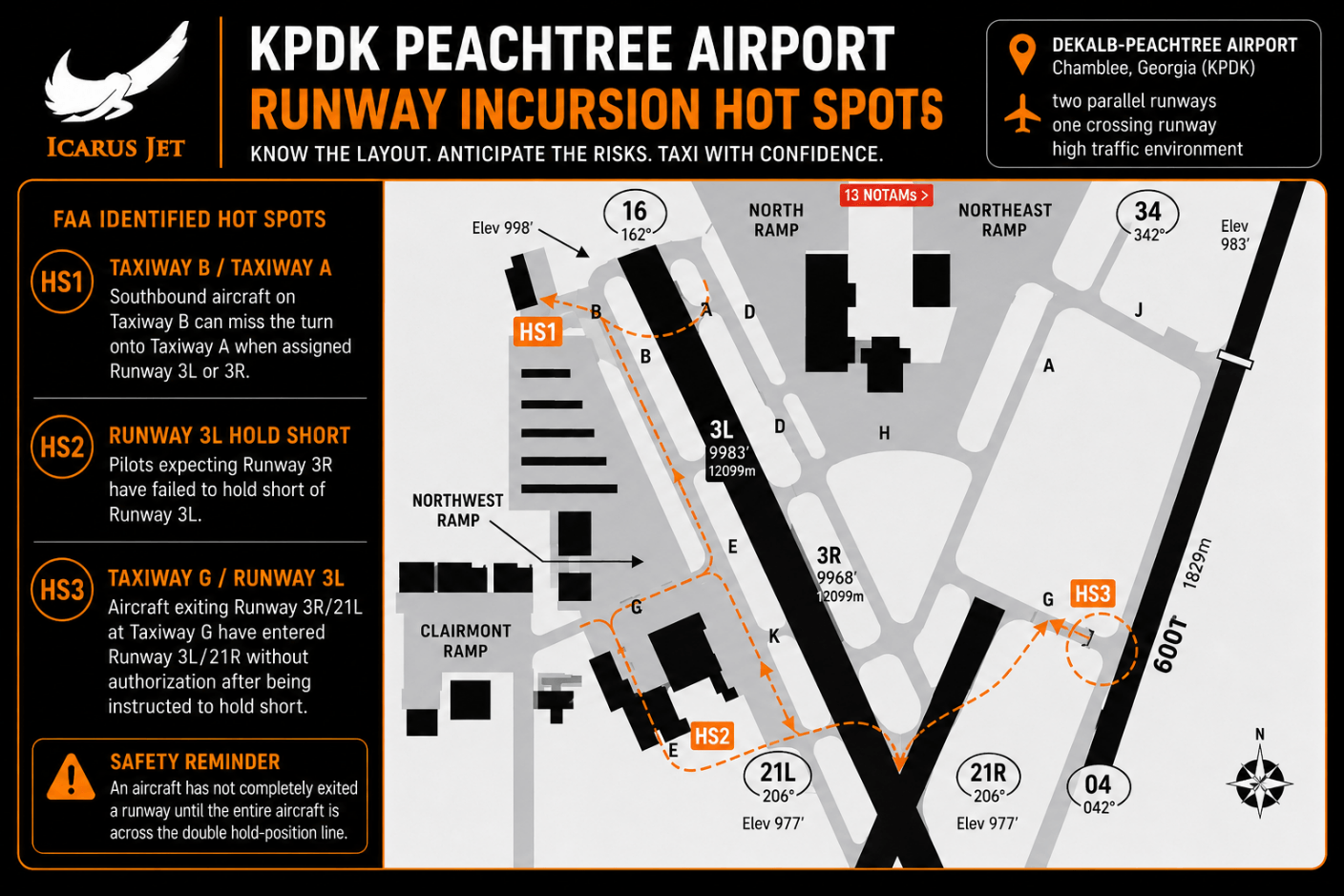
The FAA currently identifies three runway-incursion hot spots at KPDK.
HS1 is related to southbound aircraft on Taxiway B. According to the FAA, pilots may miss the turn onto Taxiway A when being assigned to Runway 3L or 3R. This hot spot proves once again that a taxi clearance may look simple but can become much more challenging when the geometry of the airport does not develop exactly as planned inside the cockpit.
HS2 is particularly relevant for crews assigned to Runway 3R. The FAA warns that pilots expecting Runway 3R failed to hold short of Runway 3L.
There is an important point related to human factors in this warning. Mental preparation for the departure runway can shift the pilot’s focus from another runway which needs to be encountered or crossed before reaching the departure runway. The departure runway may be the crew's destination, but it is not necessarily the next critical surface.
HS3 is associated with aircraft that have exited Runway 3R/21L at Taxiway G. Pilots instructed to hold short of the adjacent Runway 3L/21R enter it without clearance. Moreover, FAA warns that an aircraft does not exit the runway entirely until the whole aircraft moves past the double hold-position line.
Airport diagram of KPDK provides a clearer understanding of these warnings. The runways and taxiways are relatively close to each other, providing pilots with a little room for switching from one action to another.
Brief the taxi, not just the departure
One of the most important lessons from KPDK is that preparation for runway-incursions start even before the engines start.
Private jet pilots always give much thought to departure procedures – runway performance, SID, weather, rejected takeoff considerations, and potential threats. The same amount of attention needs to be given to a taxi route when flying to an unfamiliar or complex airport.
The crew should not only identify the expected departure runway but also every runway that can affect the taxi route. Hot spots, crossings and hold-short points can be identified before movement starts.
At KPDK, for instance, a crew expecting Runway 3R should already know how Runway 3L relates to it. The idea is to avoid figuring it out while taxiing and listening to instructions from Ground Control.
The same applies to the approach phase. Taxiing does not become an administrative phase simply because the aircraft has left the landing runway. At KPDK, pilots having landed on one of the parallel runways and taxiing to the west or northwest ramps failed to hold short of Runway 16/34 at Taxiways A and E.
After-landing checklists and cockpit procedures need to be performed against the background of surface operations.
The risk is not limited to incursions
KPDK also provides a good example of overlapping surface-related risks.
The FAA warns that there is a risk of wrong-runway landing because of the closely spaced parallel runways and staggered thresholds. The presence of Taxiway A running parallel to the entire Runway 3L/21R creates another visual trap. At night, pilots need to be careful because Buford Highway may be mistaken for Runway 3R/21L due to the brighter highway lighting compared to airport lighting.
When available, the FAA recommends backing up visual approaches with an instrument approach to help crews confirm alignment with the correct surface.
These hazards are not runway incursions, but they share one thing in common – maintaining the correct airport mental picture in mind.
What the wider FAA effort tells pilots
The FAA’s RIM program demonstrates that runway-incursion risk is not simply an unavoidable consequence of busy airports.
The program identifies airports where recurring events suggest that nonstandard geometry or other infrastructure characteristics may be contributing to incursions. The FAA can then evaluate modifications intended to make the correct path more intuitive to pilots.
The FY2025 RIM report, published in August 2026, provides further evidence that targeted mitigation can work.
For pilots, however, infrastructure improvements do not remove the need for preparation.
KPDK provides a useful example precisely because its risks are identifiable. A crew can study the diagram, understand the relationship between the three runways, identify HS1, HS2 and HS3 and anticipate where additional attention will be required.
The FAA's KPDK guidance is not a replacement for current operational information. Pilots are explicitly instructed to consult current NOTAMs, airport diagrams, charts and construction notices because airport conditions and procedures can change. For the wider preflight picture, from declared distances to the FAA’s new surface safety tools, see airport data and surface safety.
Questions
Runway incursions: questions the desk gets
What is a runway incursion?
A runway incursion happens when an aircraft, vehicle or any other object is present on the protected surface designated for aircraft landing and takeoff.
Why is KPDK especially important from the perspective of runway-incursion awareness?
This airport features closely spaced parallel runways, crossing runways, multiple connecting taxiways and a variety of aircraft types, including corporate jets, training aircraft and helicopters. DeKalb County warns that PDK is one of the airports with the highest rate of runway incursions among US airports.
How many FAA hot spots are there at KPDK?
Three. They concern Taxiways B/A, pilots expecting Runway 3R but failing to hold at 3L and aircraft exiting 3R/21L at Taxiway G and entering 3L/21R without authorization.
What should pilots read before flying to KPDK?
The current airport diagram, NOTAMs, hot spots, FAA guidance materials and airport-specific materials should be reviewed by the pilots.
Is it possible to request progressive taxi instructions?
Yes, when pilots are unfamiliar with the airport or not sure about taxi clearance and position, they can ask ATC for progressive taxi instructions.
What is the main lesson for private jet pilots?
Treat surface movement as an operational phase requiring the same preparation and crew coordination as departure and arrival. At complex airports, briefing hot spots, crossings and hold-short points before taxi can reduce workload when it matters most.
Where this sits
The guides around this one
Briefing an unfamiliar field? Planned from the desk
Send the dates, the aircraft and the stops. You get the permits filed, the routing checked against the current picture, handling confirmed, and a number you can hold us to.
Contact Us