
Caribbean Winter Private Jet Operations: What Pilots Need to Know
Winter is one of the Caribbean’s busiest periods for private aviation. Parking, permits, airport hours, fuel and customs requirements can vary significantly between islands, making advance planning essential.
Reviewed by Kevin Singh, Founder · Fact-checked against Icarus Jet fleet and airport operations data · Last updated 23 September 2026
The guide
Flying in the Caribbean can seem quite simple on paper; the distances between islands are often short, and it’s common that passengers plan few island visits during one trip.
Yet the operational reality is quite different.
Every island has its own rules, customs, regulations, permits, and limitations on parking and airport hours. With increased Caribbean private jet demand in winter, flexibility drops sharply if plans change.
For a pilot, the best strategy is to consider each stopover in the Caribbean as a separate flight and be at least one leg ahead. And here’s where an experienced trip support team can make the difference.
Private jet parking in the Caribbean is the first winter question
Before even taking off, the pilot needs to have an idea of where the aircraft will park after the passengers disembark.
Terrance B. Lettsome International Airport (TUPJ) in the British Virgin Islands illustrates why this is important. Based on our experience, ramp space is limited in the winter season, and it can be difficult to secure a parking spot on certain days or for certain aircraft types.
Request the parking spot as early as the dates are known. If the airport cannot accommodate the parking of a particular aircraft, it may be asked to drop off the passengers and perform a quick turnaround.
This means the pilot must find a place to reposition the aircraft, prepare a new flight plan, purchase fuel, and plan all airport, customs, and handling procedures again. Accommodation for the crew members might also need to be reconsidered.
This is why handling confirmed does not necessarily mean parking is confirmed during the Caribbean winter. Furthermore, if parking is not secured yet, the repositioning procedure has to be planned ahead.
Part 91 versus Part 135: landing permits by type of operation
The nature of the operation can also change what is required.
For instance, Clayton J. Lloyd International Airport (TQPF) in Anguilla requires a landing permit for Part 135 operations.
At TUPJ a landing permit is required, and certain Part 135 passenger operations pay a fee on top of it.
That distinction is particularly important for aircraft that alternate between private and charter flying. A previous Part 91 operation into an airport should not be used as the template for a subsequent Part 135 flight.
Operational status, tail number, aircraft type, MTOW and passenger information should therefore be communicated early enough for the correct requirements to be checked before departure.
Caribbean airport operating hours and after-hours charges
Short flight time does not necessarily mean a simple operation.
Anguilla publishes operating hours of 0700 to 1900 local, and charges extra outside that window.
The same situation occurs in The Bahamas. In Nassau (MYNN), government service runs after hours from 1701 to 0859 local. At Exuma (MYEF), there are customs and immigration attendance charges applicable outside daytime hours. Moreover, the information also mentions ATC/airport authority charges for operations after sunset or before sunrise.
This is where the passenger delays play an important role.
Even a 60 or 90-minute delay in departure can change the arrival hour and make it an after-hours period. Therefore, crews must consider how delays affect customs, airport availability, and ground handling.
Key Caribbean airports for private jets this winter
The same basic information applies to all Caribbean airports, but the details differ by airport.
TNCM, St Maarten: fuel and ground services
Fuel and ground services should be confirmed before operating at Princess Juliana International Airport, especially during busy periods.
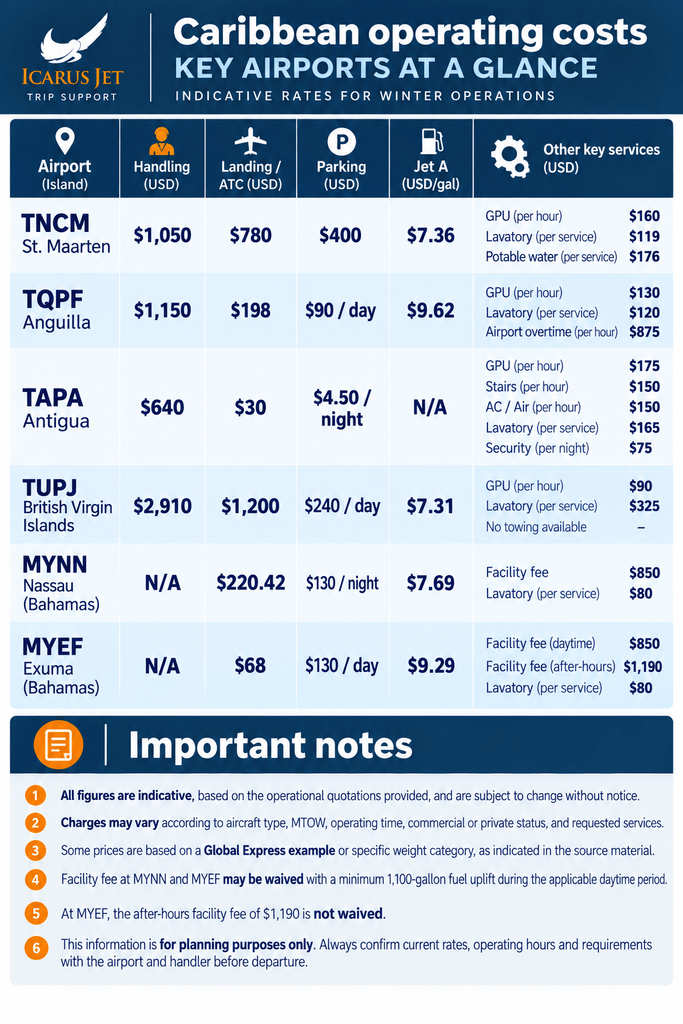
Jet A is quoted at USD 7.36 per gallon, and prices move, so the desk reconfirms the figure with the handler before departure. The data also mentions separate charges for parking, GPU, potable water, lavatory servicing, and other ground services.
For pilots using TNCM as part of a multi-island itinerary, it is worth thinking about the fuel needed for the next sector.
TQPF, Anguilla: Part 135 permits, airport hours and fuel
Anguilla offers examples of several aspects pilots must consider: Part 135 permit requirements, airport hours, and high fuel prices.
Jet A is quoted at USD 9.62 per gallon, and there are additional charges for operations outside normal hours.
With the delayed itinerary, pilots must pay close attention to the arrival time. A delay of a few minutes in the Caribbean could affect the procedure at TQPF.
TAPA, Antigua: ground services to confirm in advance
At V.C. Bird International Airport, it is necessary to check carefully the ground services required for the aircraft and when they will be needed.
There is separate provision for GPU, stairs, AC, potable water, lavatory servicing, crew transportation, and overnight security, among other services at this airport.
During the busy winter period, it is best to plan in advance.
TUPJ, British Virgin Islands: limited parking and CARICOM APIS
TUPJ deserves particular attention this winter because parking is expected to be constrained.
In addition to quick-turn operations due to limited parking, pilots should note that towing is not available at this airport.
CARICOM APIS is required before the arrival and before the departure, and the aircraft tail number should be used as the Flight ID. An electronic customs and immigration card is required as well.
Jet A is quoted at USD 7.31 per gallon.
The limited parking availability, documentation requirements, and non-availability of towing services make advance coordination necessary.
MYNN, Nassau: fuel, facility fee and after-hours service
At Lynden Pindling International Airport, fuel and ground costs may be connected.
Jet A is quoted at USD 7.69 per gallon, with a USD 850 facility fee that is waived on an uplift of 1,100 gallons or more. Overnight parking is quoted separately.
When planning the itinerary, pilots should keep in mind after-hours periods, especially when Nassau follows another destination in the Caribbean where passenger timing is not certain.
MYEF, Exuma: fuel, facility fees and customs attendance
Exuma also shows why you need to consider fuel, timing, and ground handling together.
Jet A at Exuma is quoted at USD 9.29 per gallon. The daytime facility fee can be waived with a minimum 1,100-gallon uplift, while the after-hours facility fee is not waived. Overnight parking and customs and immigration attendance are charged separately.
Additional ATC/airport authority charges are applicable after sunset or before sunrise, making the schedule changes relevant if performing the operation later in the day.
Plan one island ahead on a multi-stop Caribbean itinerary
The Caribbean itinerary should not be considered as a series of short flights.
Imagine that an aircraft is performing a flight from TNCM to TQPF and then to TUPJ. The legs are relatively short, but the arrival in each destination brings a completely new set of parking, permits, airport hours, fuel, and border regulations.
Before leaving TNCM, the crew must know what will happen after landing in Anguilla. Before leaving Anguilla, the crew must also know the parking situation at TUPJ.
The same principle is to be applied if parking disappears unexpectedly. Where is the next repositioning? Is the fuel available there? What are the airport hours? Does the repositioning require additional customs clearance? What is the effect on crew duty and passenger pick-up?
Staying one island ahead provides much more resilience when a winter itinerary starts changing.
Passenger documentation for Caribbean and Europe connections
Passenger documentation regulations outside the Caribbean could affect the passengers connecting through the Caribbean.
One of the upcoming changes concerns Saint Lucian citizens traveling to Europe. ETIAS is expected to become operational in late 2026. Once implemented, eligible visa-exempt Saint Lucian passport holders traveling to participating European countries for qualifying short stays will need an ETIAS travel authorization.
This does not replace the appropriate immigration process for employment, long-term study or stays beyond the permitted short-stay period.
For flight departments, the general lesson is more important than any particular program: passenger documentation has to be checked according to nationality, destination and purpose of travel.
Caribbean winter flying rewards preparation
Caribbean flying often combines island-hopping with significant operational variation on the ground.
But in winter, the parking limits and increased demand decrease the margin in case of passenger delays or late arrivals.
Thus, pilots have to think not only about the upcoming landing, but also about parking, permits, fuel, customs, airport hours, and the next movement of the aircraft.
In the Caribbean during the winter peak season, knowing what happens after landing is sometimes as important as planning how to get there.
Questions
Caribbean winter operations: questions the desk gets
How early should Caribbean winter parking be requested?
As early as possible. Winter ramp capacity at TUPJ is limited, and a quick turnaround may be the only way in on a busy day.
Do Part 135 flights require landing permits?
It depends on the airport. Anguilla and the British Virgin Islands both require permits for certain Part 135 operations.
Does handling confirmation guarantee parking?
No. Parking has to be confirmed separately, especially during the peak winter period.
Why do airport hours matter for short Caribbean flights?
Because even the shortest passenger delay can push an arrival into after-hours, affecting customs clearance, airport services, and ground handling.
Should crews plan fuel one sector at a time?
Not necessarily. Fuel price, availability, uplift, and next destination have to be considered together, especially during multi-island itineraries.
What is the best strategy to fly in the Caribbean?
Consider each destination separately as an international operation and plan at least one leg ahead.
Where this sits
The guides around this one
Flying the Caribbean this winter? Filed from the desk
Send the dates, the aircraft and the stops. You get the permits filed, the routing checked against the current picture, handling confirmed, and a number you can hold us to.
Contact Us