
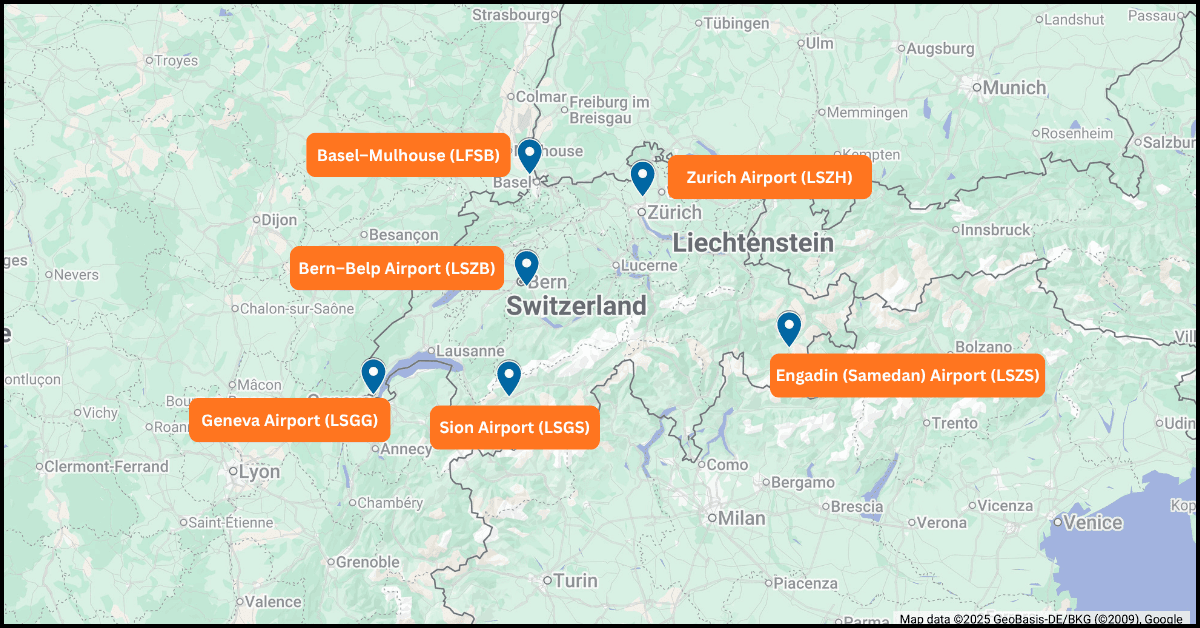
The Swiss Winter: Choosing Between Six Airports
Switzerland is the business jet traveler’s winter standard. With major cities and airports like Geneva and Zurich, and smaller alpine airports like Samedan and Sion, the air network of the country allows going from city to the snow in a matter of hours.
Reviewed by Kevin Singh, Founder · Fact-checked against Icarus Jet charter and operations data · Last updated 12 September 2026
The guide
During December through March sees Switzerland’s skies with some of the continent’s busiest private traffic. Private jet routes such as Zurich-Geneva, Paris-Geneva, Nice-Geneva, Paris-Zurich, Nice-Zurich, and Milan-Zurich are common, taking passengers from cultural hubs and beach retreats to alpine valleys.
These routes are favored by swift and convenient midsize or light jets or turboprop, such as the Pilatus PC-12, Citation CJ2, Phenom 300, Citation XLS+, or Learjet 75, for agility and speed between regional airports. When passengers are bringing the family or heavy ski gear along, the Challenger 650s or Falcons 2000 are favored for more cabin space and reach.
Zurich as the winter gateway
Zurich Airport (LSZH) is the key private jet hub for Switzerland and, for a great number of private travelers, the perfect landing location. Its 12,100-ft (3,700-m) runway supports all types of jets, from the Citation CJ2 to the Global 7500, and the executive terminal is open around the clock.
Travelers can process customs onboard, step directly onto incoming ground transportation, and interchange aircraft to Gstaad, Andermatt, or St. Moritz, all within 30 minutes. De-icing at the facility results in minimum down time, and warm hangar space is available for wide-body aircraft.
Zurich itself is frequently the beginning or the end of a winter trip schedule, with an evening spent around the lake, dinner downtown, and then a retreat to the mountains the next day. That’s where the cycle of the seasons starts.
Geneva and the French Alps
Geneva Airport (LSGG) is the western gate to the Alps and the busiest single-runway European airport during skiing season. The Gulfstream G650, Global 6000, and Falcon 8X are common nonstop aircraft from the U.S. or the Middle East, with occupants bound for Verbier, Crans-Montana, or Chamonix, just over the French border.
The airport is within five kilometers of the city center, and transfers are quick and direct. Ground or helicopter transfers from the private terminal can take passengers to Verbier within an hour. On snowy mornings, Geneva’s runway maintenance and de-icing staff maintain flow steadily, one of the reasons why the airport is popular for frequent winter operations.
Basel: The go-to alternative
Basel–Mulhouse (LFSB), jointly owned by Switzerland, France, and Germany, is an alternative for the discreet passenger. The 12,400-foot (3,800-m) runway takes all types of jets, but traffic is lighter when compared to Geneva or Zurich.
Its position keeps it within easy reach of the Bernese Oberland resorts or those passengers going to meetings in north-west Switzerland before getting to the mountains. Basel is also an alternative base for aircraft repositioning if the parking is tight elsewhere, so passengers can always touch down near their terminal even at the busiest weekends.
Sion: The airport nestled in the Alps
For those wishing to land as near to the snow as possible, Sion Airport (LSGS) is the portal to the Valais region, where Verbier and Crans-Montana are located, with a helicopter link to Zermatt. The 6,560-ft (2,000-m) runway is wide enough to support most midsize business jets, up to the Challenger 350 and Falcon 2000, but large-cabin landings do involve special performance planning for the valley approach.
It sits at the end of a stunning alpine valley, and only crews trained in mountain procedures are allowed for the winter operations. Views over the snow-capped mountains and vineyards below are provided on clear weather days. Ten minutes from touchdown, Verbier is accessible by helicopter.
Apron space is minimal, with space for about a dozen midsize jets at a time, thus visits are frequently limited. Operators will often drop passengers and reposition to Zurich or Basel. Even with these restrictions, however, Sion is among the continent’s most popular landing spots for private jet passengers who value convenience over formality.
Samedan to St. Moritz
Engadin (Samedan) Airport (LSZS) is flown directly to St. Moritz and is the highest airfield in Europe at 5,600 feet (1,707 meters). Its 5,900-foot (1,800-m) runway requires restricting operations to lighter jets; the Phenom 300, Citation CJ2+, or Pilatus PC-24.
Only daylight and visual flights are operated, so weather flexibility is imperative. The journey from Samedan to St. Moritz takes ten minutes, and helicopter transfers to convenient helipads, for example, Corviglia or Silvaplana, are offered. Parking is very restricted, so the aircraft will generally be repositioned once passengers are on the ground.
Bern for Gstaad and beyond
Bern–Belp Airport (LSZB) provides direct access to Gstaad and Adelboden, serving light and midsize jets through the Citation Latitude. With a 5,670-ft (1,730-m) runway and a compact FBO, it is efficient for rapid turnarounds. Operating hours are approximately 06:00–22:00 local, and customs are feasible to clear on arrival.
Travelers who prefer Bern value discretion and quick ground times. Gstaad is also an hour by car or 20 minutes by helicopter, with year-round mountain routes, if the weather allows.
Working with a trusted partner
Switzerland’s winter is unique, and preparation remains key. Private charter companies like Icarus Jet work alongside operators and authorities to secure all the moving pieces of a winter flight in Switzerland, like:
- Parking and slots: Zurich and Geneva are slot request airports, particularly at Christmas and New Year. The apron space at Sion and Samedan airports is very restricted.
- Weather: Alpine weather is changeable. When a mountain field is closed by snow or fog, operators switch effortlessly to Zurich or Basel.
- De-icing: Comprehensive services are offered at all major airports, and the delays are generally minimal due to scheduled coordination.
- Helicopter transfers: Twin-engine helicopters like the Agusta AW109, Airbus H135, and Bell 429 are the norm for resort transfers.
This process occurs behind the scenes. For passengers, what is seen is consistency; suitcases dispatched directly to awaiting cars, snow continuing to fall with the journey staying right on schedule.
In a nutshell, Swiss private aviation is not extravagance; it is mastery of time and coordination. The airports, ground handling, and transportation are run with the same precision as the nation’s timepieces.
It is possible to wake up in Paris, to be skiing in Verbier at lunch, to be dining in Zurich that night, all without ever encountering a queue or a hassle. That serene efficiency – on time, unstated, regular – represents the essence of Swiss luxury.
Questions
Swiss winter questions the desk gets
Which Swiss airport should I use for Davos?
Zurich takes the international arrivals but leaves roughly a two hour drive. Samedan is general aviation only and about thirty minutes closer, but it is the second highest airport in Europe and its weather closes the door more often than anyone would like, so a Zurich or Geneva alternate should be held rather than assumed.
When is the Swiss winter season busiest?
Mid-January to mid-February, when the World Economic Forum at Davos, the Snow Polo World Cup and White Turf at St Moritz fall within weeks of each other. Aircraft, crew and parking tighten together across the whole country, not just at the nearest field.
Can I fly directly into a ski resort?
Not into the resort itself. Sion and Samedan get you closest to the Valais and the Engadin respectively, and a helicopter transfer covers the last leg where a helipad exists. Everything else is a drive, and in winter the drive is the variable part.
What is the weather risk at Alpine airports?
Real and worth planning for. High-elevation fields close for visibility and wind more often than lowland ones, and an approach that is straightforward in October is not in January. The alternate is a genuine part of the plan rather than a formality.
How far ahead should I book for the winter events?
Weeks to months for the January window. It is aircraft availability and airport parking that run out first rather than the price, and the operators who know those fields well are committed earliest.
Is it worth flying into Geneva instead?
Often, for the Valais and the French Alps, because it combines long-haul access with reasonable drive times and fewer weather cancellations than the mountain fields. For the Engadin it is the wrong side of the country.
Where this sits
The guides around this one
Talk to the desk
Pricing a real trip?
Send the dates, the passengers and the stops. You get a named aircraft, itemised pricing, the operator checks done and a number you can hold us to.
Contact UsPrefer to talk? Call +1 888 277 7203 or email charter@icarusjet.com. The desk is staffed 24/7.