
Mar-a-Lago Presidential TFR Guide for Private Jet Pilots
TFRs (Temporary Flight Restrictions) define an area restricted to air travel due to an event, hazardous condition or a general warning for the entire FAA airspace. Consequently, they are essential for ensuring the security of airspace whenever the President travels.
Reviewed by Kevin Singh, Founder · Fact-checked against Icarus Jet fleet and airport operations data · Last updated 10 September 2026
The guide
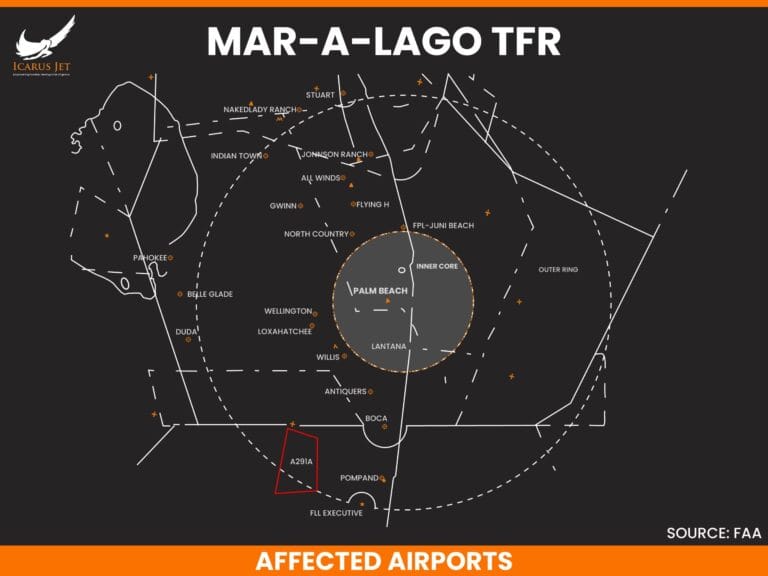
The TFR is active only when the President is in town. Its 10 NM inner core, up to 17,999 feet MSL, is closed to private flights unless pre-approved; the 10 to 30 NM outer core bans loitering and requires a flight plan, discrete squawk and ATC contact. PBI departures need TSA screening at HPN, TEB, IAD, MCO or FLL, booked 24 hours ahead. PBI ramp freezes start 5 to 7 minutes before VIP movements.
With Mar-a-Lago in Palm Beach, Florida, likely to be a regular destination for President Donald Trump, it is critical for pilots, private aviation professionals, and private jet crews that plan to operate in or near the airspace to understand the FAA’s detailed TFR procedures.
What is a TFR?
A TFR is an airspace limitation issued by the FAA that may include restrictions on aircraft operations over defined areas. The Mar-a-Lago TFR is only activated when the President is in town and has clear-cut parameters to allow as little disturbance as possible with security. This information is crucial for private jet crews and operators, who must work within the restrictions and ensure their operations are smoothly conducted.
Key elements of Mar-a-Lago TFR procedures
- Inner Core: 10 NM radius from the surface to 17,999 feet MSL. No aircraft operations are permitted except for:
- Military aircraft providing direct support to the USSS (United States Secret Service) and the President.
- Pre-coordinated law enforcement, air ambulance, and firefighting operations.
- Scheduled commercial passenger and cargo carriers under TSA-approved security programs.
- Private aviation flights pre-approved and meeting all FAA and TSA requirements.
- Outer Core: Extends from 10 to 30 NM with restrictions:
- Aircraft must be arriving or departing local airfields.
- Loitering is prohibited, and transit operations require ATC authorization.
- Pilots and private jet crews must file active IFR or VFR flight plans, squawk discrete codes, and maintain two-way ATC communication.
TFR gateway procedures for private jet crew
- TSA screening for departures to PBI. This is of specific importance for private jet operators moving high-profile customers.
- Gateway airports: HPN, TEB, IAD, MCO, and FLL.
- TSA screening should be reserved 24 hours in advance by calling 561-616-9650.
- Departures shall be in constant radio contact with ATC and squawking discrete codes. Intermediate stops are not allowed.
Restrictions at Palm Beach International Airport (PBI)
- Anticipate ramp freezes 5-7 minutes before the VIP arrival/departure. These will significantly impact private jet scheduling, and scheduling well in advance is key.
- Runway sweeps will occur before VIP activity, and the runway will be "sterilized."
- Once the VIP departs airport property, normal operations can resume.
- Pre-screened aircraft holding minimum or divert fuel are encouraged to call ATC for possible clearance; however, this may not be permitted, and approval of USSS is required.
- Submit a request for a PBI TFR Local Flight Request Form at least 24 hours in advance.
Prohibited activities within the TFR
Private aviation and jet crews have to adhere to the rules concerning TFRs very strictly. The following activities are not allowed:
- Flight training.
- Aerobatic flight and glider operations.
- Parachute and ultralight activities.
- Sightseeing and maintenance test flights.
- UAS operations.
- Banner towing and crop dusting (case-by-case permission).
Operational directives for pilots and private jet crews
1. Check NOTAMs regularly to stay updated. Your flight plan will comply with the most current TFR restrictions.
2. File necessary flight plans and obtain a Mode 3 code from ATC.
3. The 10 NM inner core is off-limits unless cleared specifically, as entry without permission by private aviation is strictly prohibited.
4. Flight should be simple, straight, and predictable not to give rise to security concerns.
5. For details on arrival procedures and other private jet requirements, operators can contact PBI TRACON at 561-684-9047 or 561-275-1430.
6. For private jet crews, TSA requirements for passengers and cargo on board are absolute.
What to do if intercepted
- Remain calm and ensure communication with your private jet crew.
- Tune to 121.5 MHz for communication.
- Follow instructions from intercepting aircraft or ATC.
Tips for seamless private jet operations during TFRs
- Plan in advance: Schedule TSA screenings and notify clients of probable delays.
- Comply with FAA and USSS instructions to avoid fines and disruptions.
- Coordinating with ATC: This is done to ensure smooth operations.
Conclusion
The Mar-a-Lago TFR requires extensive preparation and strict adherence to FAA and USSS guidelines. For private jet operators and crews, this means balancing their clients’ needs with airspace security protocols. By understanding these procedures, private aviation professionals can ensure compliance while minimizing disruptions. For the latest updates, always monitor FAA-issued NOTAMs and maintain open communication with ATC and airport authorities.
Whether you’re a pilot, part of a private jet crew, or manage private aviation logistics, these guidelines will help you navigate TFRs effectively during presidential visits to Mar-a-Lago.
Questions
Mar-a-Lago Presidential TFR Guide for Private Jet Pilots: questions the desk gets
What are the inner and outer core limits of the Mar-a-Lago TFR?
The inner core is a 10 NM radius from the surface to 17,999 feet MSL, where no aircraft operations are permitted except military support, pre-coordinated law enforcement, air ambulance and firefighting, scheduled carriers under TSA-approved security programs, and pre-approved private flights. The outer core extends from 10 to 30 NM, with aircraft limited to arriving or departing local airfields.
Can a private jet operate inside the 10 NM inner core?
Only if the flight is pre-approved and meets all FAA and TSA requirements. Entry without permission is strictly prohibited. Departures to PBI must go through TSA screening at a gateway airport, remain in constant radio contact with ATC, squawk a discrete code and make no intermediate stops along the way.
Which gateway airports serve Mar-a-Lago TFR departures to PBI?
The gateway airports are HPN, TEB, IAD, MCO and FLL. TSA screening at the gateway must be reserved 24 hours in advance by phone. A PBI TFR Local Flight Request Form should also be submitted at least 24 hours ahead. This matters most for operators moving high-profile passengers on a fixed schedule.
What are the rules in the outer core?
Between 10 and 30 NM, aircraft must be arriving at or departing from local airfields. Loitering is prohibited and transit operations require ATC authorization. Crews must file an active IFR or VFR flight plan, squawk a discrete code assigned by ATC and maintain two-way communication throughout. Keep the flight simple, straight and predictable.
How do ramp freezes at PBI affect scheduling?
Expect ramp freezes 5 to 7 minutes before the VIP arrival or departure, with runway sweeps beforehand and the runway sterilized. Normal operations resume once the VIP leaves airport property. Pre-screened aircraft holding minimum or divert fuel may ask ATC for clearance, but approval requires USSS consent and may be refused. Build buffer into the schedule.
What activities are prohibited inside the TFR?
Flight training, aerobatic flight, glider operations, parachute and ultralight activity, sightseeing, maintenance test flights and UAS operations are all prohibited. Banner towing and crop dusting are handled case by case. If intercepted, remain calm, tune to 121.5 MHz and follow instructions from the intercepting aircraft or ATC.
Where this sits
The guides around this one
Flying this region? Filed from the desk
Send the dates, the aircraft and the stops. You get the permits filed, the routing checked against the current picture, handling confirmed, and a number you can hold us to.
Contact Us