
Guide to the International Standard Atmosphere
The way the atmosphere looks and behaves is not the same everywhere and all the time. It can vary depending on how high you are, where you are on the Earth, which season it is, what time of day it is, and how active the sun is. Aviation performance and design depend on international standards, pressure, density, temperature, and sound speed. If wanted, every country can create its regulated atmosphere. In general, in aviation, developing a widely recognized standard atmosphere that is employed globally is vital.
Reviewed by Kevin Singh, Founder · Fact-checked against Icarus Jet fleet and airport operations data · Last updated 10 September 2026
The guide
Due to the inconsistent nature of the environment in the clouds, pilots use a simulated equation that presumes a few controlled constants. This hypothesized model is the ISA. Pilots can utilize these standard values to gauge the aircraft's execution, fuel utilization, and other fundamental parameters.
What is the International Standard Atmosphere?
The International Standard Atmosphere (ISA) is a comparative benchmark representing normal atmospheric conditions irrespective of location, turbulence, moisture, etc. By the 1950s, the International Civil Aviation Organisation had the ISA encoded as uniform quantities at mean sea level. At this stage in the Troposphere, the pressure and temperature parameters are constant at 1013.25 hPa and +15 °C or 59 °F, respectively. As the altitude increases, the atmospheric layers change, and the pressure and temperature drop.
The ISA gives a steady reference for international standard values at distinctive heights. Pilots utilize this data to decide lift, aircraft thrust, and other execution metrics. ISA comparative conditions can influence an aircraft's capacity to climb, drop or keep up at a certain speed. Changes in the physical conditions affect motor execution and airplane performance. The ISA gives a reference for pilots to expect how the aircraft will carry on amid ascension and plunges.
Additionally, ATCs utilize ISA-related data to direct jets through elevations and offer assistance. Exact information makes a difference by guaranteeing smooth traffic control and security within the airspace. Flight school training frequently incorporates syllabi on how the ISA influences airplane execution. Understanding how the environment changes with elevation and how it impacts different flights is vital for pilots during their certifications.
How do I find my International Standard Atmosphere temperature?
To start, you need an accurate value of your flying altitude. Simply put, it is the height measured in feet or meters over the ocean level. According to the ISA, the reference temperature starts at 15 degrees Celsius. The next step is to check which lapse rate applies to your altitude. The lapse rate constantly changes at 6.5 °C per km. The following table provides a list for reference.
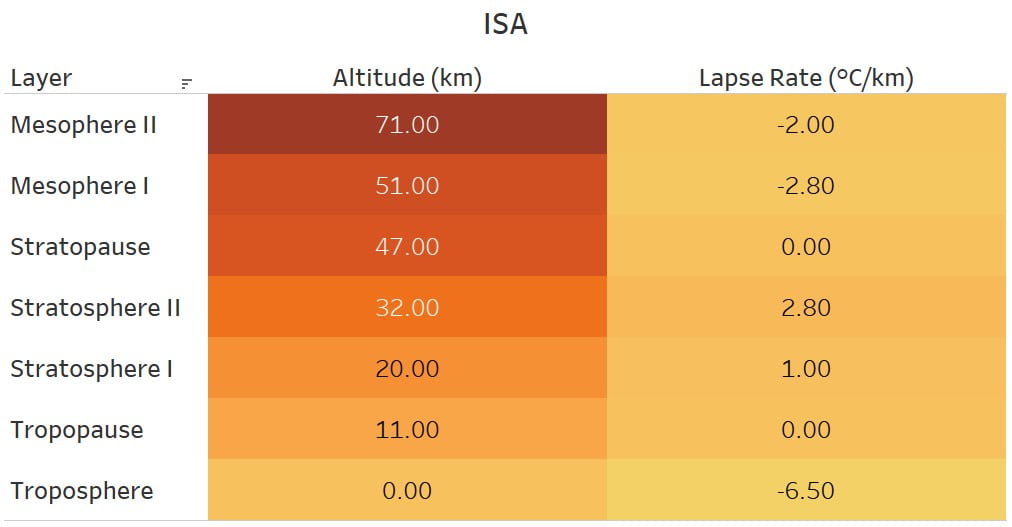
After determining the altitude and lapse rate measurements, you can conveniently use the following formula to arrive at your ISA temperature.
ISA Temperature (°C) = 15°C - (Lapse Rate * Altitude in kilometers)
Be careful that this equation gives a rearranged representation of the ISA demonstration, while barometrical conditions can shift due to multiple variables. The ISA equation is primarily used as a reference for flying and designing calculations. If this is hard for you, don't worry about any of these calculations because we can do these for you if you opt for trip support services.
What is the US Standard Atmosphere Temperature?
The USSA and the ISA are entirely similar in their fundamental concepts; however, the United States government has formulated USSA with different temperature and pressure profiles. The reference temperature is 59 degrees Fahrenheit, the same as the ISA. The lapse rate is also approximately the same at 6.49 °C per km (1.98 °C per 1000 feet). The primary difference in both standards is the units of altitude and temperature. The USSA only considers height in feet. Meanwhile, the geographical area of their implementation is different, where the USSA only applies to the United States while the ISA serves as a global reference. Many people may also refer to this as the ICAO standard atmosphere for North America.
The Significance of ICAO Standard Atmosphere
A consistent baseline metric like the ICAO standard atmosphere ensures that all global aviation professionals are on the same page. Pilots, aircraft management companies, airplane designers, etc., can all communicate and convey information based on a single reference point that maintains uniformity across the board. The employment of such a metric allows data to be compared across borders and skies. Jets are rated on efficiency based on performance analyses through a common denominator, i.e., the ISA. This framework optimizes airplane safety, fuel consumption, and the predictability of flight plan routing.
If all of that sounded too complicated, reach out to us. Icarus Jet is committed to providing impeccable service for all trip support needs. If you're stuck somewhere in planning your flight and require ad-hoc assistance, look no further. Check out all-in-one international aviation support packages for all types of jets. Lastly and most importantly, have a safe flight!
Questions
Guide to the International Standard Atmosphere: questions the desk gets
What is the International Standard Atmosphere?
The ISA is a reference model of normal atmospheric conditions that ignores location, turbulence and moisture. ICAO encoded it as uniform values at mean sea level by the 1950s: 1013.25 hPa and 15°C, or 59°F. As altitude increases, pressure and temperature fall, giving pilots a steady baseline for performance, fuel and other calculations.
How do I calculate ISA temperature at my altitude?
Start from 15°C at sea level and apply the lapse rate of 6.5°C per kilometre: ISA temperature equals 15 minus the lapse rate multiplied by altitude in kilometres. The formula is a simplified representation, since real conditions vary, but it is the standard reference for flight and design calculations.
Why do pilots use the ISA?
Because the real atmosphere changes with altitude, location, season, time of day and solar activity, pilots need constants to work from. ISA values are used to gauge lift, thrust, climb and descent performance and fuel consumption, and to anticipate how the aircraft will behave as conditions deviate from standard.
How does ATC use the ISA?
Air traffic controllers use ISA related data when directing aircraft through different altitudes and offering assistance. A shared reference makes the information exact, which supports smooth traffic control and safety within the airspace. Flight school syllabi cover ISA effects on aircraft performance for the same reason.
What is the difference between the ISA and the US Standard Atmosphere?
The USSA shares the same fundamental concepts, a sea level reference of 59°F and a near identical lapse rate of about 6.49°C per km, or 1.98°C per 1,000 feet. The differences are units and scope: the USSA measures altitude only in feet and applies to the United States, while the ISA is the global reference.
Why does a single standard atmosphere matter for aviation?
A common baseline keeps pilots, aircraft managers and designers on the same page, so data can be compared across borders and skies. Aircraft efficiency is rated through performance analyses against the same denominator, which improves safety, fuel consumption planning and the predictability of flight plan routing.
Where this sits
The guides around this one
Get it filed
Flying this region? Filed from the desk
Send the dates, the aircraft and the stops. You get the permits filed, the routing checked against the current picture, handling confirmed, and a number you can hold us to.
Contact UsPrefer to talk? Call +1 888 277 7203 or email tripsupport@icarusjet.com. The desk is staffed 24/7.