
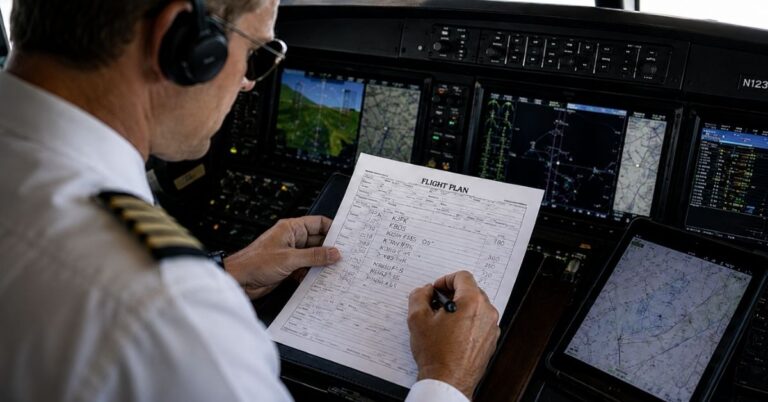
CTOTs in Europe: What Private Jet Pilots Need to Know
A CTOT (Calculated Take-Off Time) is a departure time assigned to a regulated flight by EUROCONTROL's network manager when demand exceeds capacity somewhere along the route. It is not a punishment and usually has nothing to do with your departure airport. The worst response is cancelling and refiling the flight plan, which typically produces a later slot, not an earlier one.
Reviewed by Kevin Singh, Founder · Fact-checked against Icarus Jet fleet and airport operations data · Last updated 10 September 2026
The guide
Rather than refiling, tell ATC the aircraft is ready early, since a CTOT can improve as capacity frees up. A CTOT is a network constraint separate from the airport slot and can override it, so a later slot does not fix it. EOBT, TOBT, TSAT and CTOT are linked but not equal. Summer thunderstorms, RAD changes and military activity drive restrictions, and US delays follow a different FAA system.
Private jet pilots operating in Europe face many challenges during the summer period, from congested airspace and airports to weather problems and parking capacity. However, there is another operational issue to keep in mind: CTOTs.
The CTOT (Calculated Take-Off Time) itself is nothing unusual and is quite common. Yet, how a crew or an operations department attempts to solve the problem can create a new problem. Furthermore, unnecessary refiling of a flight plan in an effort to fix the situation may actually aggravate it.
To handle the problem effectively, you have to look a bit further than the CTOT itself. EOBT, TOBT, TSAT, and airport slots can also be included in the process, and understanding their interconnection will help pilots and dispatchers make the right decisions when network traffic gets difficult.
What is a CTOT?
A CTOT is a time assigned to a regulated flight as part of air traffic flow and capacity management within the EUROCONTROL area.
In plain terms, a CTOT is the time at which the flight has been assigned a certain departure window for the purpose of proper management of its arrival to a congested sector/airport/network segment. A CTOT can occur for any reason unrelated to the departure airport.
Traffic is a clear factor, but it is not the only one. Weather, airway congestion, maintenance, security, natural disasters, and various other issues at the airport can lead to a CTOT. Lack of personnel, strikes, among others, can be another reason.
For pilots, the key idea here is that receiving a CTOT does not always mean that something went wrong with the flight. Quite often, it just means that the network cannot accept each planned flight at its initially planned time.
The Refiling Mistake That Makes a CTOT Worse
Once the CTOT is issued, there is a natural urge to try changing the flight plan in order to get a better departure time.
However, this must be done very carefully.
Unnecessary cancellation and refiling of a flight plan can affect the position of the flight within the traffic management process. The new filing will not improve the departure time; rather, it will produce a later CTOT.
Thus, the main goal here is not to file a new flight plan. The objective is to inform ATC and the relevant network services that the aircraft is ready to depart earlier.
This is because the CTOTs can change. The capacity can become available sooner than expected due to changes in the traffic pattern, cancellations, or network restrictions. Subsequently, if the aircraft is ready to depart, then the operation is in a much better operational position than after cancellation and refiling of the flight plan.
CTOT vs Airport Slot: Two Different Constraints
It is important to understand that there is a difference between a CTOT and an airport slot. These concepts relate to two different constraints.
An airport or runway slot relates to airport capacity and scheduling. A CTOT is related to the network flow management system. In case of network flow restrictions, CTOT may override the airport slot in terms of departure.
This means that trying to obtain a later airport slot does not solve the CTOT problem. The slot may be obtained to solve the airport scheduling, but it will not solve the network restriction that resulted in a CTOT.
In essence, the flight must be seen as a part of a bigger traffic management system, not simply as an aircraft that needs to be allowed to use the runway.
EOBT, TOBT, TSAT and CTOT: The Departure Sequence
Several different times can appear during the departure process, and understanding what each represents is particularly important during disruption.
- EOBT (Estimated Off-Block Time): Part of the flight plan and is important for network calculation.
- TOBT (Target Off-Block Time): The time at which the aircraft is expected to be ready for departure, meaning that its doors are closed and it is ready for departure.
- TSAT (Target Start-up Approval Time): The time at which the aircraft can be started up based on the departure sequence and the airport constraints.
- CTOT (Calculated Take-Off Time): The network-generated take-off time for a regulated flight.
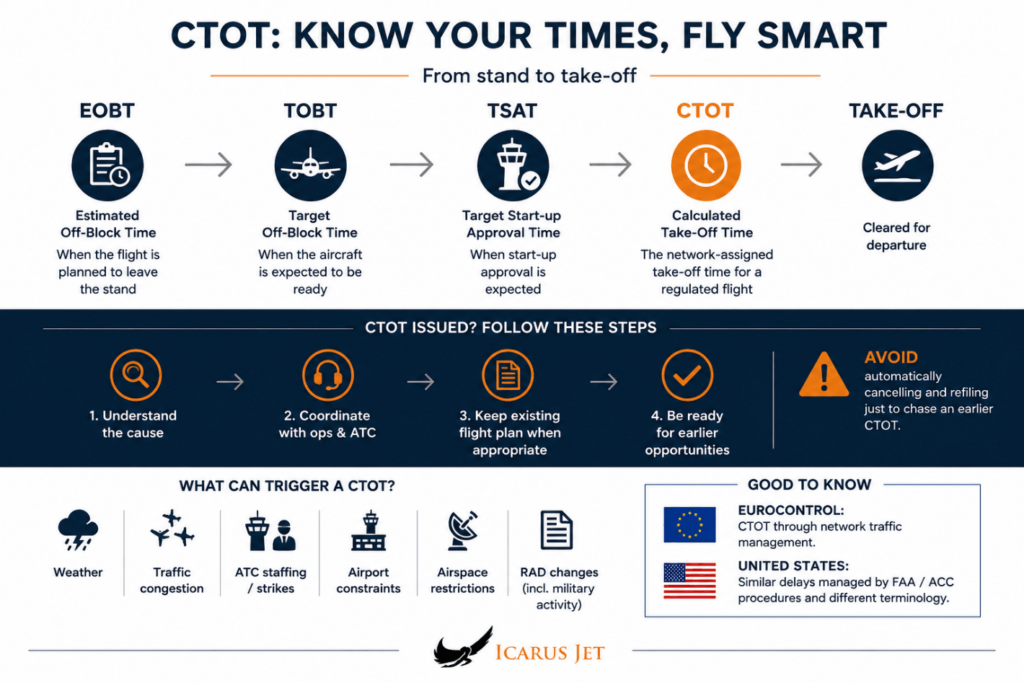
These times are linked, but they are not equal. An aircraft can be operationally ready according to TOBT, but it still cannot depart right away because of its TSAT or CTOT.
As a private jet pilot, you should have all necessary information. If the aircraft is not ready at the scheduled time, then this information should be provided. And vice versa, if the aircraft is ready earlier and there is a chance to improve the departure, then the aircraft’s readiness should be communicated to the appropriate parties.
Why Summer Makes CTOT Management Harder in Europe
Summer operations in Europe put a lot of pressure on the network. Demand concentrates on the major leisure destinations, and popular business aviation airports have parking and ramp limitations. Thunderstorms may also reduce capacity at many airports and network sectors.
Restrictions may also happen rather unexpectedly.
For example, a restriction that affects the Route Availability Document, or RAD. RAD is a document that defines restrictions and requirements for planning routes within European airspace. Any changes may limit the use of particular airways or change the routes that operators can use.
Military activities or traffic saturation can be reasons. For example, if a route that is normally used to distribute traffic suddenly becomes unavailable or restricted, then aircraft have to be redistributed over other network routes, which are usually busy, and this may create additional pressure.
This is why a flight that seemed straightforward several hours ago may suddenly find itself in a completely different operational situation.
Not Every Traffic Delay Is a CTOT (Europe vs the US)
It is important to understand that the terminology is specific depending on the geographical area.
CTOT is associated with the EUROCONTROL network management system. You should not confuse it with the system that is used in some other parts of the world, such as North America.
In the USA, traffic delays are issued and managed by FAA Air Traffic Control Facilities and Air Route Traffic Control Centers. For example, if you have a departure from Teterboro, then it operates within the ATC network of the New York area and may be subject to traffic management restrictions produced through this system.
The principle of managing the traffic in this case is the same: there is excess of the demand and departures should be managed. However, the procedure, terminology and system may be completely different.
This is important for private jet pilots who operate internationally between Europe and North America. You should not treat a traffic delay in the USA the same way as a CTOT issued by EUROCONTROL.
What Pilots Should Do When a CTOT Appears
First, you should understand the reason for the restriction and what it means for the existing flight plan. Pilots should communicate with their trip support team, ground handling and ATC instead of immediately starting to change the flight plan.
If there are no operational reasons to change the route or flight plan, then refiling can be counterproductive. The existing flight plan may keep the flight position within the network.
At the same time, the aircraft should be ready to depart when an opportunity arises. If the flight is ready to depart, then the appropriate information should be provided to the tower and the relevant operational departments to take advantage of the network improvement.
Finally, you should keep monitoring the overall situation. Weather, ATC staffing, industrial action, airport restrictions, military activities, RAD changes, among others, can influence the situation after filing the flight plan.
CTOT Management Starts Before the Restriction Arrives
It is impossible to prevent all CTOTs. Some CTOTs are generated by events that were not predictable by the operator while filing the flight plan.
However, you can control the reaction to it.
For private jet pilots, especially those who fly multiple European sectors in summer, this point is particularly important. EOBT gives the planned off-block picture. TOBT shows operational readiness. TSAT organizes the departure sequence. CTOT manages the network take-off of the flight. Airport slots are another aspect of capacity management.
Treating all these times as equals can create unnecessary trouble.
A CTOT is ultimately a network management tool, not simply another number on the flight paperwork. When one appears, the best response is rarely to start changing everything immediately. Understanding where the restriction comes from, protecting the existing flight plan when appropriate and keeping the aircraft ready for improvement can make the difference between managing a delay and unintentionally extending it.
Questions
CTOTs: questions the desk gets
What does CTOT mean in aviation?
CTOT stands for Calculated Take-Off Time. Within the EUROCONTROL network, it is a calculated time assigned to a regulated flight to manage traffic demand against available airport or airspace capacity.
Should I refile a flight plan after receiving a CTOT?
Not automatically. Canceling and refiling the flight plan solely to get an earlier departure can be counterproductive and may produce a later time. Pilots should first coordinate with dispatch, ATC, and other operational parties before changing the flight plan.
What is the difference between EOBT and CTOT?
EOBT is the Estimated Off-Block Time, which is the time when the aircraft is planned to leave its parking position. CTOT is the calculated take-off time assigned to a regulated flight within the EUROCONTROL traffic management system. One is the planned start of the movement from the stand, while the other is take-off within the managed network.
What is the difference between TOBT and TSAT?
TOBT is Target Off-Block Time and indicates when the aircraft is expected to be operationally ready to leave the stand. TSAT is Target Start-up Approval Time and indicates when the aircraft can expect start-up approval based on the departure sequence and applicable constraints.
What can cause a CTOT?
CTOTs can occur due to high traffic demand, weather, airway congestion, airport capacity limitations, ATC staffing shortages, industrial action, security or maintenance events, and other disruptions. Airspace or routing restrictions, including changes affecting available routes, can also contribute to the network congestion.
Are CTOTs used in the United States?
CTOT is the terminology used in the EUROCONTROL traffic flow management system. The USA has its own traffic flow management system based on FAA systems, ATC facilities, and traffic management procedures. Pilots operating internationally should not confuse the CTOT procedures with the US procedures.
What should a pilot do when a CTOT appears?
Understand the reason for the restriction first, then talk to the trip support desk, the handler and ATC before touching the flight plan. Refiling without an operational reason usually loses the flight's position in the network rather than improving it.
Where this sits
The guides around this one
Departing Europe in summer? Slots managed from the desk
Send the dates, the aircraft and the stops. You get the permits filed, the routing checked against the current picture, handling confirmed, and a number you can hold us to.
Contact Us