

Flight Profile: Lessons from Last-Minute Business Aviation Missions Across Africa
For a private jet pilot, each international take-off involves much more than filing a flight plan. With Africa, a continent where procedures and required advance notice differ greatly from one country to another, even a relatively simple regional operation requires ongoing background coordination.
Reviewed by Kevin Singh, Founder · Fact-checked against Icarus Jet fleet and airport operations data · Last updated 10 September 2026
The guide
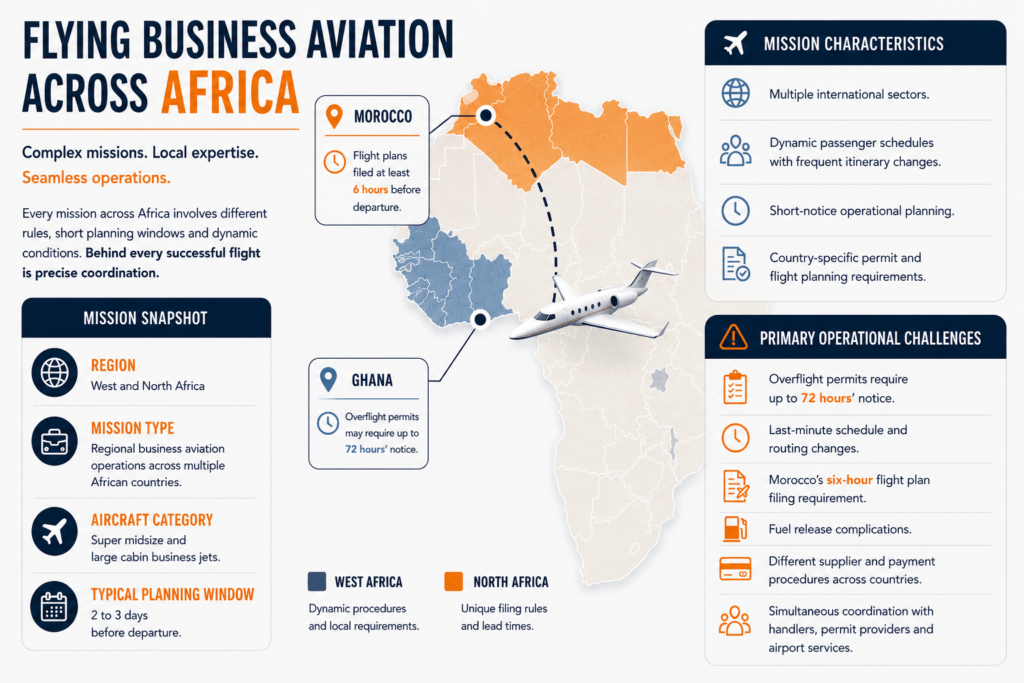
Africa missions in this profile were usually requested two or three days out, so permits, flight plans, handling and fuel were coordinated at once. Some countries require overflight permits 72 hours ahead; when the first provider could not obtain a Ghana permit in time, an alternative regional channel did. Morocco requires flight plans filed at least 6 hours before departure. Fuel releases and supplier payment terms need backup plans before arrival.
This flight profile is based on several missions conducted in recent months that illustrate many operational aspects of flying in Africa, including time pressure, permit restrictions, fuel availability and itinerary changes. Most importantly, it shows how proper planning, regional experience, and reliable local connections make such missions possible.
Last-minute planning changes the entire operation
One of the distinguishing features of these flights is a very limited planning period. The flight request is usually made only two or three days prior to the departure date, which forces our trip support team to coordinate permits, flight planning, handling arrangements, weather information and fueling simultaneously while remaining prepared for schedule changes.
The planning process rarely remains static. Departure times can change, extra destinations are added, and the schedule continues changing even when it is already partially planned. Every change requires the team to go back and take into account the new details while providing the crew with up-to-date operational information.
Across multiple African countries, where permit authorities, handlers and local suppliers each follow different procedures, those adjustments quickly multiply and require constant coordination.
Every schedule change creates a chain reaction
One of the biggest misconceptions about trip support is that a change in departure time means informing the airport. In reality, that is rarely the case during multi-country African operations, where a single schedule revision can trigger updates across several organizations operating under different local requirements.
During the missions featured in this flight profile, even quite a small change in the itinerary can influence almost every part of the international mission. Flight plans may need to be amended, permit authorities notified, handling agents updated, fuel suppliers contacted and airport services rescheduled. Depending on the countries involved, those changes may also affect permit validity or local operational requirements.
The earlier the changes are communicated, the more time there will be to accommodate them. In case of a late change, our team starts immediately coordinating with all the organizations mentioned above, trying to minimize the operational impact on the crew. Our case study on last-minute overflight permits in Africa shows one such change: a Lagos itinerary rebuilt with less than 24 hours to go.
For the pilot, all these efforts remain unseen. Ideally, revised operational information arrives seamlessly while the coordination taking place behind the scenes remains exactly that: behind the scenes.
Permit lead times require more than careful planning
Obtaining overflight permits across Africa involves more than just submitting the application and waiting for the approval.
Some countries require permits to be requested 72 hours prior to departure. This period is rather short, considering that passengers finalize travel arrangements several days before the flight. Therefore, permit requests are usually sent while the rest of the mission is still under development.
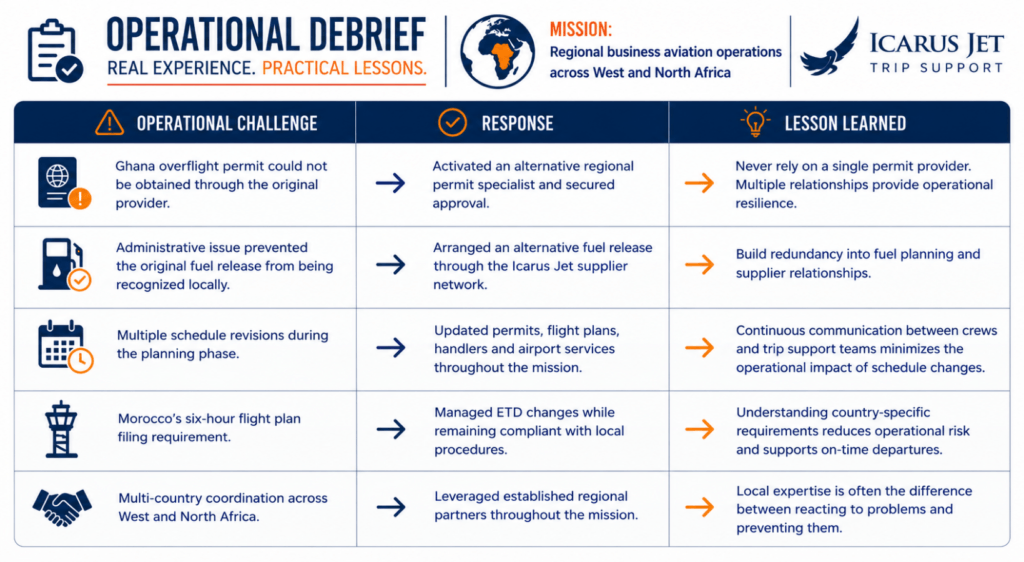
During one recent mission involving Ghana, we were told that the initial permit provider could not obtain the overflight approval in the remaining time. Instead of letting the mission stop there, our team immediately began contacting our alternative regional specialist network, which successfully obtained the permit through the new channel.
Such cases teach an important operational lesson. Successful trip support should never depend on a single permit provider. Plain and simple.
Understanding local procedures
International flight planning missions involve more than just choosing the most efficient path between two airports. In Africa, unlike Europe with EASA, each country has its own rules for filing procedures, documentation, and operational timelines, which must be known for the plane to depart.
For example, in Morocco, flight plans should be filed at least 6 hours before departure. It becomes problematic when the passengers continue changing the departure time throughout the day, particularly during fast-moving business trips where meeting schedules frequently change.
Instead of canceling and rescheduling the flight plan, our dispatch team follows local procedures by filing the flight appropriately and changing the departure time as needed. Knowledge of the local flight planning system helps us remain compliant while maintaining the flexibility business aviation passengers expect from us.
Fuel coordination often requires contingency planning
Even though operators usually deal with the fueling services directly with the suppliers, unexpected administrative problems can occasionally prevent the approved fuel release from being recognized locally. When that happens, the aircraft cannot simply begin refueling while the paperwork is sorted out.
Like permits and flight planning, fuel logistics vary considerably across Africa. Supplier networks, administrative procedures and documentation requirements are not always consistent from one country to another, making contingency planning an essential part of every mission.
Recently, one of our missions faced this problem when the administrative issue prevented the local supplier from recognizing the original fuel release. Our trip support team immediately arranged an alternative fuel release through our own supplier network, allowing refueling to proceed while the original matter was resolved separately.
Payment considerations are part of operational readiness
Another operational consideration that becomes particularly important across Africa is supplier payment coordination. While financial arrangements do not seem to be related to the flight operations initially; however, they can greatly influence how the international mission will proceed.
Throughout the missions covered in this flight profile, our team encountered different supplier procedures depending on the country and airport. Some providers required local payment methods, while others required advance confirmation before services could be released.
For this reason, our trip support team confirms payment requirements well before departure, ensuring handlers, fuel providers and airport service companies have everything they need before the aircraft arrives.
Mission outcome
Despite tight planning windows, evolving itineraries, permit challenges and fuel coordination issues, the missions were completed without unnecessary disruption to the flight crews. They reinforced the importance of proactive planning, regional expertise and strong local partnerships, demonstrating that successful trip support is measured not by the absence of challenges but by how effectively they are resolved before they affect the operation.
Questions
Flight Profile: Lessons from Last-Minute Business Aviation Missions Across Africa: questions the desk gets
How much notice do these African missions typically get?
Flight requests usually arrive only two or three days before departure. That forces the trip support team to coordinate permits, flight planning, handling, weather and fuel at the same time while staying ready for schedule changes, since departure times and destinations keep moving even once planning is under way.
What happens when a departure time changes mid-mission in Africa?
A single revision can trigger updates across several organizations under different local rules: flight plans amended, permit authorities notified, handlers updated, fuel suppliers contacted and airport services rescheduled. Depending on the country, the change may also affect permit validity. Earlier notice gives more room to accommodate it.
How far ahead must overflight permits be requested in Africa?
Some countries require permits to be requested 72 hours before departure. Since passengers often finalize plans only days out, requests are usually sent while the rest of the mission is still being built. Never rely on a single permit provider; on a Ghana mission the first provider could not deliver and an alternative regional specialist obtained it.
What are the flight plan filing rules in Morocco?
Flight plans should be filed at least six hours before departure. When passengers keep shifting the departure time during the day, the dispatch team files appropriately under local procedure and changes the departure time as needed rather than cancelling and rescheduling, keeping the flight compliant while preserving flexibility.
What if a fuel release is not recognised at an African airport?
The aircraft cannot start refueling while paperwork is sorted out. On a recent mission, an administrative issue stopped the local supplier recognising the original release, so the trip support team arranged an alternative release through its own supplier network and refueling proceeded while the original matter was resolved separately.
Why does supplier payment matter for African operations?
Procedures differ by country and airport. Some providers require local payment methods, others need advance confirmation before services are released. The trip support team confirms payment requirements well before departure so handlers, fuel providers and airport service companies have what they need before the aircraft arrives.
Where this sits
The guides around this one
Flying this region? Filed from the desk
Send the dates, the aircraft and the stops. You get the permits filed, the routing checked against the current picture, handling confirmed, and a number you can hold us to.
Contact Us