

Last-Minute Overflight Permits in Africa: When the Route Changes Before Departure
An international private jet itinerary beginning and ending in Lagos changed completely less than 24 hours before departure. For our trip support team, the challenge was not simply obtaining new permits, but rebuilding the operational plan quickly enough to keep the aircraft moving.
By Felipe Reisch · A case from the Icarus Jet trip support desk · Published 8 October 2026
The guide
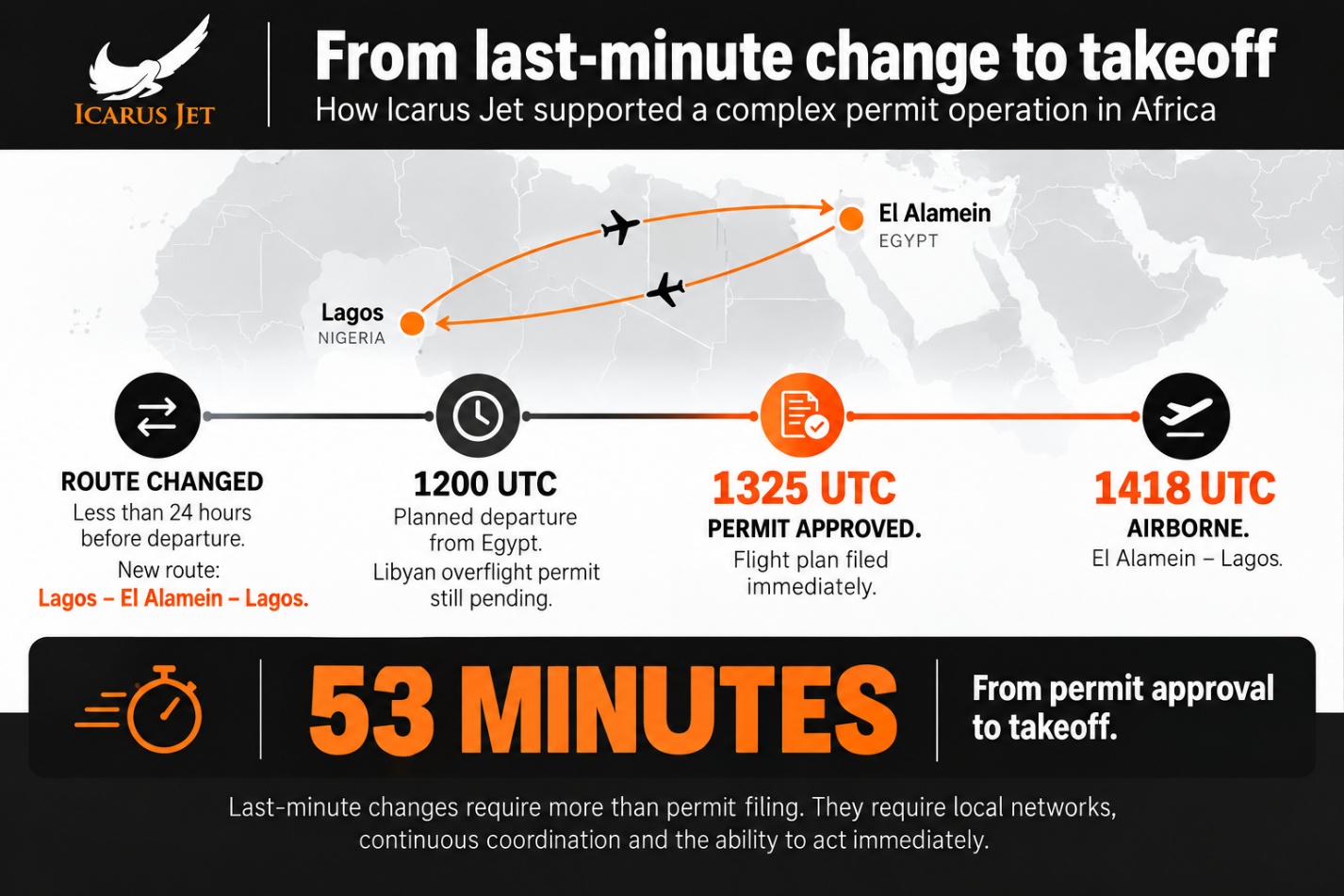
A Lagos, El Alamein, London, Canada, United States, Lagos itinerary became a Lagos, El Alamein, Lagos round trip with less than 24 hours to go, so every overflight permit had to be filed again for the new routing. The outbound leg ran on time. On the return, the Libyan overflight approval was still pending at the planned 1200 UTC departure; it arrived at 1325 UTC and the aircraft was airborne at 1418 UTC, 53 minutes later. Permits are tied to the routing, so plan for the itinerary that may actually be flown.
For private jet pilots operating across Africa, an approved itinerary can change much faster than the permits supporting it.
Even after a complex international route over multiple countries has been carefully organized and approved days ahead of schedule, passengers alter their plans. One stop is canceled, the itinerary shifts direction, and what appeared to be an intricate multi-leg international journey becomes a simple round-trip between two points.
Everything may be in order. The aircraft may be ready to depart. The passengers might already have left home for the airport. The paperwork, however, may suddenly belong to a flight that no longer exists.
A recent mission supported by our trip support team illustrates just how quickly changes can occur during a private aviation operation. It began as an elaborate international itinerary involving Nigeria, Egypt, Europe and North America, and ultimately became a single Lagos, Egypt, Lagos round-trip with less than 24 hours’ notice.
On top of that, the return to Nigeria then ran into difficulty securing the required Libyan overflight authorization just hours before departure.
The original mission
The initial itinerary was ambitious:
Lagos → El Alamein → London → Canada → United States → Lagos
A routing this long required multiple international overflight permits, and our team was responsible for securing them. With the itinerary confirmed, the operational preparations were built around those authorizations.
Then, as missions often do, the plan changed radically. Less than 24 hours before departure from Lagos, Nigeria, the itinerary became a much shorter round-trip:
Lagos → El Alamein → Lagos
The new plan was simpler for the passengers, but it brought its own operational challenges.
A new route means new permit work
The change did not simply mean entering an updated destination in the flight planning process. It meant coordinating an entirely new series of permit requests for the altered routing.
On private flights that cross several countries requiring overflight permission, the itinerary dictates which permits must be obtained. The authorizations are tied directly to the routing they were issued for.
As soon as the itinerary was revised, our team re-issued the overflight requests. A short timeframe creates challenges of its own: with departure less than a day away, there was little room for delay or administrative complications. That kind of timing is why proactive, flexible trip support coordination matters for operators flying complex journeys across international boundaries.
The outbound Lagos to El Alamein flight showed the value of that preparation. Despite the late itinerary change, the aircraft departed and operated without incident.
The return flight would prove more difficult.
Waiting for the Libyan overflight permit
The return was scheduled to depart Egypt at 1200 UTC. As that time approached, the Libyan overflight approval was still pending.
That presented an immediate operational dilemma for the crew managing the journey home.
The passengers expect to depart at their appointed time. Ground services are working to the same timeline. The aircraft is likely ready to go. Yet without the overflight clearance, the crew cannot depart.
At this point, clear visibility and responsiveness become key: understanding where the pending permit stands, communicating directly with the relevant parties, and staying responsive as circumstances change.
Experience in these environments plays a vital role too. Knowing how the process works on paper is not enough. Local experience is what tells the trip support team whether an approval timeline is likely to become a problem, and how to proceed.
The approval finally arrived at 1325 UTC. As anyone familiar with permit challenges knows, approval does not mean instant departure.
It marks the start of another operational process. The approval has to be incorporated into the operation itself and reflected in the flight planning, the handling arrangements and the other details that keep the aircraft moving on time.
In this instance, that process went smoothly. The aircraft left Egyptian territory at 1418 UTC and reached Nigeria at roughly 1930 UTC.
Considering that the entire mission had been substantially revised less than 24 hours before its first departure, the outcome shows why flexibility is an operational capability rather than simply a customer-service promise.
Why African permit experience matters
There is a temptation to discuss “African operations” as though the continent were a single operating environment. It is not.
Each country has its own permit authority. Some require notification days ahead; others, weeks. Others have particular procedures to observe. Crossing a border can mean an entirely separate permit process.
Local networks make that process faster and more efficient. Filing the permit is the starting point; experience with each country’s operating environment is what lets the team anticipate issues and solve problems quickly as timelines grow tight.
Experience also makes it possible to deal with changes to the mission itself. When passengers modify their plans, the trip support provider must be able to accommodate the new itinerary and work through whatever permit challenges follow.
Trip support for complex missions happens largely out of sight of passengers and pilots. While the aircraft is being prepared, the trip support team, local handling partners and authorities are exchanging calls and messages in parallel.
These relationships do not bypass regulations. They do allow issues to be identified quickly, and a faster response as the timeline compresses.
Plan for the itinerary that may actually be flown
For pilots, the lesson is fairly clear. Complex permit environments demand contingency planning, especially for passenger changes to the itinerary. Which points along the route pose significant permit challenges? Which overflights become critical if timings shift further? What changes if an earlier departure becomes necessary? And who tracks permit progress while the flight proceeds as planned?
These questions matter because business aviation runs on fluid timelines. Passengers move appointments and meetings, change trips and shift departure times unexpectedly, and the support structure has to adapt.
At Icarus Jet, this experience is a critical part of our permit and trip support service. Filing permits is part of the job. Knowing how to manage the operation when the original plan disappears is where experience and a strong international network matter most.
That knowledge is particularly important across Africa, where every national border brings different rules and requirements.
Questions
Last-minute permits in Africa: questions the desk gets
How does modifying a private aircraft itinerary affect existing permits?
Overflight permits are issued for the specified routing. When the itinerary changes, the existing permissions may no longer cover the new flight plan, so pilots and dispatchers must check that every permit still matches the revised routing before departure.
How far in advance should African overflight permits be requested?
There is no single timeframe across Africa. Requirements vary by country and can depend on the mission itself, so request overflight authorizations as far ahead as practical and pay particular attention to the countries that ask for longer advance notice.
Can a flight plan be filed while an essential permit is still pending?
Flight planners have to confirm that every permit requirement for the operation is met, so a pending approval can hold up both the flight plan filing and the departure. On the Egypt to Nigeria return described here, the flight plan was filed once the Libyan permit was approved.
What do local networks add to private flights in Africa?
Established local partners and contacts give visibility of a permit’s status and help the process run smoothly in each country. They do not replace the authority that issues the permit, but they are an important part of effective coordination.
What should pilots do when passengers make a last-minute itinerary change?
Tell the trip support provider as soon as possible. Once the mission details are updated, the new itinerary has to be reviewed against every operational requirement for a safe and legal flight, starting with the permits.
How does Icarus Jet support challenging permit operations in Africa?
Icarus Jet provides international trip support for private aviation operators, coordinating permits, flight planning and other operational requirements with an established network of local partners. On time-sensitive operations the desk manages itinerary revisions and follows outstanding requirements, so pilots keep visibility as the situation develops.
Where this sits
The guides around this one
Route changed at the last minute? Filed from the desk
Send the dates, the aircraft and the stops. You get the permits filed, the routing checked against the current picture, handling confirmed, and a number you can hold us to.
Contact Us