Private Jet Deicing Costs in 2026-2027: What Operators Should Expect at US Airports
An Icarus Jet comparison of Type I and Type IV deicing fluid prices at five major US business aviation airports, with what it means for winter flight planning.
From the Icarus Jet trip support desk · Prices collected from service providers · Published 5 November 2026
The data
Reported 2026-2027 deicing fluid prices at five US business aviation airports range from USD 31.00 to USD 43.00 per gallon for Type I and USD 36.00 to USD 47.40 for Type IV. Teterboro is cheapest for Type I and Aspen the most expensive for both. For a hypothetical 100 gallons of Type I and 50 of Type IV, the fluid alone costs USD 4,950 at Teterboro and USD 6,670 at Aspen, before equipment, labor, minimum charges and taxes. Volume depends on aircraft size, contamination and weather, so quotes should be checked airport by airport.
Winter operations add cost elements that have to be considered when estimating the expense of a flight. When snow, frost or icing conditions occur, deicing may be necessary before takeoff. Deicing costs are hard to predict in advance, because the charges depend on the volume of fluid used, the airport, the aircraft category and the weather at the time.
Pilots and flight departments should factor these expenses into their planning. Initial flight planning works from a predetermined cost baseline, but adverse weather may demand multiple deicing treatments or more fluid, and the final bill can come in higher than projected. Deicing also adds an operational delay until the aircraft is clear for departure.
Ahead of the 2026-2027 winter season, our trip support team reviewed the deicing fluid prices reported by service providers at five major US business aviation airports, to help private jet operators and crews estimate costs for the winter ahead.
How much does private jet deicing cost in 2026-2027?
Deicing is traditionally charged per volume, for the amount of deicing fluid applied to the aircraft. Some suppliers use other cost models as well, including charges for equipment, labor, minimum service charges and related ancillary fees.
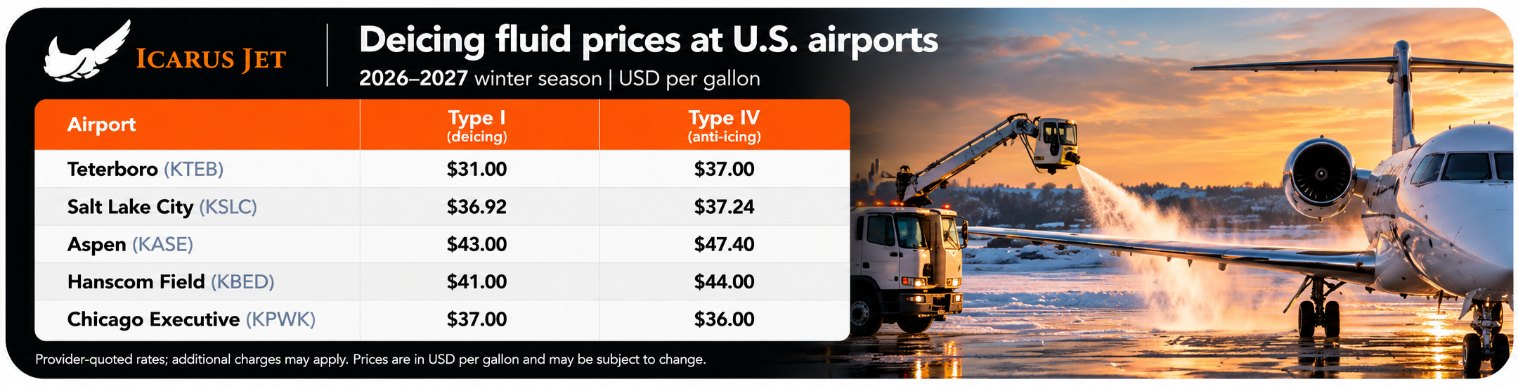
The comparison below shows the reported Type I and Type IV fluid prices at five US airports. All amounts are in US dollars per gallon.
| Airport | Type I (USD per gallon) | Type IV (USD per gallon) | Example fluid cost (USD) |
|---|---|---|---|
| Teterboro (KTEB) | 31.00 | 37.00 | 4,950 |
| Chicago Executive (KPWK) | 37.00 | 36.00 | 5,500 |
| Salt Lake City (KSLC) | 36.92 | 37.24 | 5,554 |
| Hanscom Field (KBED) | 41.00 | 44.00 | 6,300 |
| Aspen (KASE) | 43.00 | 47.40 | 6,670 |
Source: prices collected by Icarus Jet from service providers ahead of the 2026-2027 winter season. Rates may change and additional charges may apply. Example fluid cost = 100 gallons of Type I plus 50 gallons of Type IV, for comparison only.
Among the providers sampled, Teterboro (KTEB) has the lowest price for Type I fluid at USD 31.00 per gallon, against USD 43.00 at Aspen (KASE), a difference of around 39 percent. Type IV varies in the same way, from USD 36.00 at Chicago Executive (KPWK) to USD 47.40 at KASE.
KPWK is the only airport in the sample where Type IV fluid is cheaper than Type I, at USD 36.00 against USD 37.00. The difference is small.
Salt Lake City (KSLC) also prices differently, at USD 36.92 per gallon for Type I and USD 37.24 for Type IV. The provider confirmed that charges are based on gallons pumped, but said a tail number would be needed to give a fuller breakdown of the additional fees.
These variations show why operators should be careful about assuming deicing costs across several airports without checking the specific prices. Differences in the volume of fluid used can produce very different charges, before any ancillary costs are added.
Understanding Type I and Type IV deicing fluids
It is important to understand the difference between Type I and Type IV fluids, both common in the US, along with their application requirements and operational limits.
Type I fluid removes existing contamination. It is usually applied heated, to clear frost, snow and ice from the aircraft. Its protection against new contamination is minimal, especially in active freezing precipitation.
Type IV fluid, by contrast, is an anti-icing fluid designed to stay on the treated aircraft. It keeps protecting against further contamination for a limited time after application, following a specific operational procedure approved for certain aircraft.
Operators are responsible for following the right procedures according to the manufacturer’s guidance, as some aircraft require specific types of fluid. For pilots, an essential part of winter flight preparation is the holdover time: how long the anti-icing fluid provides protection. It does not guarantee the aircraft stays free of new contamination. How de-icing and anti-icing work, and who decides, is covered in our guide to de-icing a private jet.
What influences deicing costs?
The final cost depends on several elements rather than a flat rate. The volume of fluid used can vary widely with the aircraft category, the level of contamination and the method used to clear the aircraft.
A light jet with a small exterior surface area, for instance, needs comparatively less fluid than a large-cabin jet. At the same time, heavier contamination can take more fluid to prepare the aircraft for takeoff.
Weather conditions also drive consumption. Removing a light layer of frost is different from clearing accumulated snow or treating an aircraft in ongoing freezing precipitation. A two-step procedure using both Type I and Type IV fluids adds further cost.
To show how airport pricing affects the total, consider a hypothetical application of 100 gallons of Type I and 50 gallons of Type IV.
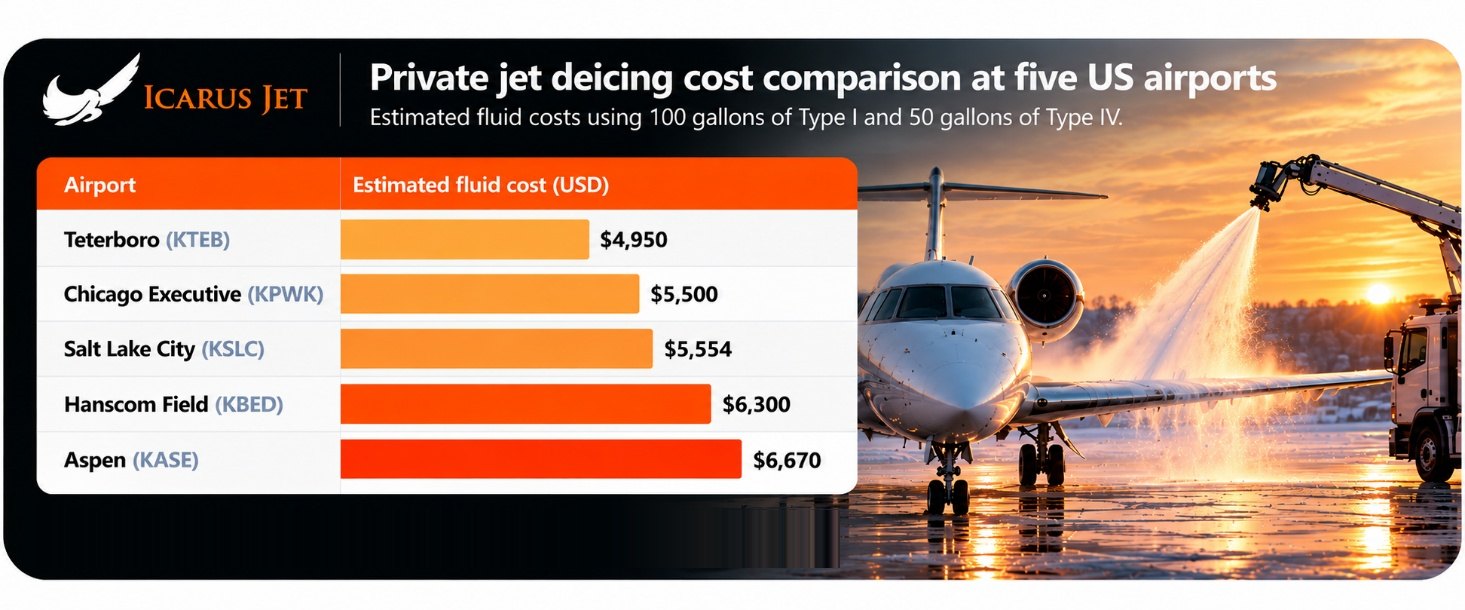
In this example, the difference between Teterboro and Aspen reaches USD 1,720 for the fluid alone, with Aspen about 35 percent more expensive.
Hanscom Field (KBED) also stands out, with a hypothetical fluid cost of USD 6,300, the second most expensive airport in the comparison. Chicago Executive and Salt Lake City produce similar totals despite the differences in their individual fluid prices.
Operators should also check whether a quote refers to ready-to-use fluid, a diluted mixture or another billing basis. Without that, comparing prices between providers may not give an accurate picture of the total cost.
How flight departments can prepare for deicing expenses
Fluid volume is inherently hard to predict. Several steps still give better visibility of the likely expense, and the most basic is requesting detailed quotes from service providers before travel.
Rather than asking only for the Type I and Type IV prices, flight departments should ask how the fluid volume is measured and whether anything else applies. Minimum volume thresholds, equipment and labor fees, or supplementary services can add costs on top of the fluid charge.
Flight departments should also check whether the aircraft is likely to need both deicing and anti-icing, based on the forecast. Building an allowance into the budget matters most when a trip has several legs.
Operational coordination remains essential. Agreeing a realistic departure time with the provider helps make sure the treatment happens on time. Ground handlers should tell pilots and operators about any delays, and whether deicing will take place at the aircraft stand or at a dedicated facility.
Cost must never take priority over safe procedures and regulatory compliance. Before departing, an aircraft has to meet every applicable deicing and anti-icing requirement.
Planning ahead for the 2026-2027 winter season
Deicing is an essential part of safe winter operations, but the cost can vary greatly between airports and service providers. Comparing deicing expenses means knowing the airport procedures, the aircraft category, the likely fluid volume and the local prices.
From what we have seen, operators should recognize that estimating deicing expenses goes beyond the volume rates charged by suppliers. Poor planning can expose them to unexpected charges, operational disruption, or even liability tied to unsafe departure practices.
Our data shows that providers usually charge according to the volume used, and may add fees for labor, equipment and minimum thresholds. The aim is to know in advance how the aircraft will be deiced and anti-iced. Without that, an accurate cost estimate is hard to reach. Our trip support desk requests these quotes and confirms the deicing arrangements with the handler as part of planning a winter trip.
Questions
Deicing costs: questions the desk gets
How much does it cost to deice a private jet?
The total depends on how much deicing fluid the aircraft uses. Based on rates reported to Icarus Jet by service providers for the 2026-2027 winter, Type I fluid costs between USD 31.00 and USD 43.00 per gallon, and Type IV between USD 36.00 and USD 47.40 per gallon.
Why do private jet deicing prices vary between airports?
Charges vary with local costs, the agreements in place with service providers, access to equipment, the cost of buying the fluid, and pricing arrangements specific to each airport. Operators should ask what each quote is based on before comparing them.
What is the difference between Type I and Type IV deicing fluid?
Type I removes existing contamination. Type IV is an anti-icing fluid that protects against new contamination for a limited time after application, depending on the weather conditions and the approvals for the particular flight.
Is there a fixed volume of fluid for each private aircraft?
No. The volume depends on the size of the aircraft, the contamination found and the weather during deicing. A light jet will usually need less fluid than a large-cabin jet.
Are deicing fees included in standard ground handling charges?
Usually not. Deicing is often billed separately from ground handling, and providers may add fees for equipment or minimum volumes regardless of how much fluid is used.
Can a private jet need more than one round of deicing?
Yes. Multiple rounds are possible, particularly when new contamination builds up in active weather or when the anti-icing fluid applied earlier has stopped protecting the aircraft.
Where this sits
The guides around this one
Flying into winter weather? Planned from the desk
Send the dates, the aircraft and the stops. You get the permits filed, the routing checked against the current picture, handling confirmed, and a number you can hold us to.
Contact Us