

New US Entry Rules: What Private Jet Pilots and Operators Should Know
The U.S. has imposed new nationality-based travel restrictions in 2025 that can impact travelers arriving by private aircraft. The imminent restrictions, the result of national security and immigration policy revisions that continue to evolve, echo past executive action banning entry by the nationals of specific countries.
Reviewed by Kevin Singh, Founder · Fact-checked against Icarus Jet fleet and airport operations data · Last updated 10 September 2026
The guide
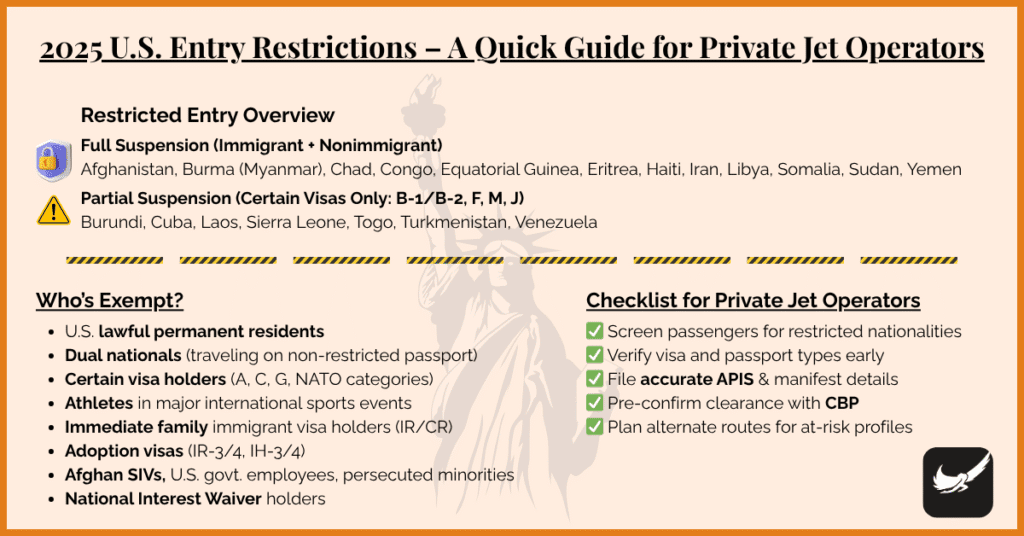
Twelve countries face full U.S. entry suspension, including Afghanistan, Iran and Haiti, and seven face partial suspension for B-1, B-2, B-1/B-2, F, M and J visas, including Cuba. Exemptions cover lawful permanent residents, dual nationals on a non-restricted passport, A-1, A-2, C-2, C-3, G-1 to G-4 and NATO-1 to NATO-6 visa holders, and athletes at major sporting events. Operators should screen passenger nationality at booking, file accurate APIS and preconfirm entry clearance with CBP.
For flight crew members and trip support professionals, the solution is preparation: understanding who’s impacted, what documentation is needed, and how to maintain operational continuity without delays or denials.
Changes to U.S. entry procedures
Although the complete list of targeted nationalities is under consideration, the policy – outlined in a new White House proclamation – targets nations that are not complying with U.S. security and intelligence-sharing requirements. The action, like previous travel bans, is meant to preempt perceived security threats from foreign nationals trying to enter the country.
These restrictions will be imposed on all ports of entry, both those utilized by commercial flights and private aircraft. Although lawful permanent residents, dual nationals, and particular visa holders will be exempted, crews and travelers can expect heightened screening processes and documentation.
Countries with Full Entry Suspension (Immigrant and Nonimmigrant Travelers)
Nationals from the following countries are fully suspended from entering the U.S., with exceptions and waivers as defined in Section 5 of the proclamation:
- Afghanistan
- Burma (Myanmar)
- Chad
- Republic of the Congo
- Equatorial Guinea
- Eritrea
- Haiti
- Iran
- Libya
- Somalia
- Sudan
- Yemen
Countries with Partial Entry Suspension (Specific Visa Categories Only)
Nationals from the countries below are partially suspended – entry is restricted for immigrants and nonimmigrants holding the following visa types: B-1, B-2, B-1/B-2, F, M, and J.
- Burundi
- Cuba
- Laos
- Sierra Leone
- Togo
- Turkmenistan
- Venezuela
Who is Exempt from these restrictions?
The suspensions do not apply to:
- U.S. lawful permanent residents
- Dual nationals traveling on a passport not from a restricted country
- Travelers with valid nonimmigrant visas in the following categories:
A-1, A-2, C-2, C-3, G-1 to G-4, NATO-1 to NATO-6 - Athletes (including coaches, essential support staff, and immediate family) attending major international sporting events
- Holders of immediate family immigrant visas (IR-1/CR-1, IR-2/CR-2, IR-5) with verifiable proof of relationship (e.g., DNA)
- Adoption visas (IR-3, IR-4, IH-3, IH-4)
- Afghan Special Immigrant Visas (SIVs)
- SIVs for U.S. Government employees
- Iranian nationals facing ethnic or religious persecution
- Individuals granted a National Interest Waiver through the U.S. Department of State
Implications for private jet travel
For charter operators, dispatchers, and aircraft owners, the imposition of these limitations means:
- Passenger nationality screening: Passenger manifestations must be carefully examined at the time of booking. Passengers holding passports from affected countries will require additional screening or waivers before boarding.
- Trip routing considerations: Even when passengers are not native to banned nations, travel via flagged areas may enhance the risk of examination or stoppage at U.S. ports of entry.
- Manifest accuracy and pre-clearance: APIS filing has to be accurate and timely. Incorrect reporting of small details of data can lead to denied entry, fines, or disruption of the trip.
- Contact with U.S. Customs and Border Protection (CBP): Preconfirmation of entry clearance at the intended port of entry is required, especially if there are passengers on the flight with recent travel to specified countries.
Trip support to reduce uncertainties
A proactive trip support approach can prevent extended delays. For a seamless process, trip support teams would need to take the following actions:
- Early verification of passengers’ documents
- Coordination with CBP officers and airport authorities
- Tracking legal exceptions and waivers to admission
- Providing contingency routing plans if the passenger is denied entry clearance
Trip support personnel should stay in touch with developments as they happen, especially with enforcement tools and interpretations developing following the passage of the proclamation.
Furthermore, while passengers are the ones limited, pilots and crew members can also be subjected to heightened screening. Up-to-date crew documentation, streamlined routes, and clean and complete manifests will facilitate the arrival process.
Operators should also be mindful that processing international arrivals, particularly from nations with no preclearance or limited diplomatic arrangements, can take longer.
Questions
New US Entry Rules: What Private Jet Pilots and Operators Should Know: questions the desk gets
Flying this route or region? Icarus Jet provides 24/7 trip support, flight planning, flight permits for private jet operators worldwide.
Which countries are fully suspended from US entry under the 2025 proclamation?
The proclamation fully suspends immigrant and nonimmigrant entry for nationals of Afghanistan, Burma, Chad, Republic of the Congo, Equatorial Guinea, Eritrea, Haiti, Iran, Libya, Somalia, Sudan and Yemen, subject to the exceptions and waivers defined in Section 5. Passengers holding these passports need additional screening or an approved waiver before boarding.
Which countries face a partial suspension, and which visa types are affected?
Burundi, Cuba, Laos, Sierra Leone, Togo, Turkmenistan and Venezuela are partially suspended. Entry is restricted for nationals of these countries holding B-1, B-2, B-1/B-2, F, M and J visas. Other visa categories are not covered by the partial suspension, so check each passenger's visa type against the list at booking.
Who is exempt from the entry suspensions?
Exemptions cover US lawful permanent residents, dual nationals traveling on a passport from a non-restricted country, holders of A-1, A-2, C-2, C-3, G-1 to G-4 and NATO-1 to NATO-6 visas, athletes and support staff attending major international sporting events, immediate family and adoption immigrant visa holders, Afghan and US government SIVs, and anyone granted a National Interest Waiver.
Do the restrictions apply to private aircraft arrivals as well as airlines?
Yes. The restrictions apply at every US port of entry, including those used by private aircraft. Enforcement can vary by port depending on CBP staffing and traffic, and busier general aviation gateways such as Teterboro, Van Nuys and Miami are more familiar with complex international arrivals. Confirm entry clearance with the intended port before departure.
What should an operator do if a passenger holds a passport from a restricted country?
Screen the manifest at booking, not at departure. Verify documents early, check whether the passenger falls under an exemption, and request any humanitarian or national interest waiver well in advance, since waivers must be approved before travel. Pre-clear the manifest with CBP at the port of entry and prepare a contingency routing plan in case entry is denied.
Are pilots and crew affected by the new entry rules?
The suspensions target passengers, but crews should still expect heightened screening on arrival. Keep crew documentation current, file APIS accurately and on time, and keep the manifest clean and complete. Small reporting errors can lead to denied entry, fines or trip disruption, and arrivals from countries without preclearance or limited diplomatic arrangements can take longer to process.
Where this sits
The guides around this one
Flying this region? Filed from the desk
Send the dates, the aircraft and the stops. You get the permits filed, the routing checked against the current picture, handling confirmed, and a number you can hold us to.
Contact Us