
U.S. Preclearance at Shannon for Private Jets
For U.S.-bound private jet crews crossing the Atlantic, Shannon can move the CBP inspection to the European side of the flight. Icarus Jet explains what pilots should understand about planning, APIS, ground procedures, and protecting the aircraft’s precleared status.
Reviewed by Kevin Singh, Founder · Fact-checked against Icarus Jet fleet and airport operations data · Last updated 17 September 2026
The guide
For a private jet crew flying westbound across the Atlantic, customs is generally handled after landing in the USA. However, Shannon Airport provides an opportunity to perform it earlier, before leaving Ireland.
Shannon has been providing General Aviation preclearance by U.S. CBP since 2010 for qualified private aircraft and unscheduled commercial flights.
In practice, passengers, crew, baggage, and the aircraft are processed and inspected as required under U.S. regulations at Shannon Airport.
However, pilots should remember that preclearance is not just an extra service at Shannon. It affects flight planning, the information you must send in advance, and what can happen to the aircraft during CBP processing.
Why Shannon preclearance can change the U.S. arrival
The operational advantage of preclearance is clear: instead of planning processing after landing, you do it before departure from Shannon.
That makes Shannon especially relevant for business aviation flights from Europe, the Middle East, or other parts of the world crossing the Atlantic towards the USA.
However, it has an important limitation. Preclearance does not mean you can choose any U.S. airport as the destination. CBP guidelines state that the U.S. destination for a precleared General Aviation flight must be approved and able to receive internationally regulated garbage under USDA requirements.
Therefore, destination verification should be part of the planning process, not the other way around.
Start the process before reaching Ireland
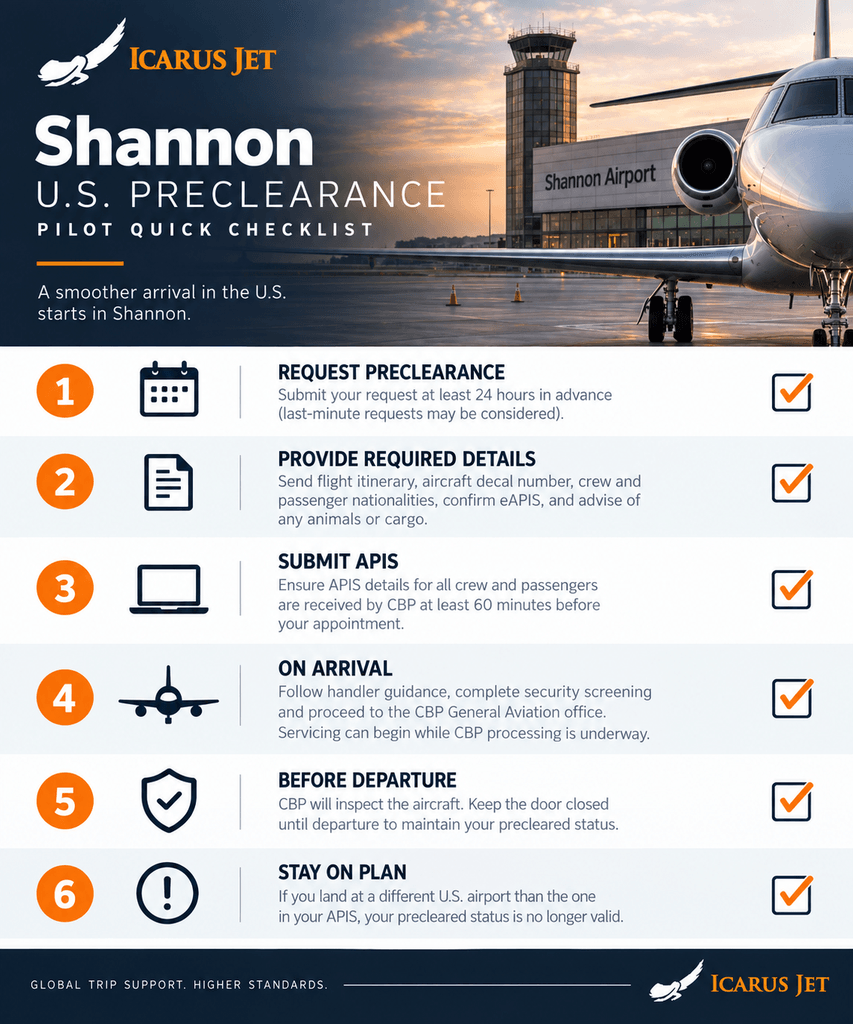
Shannon guidance for operators on CBP preclearance recommends informing CBP at least 24 hours before arrival for a preclearance request, although a last-minute application may be considered on a case-by-case basis.
Thus, preclearance should be part of the trip-planning process.
Besides, the briefing mentions several items of information to be submitted in advance, including the itinerary and times, aircraft decal number, whether it is private or charter, email address of the captain, eAPIS status and transmission number, nationalities of passengers and crew, whether animals or cargo are onboard, and whether passengers travel under the Visa Waiver Program.
For private flights, CBP guidelines emphasize that the pilot in command is responsible for the information provided, including the APIS manifest.
The lesson for the pilot is simple: he or she should review information sent and not rely on the third party.
APIS and preclearance are connected, but not interchangeable
APIS is an essential part of the process.
Because CBP requires APIS manifest information for General Aviation flights entering and leaving the USA, pilots and operators are responsible for its accuracy and timely submission.
According to the Shannon operational briefing, APIS information should reach CBP no later than 60 minutes before the scheduled CBP preclearance appointment.
Note the difference between APIS and eAPIS. APIS is the required Advanced Passenger Information System submission, while eAPIS is the CBP web portal used to submit it. They are related terms, but not equal.
What can crews expect on the ground?
After the aircraft arrives at Shannon, the preclearance becomes a ground process.
Under the procedure, the aircraft is coned to indicate that CBP inspection is underway. Aircraft servicing, including fueling, catering, and lavatory service, can start immediately.
That is very helpful from the operational standpoint, since CBP inspection does not have to pause all the turnaround activities.
Passengers and crew proceed to the necessary security screening and then to the CBP General Aviation facility. The procedure generally allows one crew member to stay with the aircraft to perform the servicing, while the others are processed. Baggage can also remain at the aircraft unless CBP requests certain items for inspection.
After the first group is processed, CBP officers return to the aircraft to inspect it and the baggage. The remaining crew member completes the required screening and CBP process.
The briefing assumes an approximate target time of 45 to 60 minutes, but it depends on the number of passengers and crew, baggage, and CBP requirements.
Factor that into scheduling the Shannon stop. The crew should not assume 45 minutes is always available.
Protecting precleared status before departure
The most important part of the process is performed after the inspection is almost over.
Under local procedure, CBP officers stay at the aircraft until its door is closed. Once closed, the door must remain closed until departure. Any opening will result in loss of preclearance status.
For the crew, that marks the clear line between operational activities and customs procedures.
Any fuel, catering, baggage questions, or other aircraft-side activities should be completed before reaching that stage. Any unfinished catering or baggage issue becomes a small problem, since opening the closed aircraft door ends preclearance.
Thus, good coordination of the captain, cabin crew, handler, and trip support team is especially important during the final phase of the stop.
What happens if the U.S. destination changes?
Preclearance is linked to the flight that CBP has reviewed, including its declared destination.
The local procedure clearly warns that if the aircraft lands at an airport other than the airport designated in the APIS transmission, including due to weather or emergency, its preclearance status is no longer valid.
That factor is especially important for pilots because the Atlantic crossing always requires careful planning.
The diversion may be fully justified from an operational standpoint, but crews should remember that customs procedures do not simply follow the aircraft to the alternate destination. In addition, the CBP guidelines emphasize that the preclearance status is linked to the data submitted via APIS and the changes, including travelers’ additions/substitutions or tail-number changes, require reconfirmation.
Thus, the preclearance process adds yet another question to the preflight planning: not only “where can we safely divert?”, but also “what happens to our entry process if we do?”.
Where trip support fits into the process
For the pilot, the value of trip support in Shannon isn’t about completing one form; it’s about coordinating several items at the same time.
Handler, CBP appointment, APIS transmission, passenger information, aircraft documents, servicing, and the U.S. destination are all interrelated. Changing one item can affect the others.
This is especially important during rapid schedule changes. Any passenger addition, departure delay, destination change, or late repositioning to Shannon may require more than updating the flight plan.
The goal is to arrive in Shannon with all administration ready, complete the CBP process efficiently, and leave the airport with all aircraft preclearance conditions known.
For a U.S.-bound private jet, Shannon can transform a technical or fuel stop into a more useful one. But for the pilot, the true value of preclearance is incorporating it into the flight planning process from the start, not adding it as an airport service at the end.
Questions
Shannon preclearance: questions the desk gets
What is U.S. preclearance at Shannon?
It allows eligible private and unscheduled charter flights to perform CBP inspection in Ireland before departure for the United States.
How much notice should a private jet provide for the Shannon preclearance?
Local guidance recommends at least 24 hours’ notice, although last-minute requests may be considered individually.
Does filing the eAPIS automatically arrange preclearance?
No. APIS is the required manifest submission, while the Shannon preclearance appointment is a separate coordinated process. CBP guidance also differentiates APIS from eAPIS, the web portal for submitting information.
Can the aircraft be fueled while passengers are performing CBP inspection?
According to the Shannon procedure, aircraft servicing, including fuel, catering, and lavatory service, can be performed while the preclearance process is underway.
How long should crews plan the process?
The target time of the local procedure is 45 to 60 minutes, but the actual ground time depends on the number of passengers, crew, and baggage.
What happens if the aircraft diverts after leaving Shannon?
If it lands at an airport other than the U.S. destination designated in the APIS transmission, Shannon guidance assumes the aircraft’s preclearance status is no longer valid.
Where this sits
The guides around this one
Get it filed
Routing through Shannon? Booked from the desk
Send the dates, the aircraft and the stops. You get the permits filed, the routing checked against the current picture, handling confirmed, and a number you can hold us to.
Prefer to talk? Call +1 888 277 7203 or email tripsupport@icarusjet.com. The desk is staffed 24/7.