
Private Jet Flights in Hurricane Season: Operational Considerations Beyond Weather Predictions
Hurricane season brings operational challenges for private jet pilots, from rapidly changing weather and airport closures to last-minute rerouting and aircraft repositioning.
By Felipe Reisch · From the Icarus Jet trip support desk · Published 14 October 2026
The guide
A hurricane affects far more than its forecast track: convection, turbulence and strong winds reach well beyond the center and often above business jet cruising levels. Plan the alternate route before departure, choose alternates that work operationally (runway, fuel, handling, parking, hangar, customs hours, slots and permits), book hangars and fuel early, separate confirmed facts from forecasts in every update, and confirm services, not just the reopening, before flying back in.
What hurricane season adds to a private jet mission is complexity. A destination can look accessible several days before take-off and become unreachable within hours of departure, and an airport can sit clear of the forecast storm and still run into operational problems.
The challenge applies to pilots flying across the Caribbean, the Gulf of Mexico, the southeastern United States and any region where tropical storms form.
This guide sets out what hurricane season brings to private aviation operations, as the Icarus Jet trip support team plans for it: how the weather is monitored while the whole mission, from dispatch to the ground, is coordinated around it.
The Atlantic hurricane season officially runs from June 1 through November 30, with activity typically peaking between August and October. Tropical systems can still develop outside those dates, and the same operational considerations apply to typhoons in the Pacific and tropical cyclones elsewhere.
Going beyond hurricane tracking
When pilots prepare their pre-departure planning, one point matters above the rest: a hurricane affects far more than its center. The forecast track gives a general idea of the storm’s course, but it is not the full extent of the dangerous weather involved.
Strong winds, embedded thunderstorms, convective activity and turbulence can reach a long way from the center. Cruising higher does not remove the hazard either: convective clouds associated with tropical cyclones often build above normal business jet cruising levels.
Before departure, pilots should review several sources of information:
- National Hurricane Center (NHC) advisories: storm position, movement, forecast track, intensity, and the potential for changes in direction or strength.
- SIGMETs and significant weather charts: areas of severe turbulence, thunderstorms, icing and other hazardous conditions affecting the planned route.
- METARs and TAFs: current and forecast airport conditions, including visibility, cloud ceilings, wind speed, gusts and crosswind components.
- NOTAMs: runway restrictions, airport closures, navigation equipment outages and other operational limitations.
- Satellite and radar imagery: the distribution and development of convective activity, including weather extending beyond the forecast track.
- Winds and fuel considerations: forecast winds, potential deviations, holding requirements, and their effect on fuel reserves.
The Aviation Weather Center, part of NOAA’s National Weather Service, publishes additional aviation-specific products that pilots and dispatchers can use alongside the official tropical cyclone advisories.
The key is to read these sources together rather than relying on any single forecast product. Our weather guides cover the individual products in more depth.
Why hurricane routing requires planning
Routing around a tropical cyclone is very different from an ordinary flight plan adjusted for the day’s forecast.
When a route crosses the path of an active storm, dispatchers monitor its position, forecast track, intensity and the surrounding weather before advising the crew. The objective is to have an alternate plan ready beforehand, rather than making sudden last-minute changes dictated by fast-moving conditions.
A safe route avoids both the storm center and the outer bands of hazardous weather, whatever the cruise altitude. Planning those alternatives brings its own operational work: higher fuel burn, extra coordination with air traffic control, and overflight clearances in international airspace.
Take a flight from the Caribbean to North America while a hurricane develops over the western Atlantic. From a meteorological standpoint, routing away from the storm looks simple. Operationally, the longer flight time, revised fuel calculations and new alternate airports all have to be accounted for.
Dispatchers support those changes by analyzing the alternative tracks, preparing updated flight plans and securing clearances where needed. Planning the alternatives in advance gives pilots and operators the most flexibility.
Alternate airports must be operationally suitable
For a private jet flight that needs an alternate, finding an airport outside the forecast storm is only half the battle.
A favorable weather report can look sufficient on its own. But an airport receiving a wave of diverted aircraft escaping the incoming storm may run short of fuel or parking.
Several criteria need checking before an airport is proposed as an alternate during hurricane season:
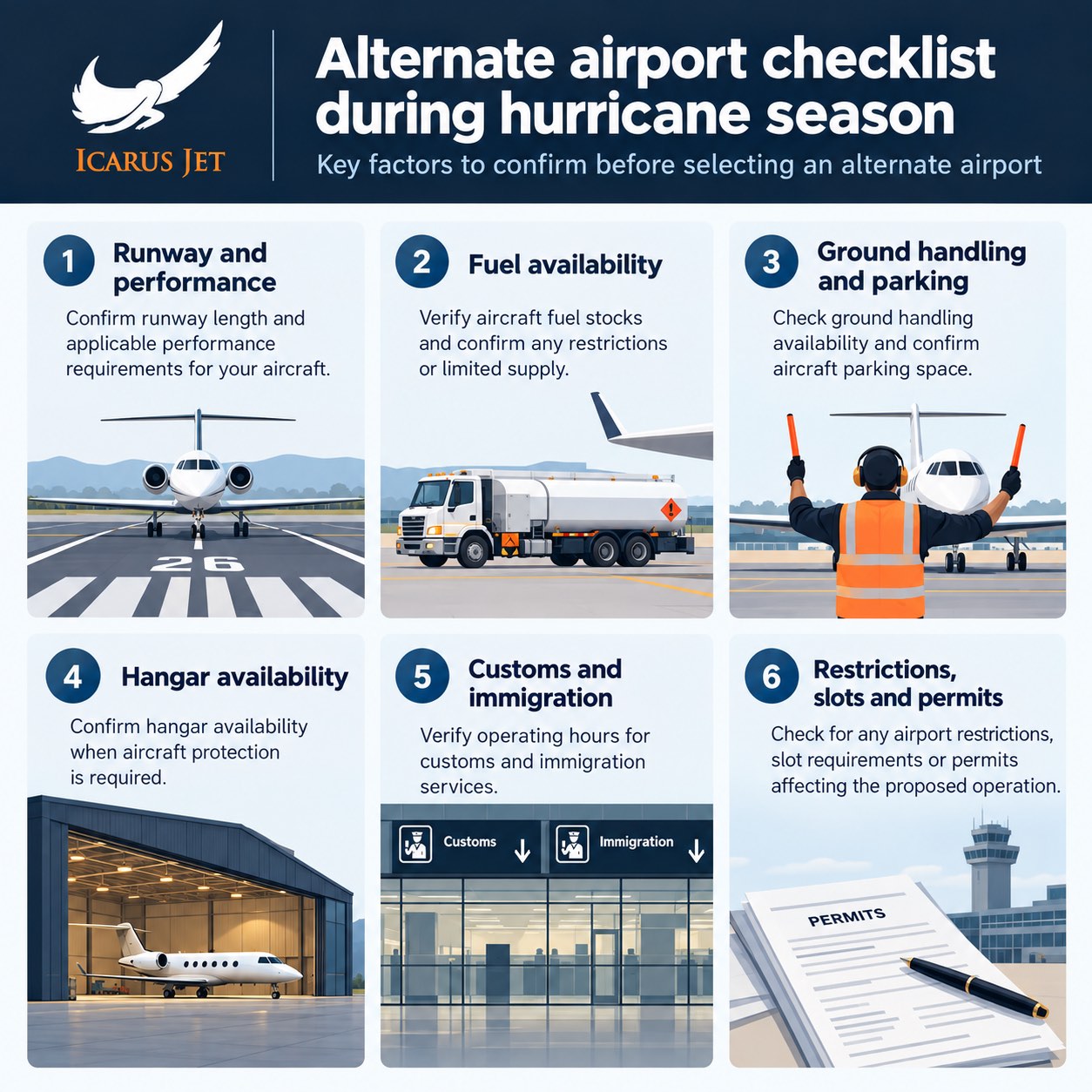
- Runway and performance: confirm the runway length and the performance requirements that apply to your aircraft.
- Fuel availability: verify fuel stocks and any restrictions or limited supply.
- Ground handling and parking: check that handling is available and that parking space is confirmed.
- Hangar availability: confirm a hangar where the aircraft needs protecting.
- Customs and immigration: verify the operating hours of customs and immigration services.
- Restrictions, slots and permits: check for airport restrictions, slot requirements or permits affecting the proposed operation.
Where any of these is in doubt, the trip support team arranges handling, parking, slots and the necessary permits ahead of time. International operations face extra complications with last-minute destination changes, because foreign regulations and processes are less familiar.
Protecting aircraft before the storm arrives
Aircraft already based in an area facing a developing tropical storm present a problem of their own: whether to relocate the aircraft or secure it where it is.
That decision depends on the hurricane forecast, the aircraft’s limitations, the availability of airports with secure hangar space, and whether suitable alternatives exist elsewhere.
Hangar space often becomes scarce as landfall approaches. Operators looking for shelter compete for limited capacity, particularly at popular business aviation destinations.
Dispatchers therefore need to arrange hangar space early, rather than scrambling once facilities are full.
The alternative is relocating away from the storm. If that is not possible, the aircraft has to be secured on the ground in line with the operator’s procedures.
Fuel services present another challenge. Suppliers may shorten their operating hours, impose quotas or shut down altogether ahead of an expected storm. The aircraft may be mechanically ready, but without enough fuel the repositioning flight is not feasible. The same applies when the ground services needed for a safe departure and arrival are not available.
The role of dispatchers in maintaining communication
Hurricane operations involve many parties, often across different airports, countries and time zones. Crews may have accurate forecasts of the approaching weather, yet still need confirmation that ground facilities are operating. This is where a dedicated trip support team adds value to the mission.
Our dispatchers liaise with the crew, airport handlers, fuel suppliers, ground crews, customs officers and everyone else involved in preparing the flight. Those conversations start well before the weather arrives, with agreed contacts and channels: telephone, instant messaging such as WhatsApp, or whatever works best. All of them depend on telecommunications that keep working through the bad weather, so a fallback contact matters.
Regular updates should separate confirmed operational information from developing forecasts.
A forecast that an airport may be affected is different from an official airport closure. In the same way, an airport reopening does not mean handling, fuel and customs services have resumed.
Clear communication helps pilots understand which arrangements are confirmed and which are still subject to change. Flight watch keeps that picture current while the aircraft is in the air.
Crew and passenger arrangements also matter
Disruption in hurricane season goes beyond flight routing.
Hotels can fill up with evacuations ahead of a storm, and ground transport becomes harder to find with road closures or curfews in affected areas. That makes it important to arrange accommodation and transport in advance for delayed departures or changed destinations.
Telling passengers and clients early and accurately about possible delays, changes and alternate arrangements lets them plan, and takes much of the stress out of the uncertainty. The captain keeps final authority over the safety of the flight. The groundwork beforehand, though, benefits enormously from good dispatch: collecting the information, coordinating the services and presenting workable options, so the crew can choose the best route.
Post-hurricane activities and procedures
Once a hurricane has passed, operators are often eager to get back to their original schedules. The end of severe weather, however, does not automatically restore normal airport operations.
Before any departure or arrival is arranged, the airport’s official reopening has to be confirmed and any runway, taxiway or infrastructure constraints addressed. Ground handling capability is verified separately. Foreign object debris can cause damage, and facilities may be without power or staff.
Fuel, customs and immigration availability has to be checked with each provider at the reopened airport. This matters most at small Caribbean island airports, such as those covered in our US Virgin Islands guide, which have less emergency equipment and tend to restore capacity more slowly than large airports elsewhere.
The Icarus Jet trip support team assists operators with weather monitoring, flight planning, rerouting, alternate airport arrangements, permits and ground handling coordination throughout hurricane season. For island-specific planning, see our Caribbean and Pacific trip support guides, including Caribbean winter operations.
Conclusion
Hurricanes disrupt normal private aviation operations and call for careful planning on top of the usual preparation. Flying around developing storms takes more than tracking the weather: alternative routes, higher fuel requirements, alternate airports that suit the aircraft, ground services through fuel shortages or restricted access, and moving aircraft out ahead of the storm.
For operators flying in these conditions, a trip support team monitors the hazardous weather and handles the flight plans, reroutes, alternate airports, permit applications and ground logistics throughout hurricane season.
Questions
Hurricane season flying: questions the desk gets
Can private jets fly above a hurricane?
Flying above a hurricane is not a reliable avoidance strategy. Deep convection in tropical systems can extend beyond typical business jet cruising altitudes, and severe turbulence and thunderstorms can occur far from the storm’s center. Plan routes that avoid the hazardous weather rather than relying on altitude alone.
What weather information should private jet pilots review during hurricane season?
National Hurricane Center advisories, SIGMETs, METARs, TAFs, NOTAMs, satellite imagery and the relevant significant weather forecasts. Pilots should also keep watching for changes in storm intensity, forecast track and airport operating conditions throughout the planning process.
How do flight dispatchers support pilots during a hurricane?
Dispatchers monitor the weather, evaluate alternative routes, coordinate revised flight plans and verify airport services. They also arrange fuel, overflight and landing permits, ground handling and aircraft repositioning, and keep communication open with local providers.
When should an aircraft be repositioned ahead of a hurricane?
Early enough to stay ahead of deteriorating weather, airport closures and shortages of fuel or parking. The timing depends on the storm forecast, the aircraft’s limitations, airport conditions and the availability of suitable destinations. Operators should not wait until evacuation becomes urgent.
What makes a suitable alternate airport during hurricane season?
Acceptable weather plus the aircraft’s operational requirements: runway performance, fuel availability and the applicable regulatory requirements. Pilots and dispatchers should also verify handling, parking, airport operating hours, and customs and immigration availability where required.
Can private jet flights resume immediately after a hurricane passes?
Not necessarily. An airport may reopen while fuel, ground handling, customs or other essential services are still unavailable. Dispatchers should verify the airport status, the relevant NOTAMs and the restoration of the services the flight needs before the operator proceeds.
Where this sits
The guides around this one
Flying through hurricane season? Planned from the desk
Send the dates, the aircraft and the stops. You get the permits filed, the routing checked against the current picture, handling confirmed, and a number you can hold us to.
Contact Us