
APU Limits in Nice: What Private Jet Crews Need to Know at LFMN
Nice Côte d'Azur Airport (LFMN) is one of Europe’s most congested private aviation gateways, particularly during the summer months when traffic to the French Riviera reaches its peak. Whether it’s corporate or leisure travelers, the airport experiences plenty of private jet traffic. But pilots and crews operating into Nice are facing growing restrictions that can impact turnaround times, aircraft servicing, and cabin comfort: the airport’s strict APU (Auxiliary Power Unit) policies.
Reviewed by Kevin Singh, Founder · Fact-checked against Icarus Jet fleet and airport operations data · Last updated 10 September 2026
The guide
The airport operator, not ATC, enforces these rules through spot checks, with fines or delays for non-compliance. On Stand 1 the APU may run only within 10 minutes before TSAT. Self-maneuvering stands allow 15 minutes after arrival and 30 minutes before TOBT, and KILO overnight parking bans APU use entirely. With summer ramp temperatures over 30°C (86°F), crews should plan turns under 60 minutes, finish servicing before the KILO tow, and pre-request GPU.
This blog explains the APU policy at LFMN, what it implies for business jet flights, and best practices to help flight departments manage the challenges, especially during hot-weather, high-traffic conditions.
APU use at LFMN
Nice Airport has among the most restrictive APU policies in Europe, in line with its environmental goals and noise abatement procedures. The airport operator, not ATC, enforces these rules, and crews should not expect exceptions without clearance.
The following is the current breakdown:
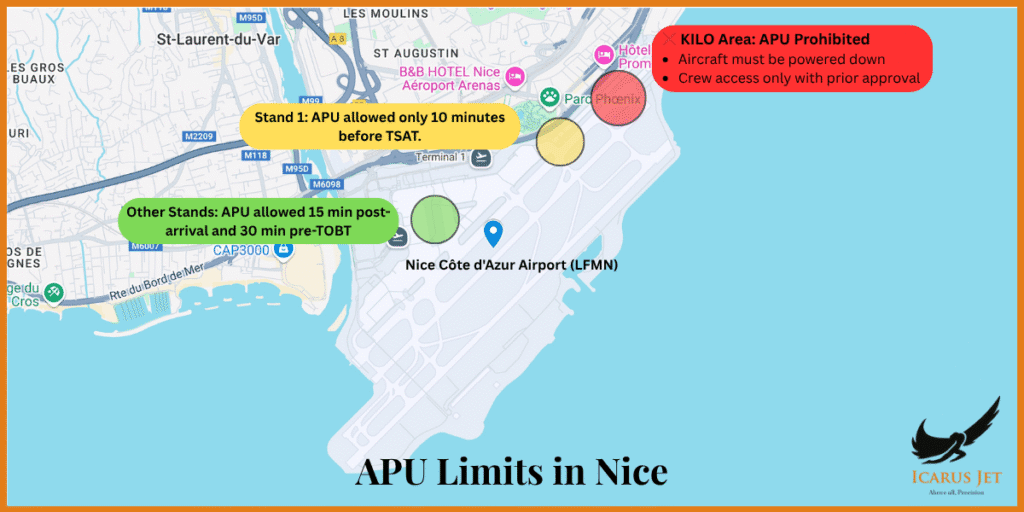
On Stand 1 (With Pop-Up GPU): APU usage is allowed within 10 minutes before TSAT (Target Start-Up Approval Time) alone.
Self-maneuvering stands: The crews can use the APU for 15 minutes after arrival and 30 minutes prior to TOBT (Target Off-Block Time).
KILO overnight parking area: Total prohibition of APU usage. After being towed into KILO, the airplane should be fully powered down and access is prohibited unless requested and approved by airport officials.
These procedures are enforced by spot checks, and handlers indicate that failure to comply can result in fines or operational delays. Given that the majority of contemporary aircraft rely on APU power for environmental control and system checks, particularly on hot days, this policy requires careful operational planning.
Why it matters
Private jet crews have reported that cabin temperatures can rise rapidly without air conditioning provided by APU. Ramp temperatures in Nice can be over 30°C (86°F) in the summer. This impacts not only passenger comfort but also the ability to perform required preflight checks, catering loading, and equipment checks.
The restrictions particularly affect long ground times and overnight parking scenarios, where usual APU operation for cabin preparation isn’t feasible. In hot weather, the inability to cool the cabin can lead to discomfort, delayed tasks, or schedule conflicts.
Best practices
As enforcement tightens, operators and pilots need to embrace proactive planning to ensure efficiency without compromising compliance. Here are some best practices based on recent feedback and reports from our partners and FBOs at LFMN:
1. Plan for short turnarounds
Where operationally possible, schedule short turns of under 60 minutes. This fits easily within the 30-minute pre-TOBT and 15-minute after arrival APU running time allowed.
It also minimizes the need for ground power and reliance on airport approvals for extended GPU access or tow requests.
2. Perform full service on arrival
Particularly for overnight parking in the KILO zone, ground servicing like interior cleaning, lavatory servicing, waste disposal, and refueling should be completed as soon after arrival as possible. Once the aircraft is towed into KILO, ground handling access is very restricted unless pre-approved specially in advance.
3. Strategic GPU use
Although not all parking stands have stable GPU access, Stand 1 has a pop-up GPU, which can provide support for essential systems and cooling for short ground stays. Nevertheless, GPU use also needs to be requested and planned ahead of time.
Crews can verify GPU availability with the Icarus Jet trip support team and check aircraft compatibility. Having the correct GPU connector or adapter onboard can avoid last-minute problems.
4. Cool aircraft during evening hours
If the aircraft is going to leave early the next morning, one solution is to cool the cabin when it is cooler in the evening, with the help of GPU. This will keep the cabin comfortable without needing to use the APU on warm mornings when it is prohibited.
5. Coordinate with ground handlers
FBOs and ground handlers can provide significant support in dealing with APU constraints. They can confirm towing timings, organize GPU connections, and request access exemptions where necessary.
LFMN APU policy in context
LFMN’s eco-policies aren’t unique. Across Europe, airports such as London Luton (EGGW), Zurich (LSZH), and Geneva (LSGG) are implementing or developing the same ground power and emissions processes. The momentum for cleaner, quieter, and more sustainable airport operations is being built, and private aviation will need to keep up.
Along those lines, APU limits at Nice are part of an overall movement toward environmentally friendly airport procedures. For private jet operators and crews, this will mean factoring such considerations into daily planning.
Final thoughts
Flying into LFMN in high season takes more than a slot – it takes a ground plan that respects real-world limitations. APU restrictions are now a part of the operational landscape at Nice, and crews that plan accordingly will prevent fines, delays, and last-minute surprises.
At Icarus Jet, we work in concert with flight departments to make each departure and arrival unfold flawlessly, whether it’s arranging GPU access, booking FBOs, or advising on best parking practices. For crews flying to the French Riviera this season, planning is the best power source.
For detailed airport procedures, visit the Nice Business Aviation Portal.
Questions
APU Limits in Nice: What Private Jet Crews Need to Know at LFMN: questions the desk gets
How long can the APU run on a self-maneuvering stand at LFMN?
On self-maneuvering stands crews may run the APU for 15 minutes after arrival and for 30 minutes before TOBT (Target Off-Block Time). Nothing outside those windows is permitted without clearance from the airport operator. A turnaround of under 60 minutes fits comfortably inside the allowance, which is why the desk plans short turns at Nice where the schedule permits.
What is the APU rule on Stand 1 at Nice?
Stand 1 has a pop-up GPU, so APU use there is allowed only within 10 minutes before TSAT (Target Start-Up Approval Time). For anything longer, crews rely on the GPU for essential systems and cabin cooling during short ground stays. GPU use still has to be requested and planned in advance, and the correct connector or adapter should be on board.
Can I use the APU in the KILO overnight parking area?
No. APU use is completely prohibited in KILO. Once the aircraft has been towed in it must be fully powered down, and access to it is prohibited unless requested and approved by airport officials. Any cabin preparation, cleaning, fueling or lavatory servicing for an overnight stay needs to be finished before the tow, not after.
Who enforces the APU policy and what happens if a crew breaks it?
The airport operator enforces the policy, not ATC, and crews should not expect exceptions without clearance. Compliance is checked through random spot checks on the ramp. Handlers report that violations can result in fines or operational delays, so the desk treats the APU windows as hard limits when building the ground plan for Nice.
How do I keep the cabin cool at Nice without running the APU?
Use ground power in the cooler evening hours. If the aircraft departs early the next morning, pre-cool the cabin the evening before with GPU support so it stays comfortable without APU use on a warm morning when it is prohibited. Ramp temperatures at Nice can exceed 30°C in summer, so plan the cooling window rather than hoping for an exception.
What should be completed before the aircraft is towed into KILO?
Everything. Interior cleaning, lavatory servicing, waste disposal and refueling should be done as soon after arrival as possible, because ground handling access inside KILO is very restricted unless it was specially pre-approved. The desk also confirms towing timings and any GPU connection with the FBO or handler in advance so nothing is left for the morning.
Where this sits
The guides around this one
Flying this region? Filed from the desk
Send the dates, the aircraft and the stops. You get the permits filed, the routing checked against the current picture, handling confirmed, and a number you can hold us to.
Contact Us