
Italy Disinsection Protocols: What Private Jet Pilots Should Know
Italy is one of Europe’s most popular and busiest private aviation hotspots, from the fashion centers of Milan to the sea-side retreats of Naples and Genoa. But in addition to the logistical challenges of slot coordination, customs clearance, and parking, 2025 introduces increased focus on an under-the-radar regulatory requirement: aircraft disinsection.
Reviewed by Kevin Singh, Founder · Fact-checked against Icarus Jet fleet and airport operations data · Last updated 10 September 2026
The guide
Italy requires cabin disinsection for aircraft arriving from at-risk regions (Central and South America, sub-Saharan Africa, Southeast Asia, the Caribbean) by pre-flight spray, residual spray (usually every eight weeks) or on-arrival treatment. Records must show method, date, time, product and applicator and stay onboard. Malpensa, Fiumicino and Naples lead enforcement. At Linate, aircraft doors must stay closed from 10:00 to 18:00 because of the Japanese beetle. Crews should add 30 to 45 minutes on arrival.
For flight departments, trip support specialists, and private jet pilots, it’s essential to know Italy’s new policy on cabin disinsection for operational efficiency, compliance, and the safety of passengers. Our Trip Support team explains what to anticipate and how advance trip support planning can prevent delays, fines, and client disappointment.
Disinsection requirements in Italy
Disinsection refers to the elimination or prevention of infestation of insects in aircraft cabins, most notably, mosquitoes, along with their vector-borne disease transmissions like dengue, Zika, and chikungunya. In Italy, the procedure is overseen by the Ministry of Health and implemented in several international airports.
Italy still has strict cabin disinsection procedures against aircraft coming from nations considered “at risk” of vector-borne illnesses, countries which are located in Central and South America, sub-Saharan Africa, Southeast Asia, and the Caribbean.
Pilots are advised that compliance with disinsection is liable to be verified by Italian health authorities upon arrival. Allowable methods are:
- Pre-flight spray: Conducted before departure with WHO-standard insecticides.
- Residual spray: Used at regular intervals (usually every eight weeks) as a prophylactic barrier.
- On-arrival disinsection: Conducted by qualified ground handlers in Italy when pre-treatment certification has not been provided.
Operational Update – Milano Linate (LIML): New Phytosanitary Measures in Effect
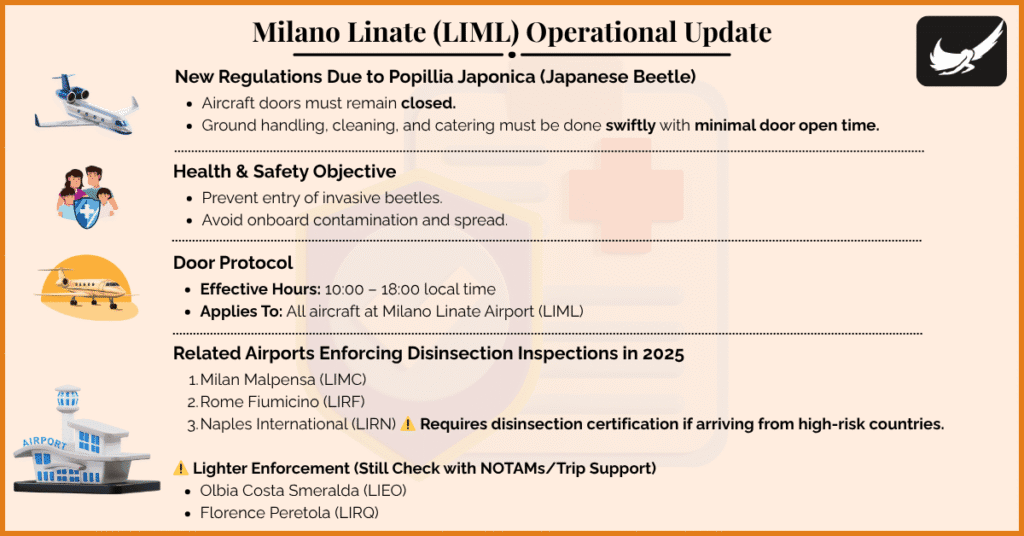
Due to the spread of Popillia japonica (Japanese beetle), new regulations are now enforced at Milano Linate Airport (LIML). From 10:00 to 18:00 local time, all aircraft doors must remain closed. Ground handling, catering, and cleaning operations during this window must be conducted swiftly, with doors kept closed as much as possible to prevent insect entry.
Health rationale behind the procedure
The continued spread of numerous international vector-borne infections – many of which are now expanding outside their historical geographic distribution – has led public health authorities to increase surveillance on potential vectors. Aircraft cabins present a confined space in which unsuspected insects can be transported over long distances and multiply.
In 2024, a paper in the National Library of Medicine highlighted the contribution of air travel to the inter-continent dissemination of Aedes aegypti mosquitoes, the primary vector of dengue and Zika viruses. The paper highlights the risk of “airport malaria” and the importance of strict port-of-entry health measures.
Documentation and crew duties
From a crew perspective, flight departments and pilots must ensure that correct documentation accompanies all flights necessitating disinsection. Documentation must:
- Detail the method of application (i.e., pre-flight or residual spraying)
- State date and time of application
- Identify the product and applicator used
- Be kept onboard and available for inspection if required
Inadequate documentation can lead to on-site disinsection at the expense of the operator and potential ramp check delays.
It is especially important that charter operators brief cabin staff on how to deal with Italian health authorities’ questioning and pre-brief the passengers on any procedures that may occur upon arrival.
The certificate below is valid for 8 weeks:
ICAO’s Certificate of Residual Disinsection.
Airports implementing disinsection inspections
A number of airports in Italy have established specific 2025 enforcement procedures, headed by Milan Malpensa (LIMC), Rome Fiumicino (LIRF), and Naples International (LIRN). They mandate operators to present health declarations before arriving from infected countries.
Smaller airports such as Olbia Costa Smeralda (LIEO) or Florence Peretola (LIRQ) might not enforce these regulations as strictly, but pilots must always confirm regulatory procedures with their trip support team or NOTAMs prior to departure.
Tips for private jet flights to Italy
Here is how Icarus Jet suggests you plan for a compliant and smooth entry into Italy:
1. Pre-Flight Planning Needs to Be Country-Specific
Not all origins need disinsection requirements. Check with our trip support team to see if your departure nation is “at risk.” This dictates if any disinsection documentation needs to follow your aircraft.
2. Utilize WHO-Approved Disinsection Products
Residual sprays are to be insecticide-treated using the WHO-recommended list of insecticides. Avoid using untested or generic products that may be rejected during inspection. Icarus Jet can assist in coordinating ground handlers or maintenance staff for certified treatment and documentation.
3. Keep Documentation Timetables in Advance
Pre-submission of health documentation along with routine arrival and parking requests is now required by the majority of Italian FBOs. This comprises copies of disinsection certificates, gen dec, and aircraft sanitation records. Pre-submitting them will avoid last-minute problems in busy traffic periods.
4. Select Airports with Productive Ground Services
If you have flexibility in your planning, choose airfields that have a reputation for experienced customs and health processing. Milan Linate (LIML), for instance, will clear disinsection checks more quickly than Malpensa during busy periods due to improved business aviation channels.
5. Allow Delays into the Schedule
Health inspections – generally brief – may occasionally slow turnaround times. When arriving in Italy with VIP passengers or close onward connections, add 30 to 45 minutes to the arrival schedule to allow for possible inspections or documentation checks.
Wider operational considerations in Italy
Aside from disinsection, pilots will have to continue working with Italy's broader operating environment, including:
- PPR Requirements: Pre-approval needed for most secondary airports such as Capri (LIQC) or Bolzano (LIPB), particularly during summer.
- Slot Availability: Slots are needed in advance at busy airports, sometimes 72 hours earlier, especially if it is peak tourist season.
- Parking Restrictions: Overnight parking is becoming more limited in city centers such as Rome and Florence. Drop-and-go options are frequently required.
- Fuel Availability: Whereas large FBOs carry Jet A-1 on an ongoing basis, smaller centers can require 24-hour notice for fueling services.
Final thoughts for crews
Disinsection isn’t a procedural formality, it’s a regulatory imperative with a direct effect on your schedule, operating cost, and reputation with customers. Italian health authorities are stepping up surveillance of business aviation, and lack of preparedness is an open invitation to disruption. With Icarus Jet’s trip support services, crews can concentrate on flying while we manage the details on the ground – documentation, coordination, and compliance.
For customized trip support solutions or to discuss Italy-specific operational requirements, contact the Icarus Jet team today.
Questions
Italy Disinsection Protocols: What Private Jet Pilots Should Know: questions the desk gets
Which arrivals into Italy need disinsection?
Aircraft arriving from countries Italy considers at risk of vector-borne illness, broadly Central and South America, sub-Saharan Africa, Southeast Asia and the Caribbean. The procedure is overseen by the Ministry of Health and checked at several international airports. Not every origin triggers it, so the desk confirms whether the departure country is on the at-risk list before the flight.
What disinsection methods does Italy accept?
Three: a pre-flight spray carried out before departure with WHO-standard insecticides; a residual spray applied at regular intervals, usually every eight weeks, as a prophylactic barrier; and on-arrival disinsection by qualified ground handlers in Italy when no pre-treatment certificate is presented. Residual treatments must be applied by authorized maintenance personnel or handlers, not by the crew.
What must the disinsection paperwork show?
The method of application (pre-flight or residual), the date and time it was applied, and the product and applicator used. It must be kept on board and available for inspection. A residual disinsection certificate is valid for eight weeks. Inadequate paperwork can mean on-site disinsection at the operator's expense and a ramp check delay.
Which Italian airports enforce disinsection most strictly?
Milan Malpensa (LIMC), Rome Fiumicino (LIRF) and Naples (LIRN) lead the 2025 enforcement and require health declarations before arrival from affected countries. Smaller airports such as Olbia (LIEO) or Florence (LIRQ) may be less strict, but crews should confirm the current procedure through their trip support team or NOTAMs before departure rather than assume.
What is the closed-door rule at Milan Linate (LIML)?
Because of the spread of Popillia japonica, the Japanese beetle, all aircraft doors at Linate must remain closed between 10:00 and 18:00 local time. Ground handling, catering and cleaning during that window have to be done quickly with doors kept closed as much as possible. Plan servicing outside the window where the schedule allows.
How much extra time should I allow for health checks on arrival?
Allow 30 to 45 minutes on the arrival schedule for possible inspections or documentation checks, especially with VIP passengers or tight onward connections. Most Italian FBOs now expect health documentation, including disinsection certificates, gen dec and sanitation records, to be submitted with the arrival and parking request, which shortens the check on the day.
Where this sits
The guides around this one
Flying this region? Filed from the desk
Send the dates, the aircraft and the stops. You get the permits filed, the routing checked against the current picture, handling confirmed, and a number you can hold us to.
Contact Us