
Flight Plan Suspension in Europe: How to Avoid a Common Operational Surprise
Flight plan suspensions are one of Europe’s least understood operational challenges. Knowing why they happen and how to stay ahead of them can prevent unnecessary delays during multi-sector business aviation missions.
Reviewed by Kevin Singh, Founder · Fact-checked against Icarus Jet fleet and airport operations data · Last updated 10 September 2026
The guide
EUROCONTROL's Network Manager can suspend an IFR flight plan when the filed departure time passes without a clearance request, as with a 0400 UTC plan at 0403 UTC, or when slots, airport restrictions or airspace limits change. A CTOT delay on a Greece mission and extended holding on a Montenegro mission threatened the next leg's plan. Clearance for the current sector does not protect later sectors, so revised times must reach downstream plans.
Your first leg has been flown successfully in Europe, and things seem to go smoothly. As you begin to get ready for your next departure, however, ATC lets you know that your flight plan has been suspended.
No apparent problem with anything. The aircraft is ready. The route has not changed. No clearance, though.
For many US private jet pilots, such a situation would be unusual because of the completely different nature of the European air traffic control system, which works quite differently from the FAA system. In Europe, flight plans are continuously monitored by EUROCONTROL’s Network Manager, and operational changes throughout the day could potentially impact flights filed hours ago.
The key point here is that a flight plan suspension happens not because of any mistakes made by the pilot. In many cases, it reflects the dynamics of Europe’s air traffic network, which are especially noticeable during peak operations and various Air Traffic Flow Management (ATFM) restrictions.
Knowing the cause of such suspensions and their influence on upcoming flights could help avoid delays at departure.
What is a flight plan suspension?
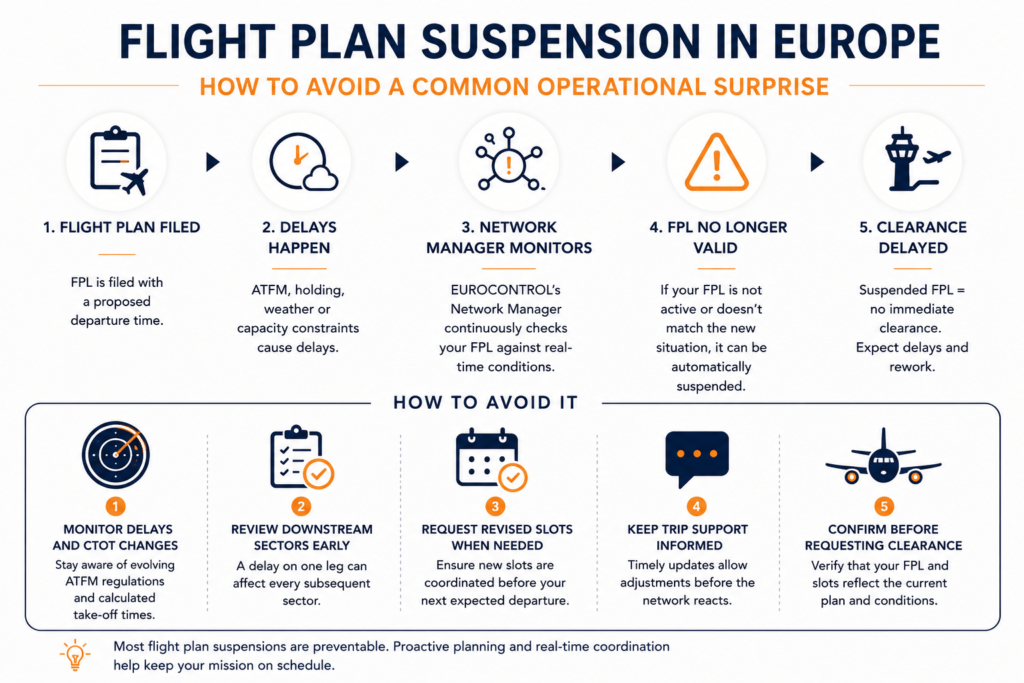
In Europe, IFR flight plans are handled by EUROCONTROL’s Network Manager, which is continuously monitoring all flights operated in participating states. Once a flight plan has been filed, the system checks it against the actual situation throughout the network.
Typically, flight plan suspensions happen when the Network Manager identifies that the flight plan is no longer active or no longer corresponds to the expected aircraft operation.
The most common reason for a flight plan suspension is rather simple. If the filed departure time has already expired and the crew has not requested clearance from ATC, it is assumed that the aircraft will not depart as filed.
For instance, if the flight plan was filed for 0400 UTC and the current time is 0403 UTC with no request from the aircraft for ATC clearance, it could lead to automatic suspension of the flight plan.
Nevertheless, departure time is just one of the triggers of a suspension.
It could happen as a result of non-compliance with an allocated slot, airport restrictions, temporary airspace limitations, or other operational changes affecting the European network. In many cases, those changes happen automatically, making crews unaware of them until they request clearance.
Why European flight plans work differently
Many US pilots are used to filing a flight plan, getting clearance, and operating with minimum interaction between successive flight segments.
European air traffic control systems work differently.
Every IFR flight becomes a part of an integrated network where airports, sectors, weather, military airspace, route capacity and traffic demands are always balanced with each other. The Network Manager continuously checks whether flights remain compatible with available capacity and current regulations.
It means that delays do not remain isolated to just one departure.
A late departure could affect subsequent sectors, positioning flights, airport slot allocations, and even crew schedules for the rest of the day. A small delay of one flight could quickly become an operational problem for every remaining leg.
For pilots flying several sectors across Europe, it is crucial to understand how one delay affects the entire day’s operation.
How a CTOT delay affects the next flight plan
A recently completed business aviation mission into Greece is a good example of how quickly schedule changes can influence the next flight.
The aircraft faced considerable departure delay due to being granted a Calculated Take-Off Time (CTOT) under ATFM regulations. As the crew already had clearance for the active flight, the first leg itself remained valid and was not suspended.
The more worrying thing was the following flight.
Since the changed operating schedule did not match the originally filed flight plan, there was a risk that the next flight plan would become invalid even before the aircraft arrived.
Fortunately, before that happened, the next flight plan was adjusted, and slot requests were revised to reflect the aircraft’s new schedule. Anticipating the issue before its occurrence allowed the subsequent leg to be aligned with the European network and the operation to proceed without further disruption.
For pilots, it is an important lesson that delay of the current leg is not necessarily the largest operational problem. It often takes place several hours later at the next departure.
Small delays can suspend the next flight plan
Not every suspension starts with a considerable ATFM delay.
On another European mission, the aircraft faced a long holding period while operating to Montenegro. Even though the delay itself was not big, the subsequent leg was not adjusted accordingly.
By the time the crew was ready for the next departure, the original flight plan no longer corresponded to the actual operation of the aircraft. Clearance became problematic due to inconsistency between the filed information and the data within the Network Manager.
Such situations illustrate that the initial delay is often just a part of the problem. Maintaining accurate flight plans becomes crucial during schedule changes throughout the day.
Why continuous flight plan monitoring is crucial
One of the biggest misconceptions regarding European operations is that filing a flight plan completes the procedure. In fact, filing is just a start.
Throughout the day, weather changes, airport congestion builds up, military airspace gets activated, ATFM regulations come into effect or expire, and traffic demands change throughout multiple countries. All of these changes have the potential to impact flights that have already been filed.
This means that successful European operations depend not only on filing but also on continuous monitoring of active missions.
Once a schedule changes, subsequent sectors need to be checked to see if any revisions to flight plans, slots, or further coordination are needed. Addressing changes early becomes a key factor between routine adjustments and delays at departure.
How pilots can avoid flight plan suspensions
Even though most coordination is done outside the cockpit, pilots can minimize the likelihood of flight plan suspension by tracking changes and their impact on the rest of the day’s schedule.
In essence, pilots need to think not just about the current leg but also whether the revised departure time needs to be incorporated into the rest of the flight plan, especially during busy times of operation or when flying several sectors.
Communication plays an important role here too. Informing trip support about any developing delays allows them to make the needed changes before automated systems detect inconsistencies between the filed flight plan and the aircraft’s actual operation.
Last but not least, pilots should keep in mind that getting clearance for the current sector does not guarantee that subsequent sectors are not affected. Every flight continues to be analyzed in the context of the changing situation in the European network.
The value of proactive trip support
European flight plan suspensions are rarely caused by a single mistake. More often, they result from a series of operational changes that gradually move an aircraft away from its original schedule. A delayed departure, an updated CTOT, extended holding, or a new ATFM regulation may seem manageable individually, but together they can affect subsequent sectors long before the crew requests clearance.
This is where experienced trip support becomes an operational advantage. Beyond filing flight plans, a dedicated team continuously monitors active missions, reviews how delays affect downstream sectors, coordinates revised slots when necessary and updates flight plans before they become invalid.
For pilots, that means spending less time resolving administrative issues on the ground and more time focusing on the safe operation of the aircraft.
Questions
Flight Plan Suspension FAQs
What does it mean when a flight plan is suspended in Europe?
It means EUROCONTROL’s Network Manager has deactivated your filed IFR flight plan because it no longer matches the expected operation, most often an expired departure time with no clearance request. ATC will not issue clearance until the flight plan is updated and reactivated.
Why do flight plans get suspended in Europe?
The most common trigger is an expired departure time without a request for ATC clearance. Other causes include non-compliance with an allocated slot (CTOT), airport restrictions, temporary airspace limitations, and network changes made after the flight plan was filed.
How do you reactivate a suspended flight plan?
The flight plan must be brought back in line with the aircraft’s actual schedule, typically by sending a delay (DLA) or change (CHG) message with a revised departure time and coordinating a new slot where required. A trip support team normally handles this before the crew requests clearance.
Can a delay on one leg suspend the next flight plan?
Yes. On multi-sector days, a CTOT delay or extended holding can push the aircraft off its filed schedule, leaving the next flight plan inconsistent with the Network Manager’s data. Updating downstream flight plans and slot requests early prevents the suspension.
How soon after the filed departure time can a flight plan be suspended?
Within minutes. If the plan is filed for 0400 UTC and by 0403 UTC the crew has not requested ATC clearance, the Network Manager can suspend it automatically. The trigger is the expired departure time with no clearance request, so a short slip on the ground is enough. Pass any expected delay to the desk before the filed time passes.
What should pilots do when a delay develops mid-mission?
Tell trip support as soon as the delay appears, whether it is a CTOT, extended holding or a schedule change. The desk then checks every downstream sector and revises flight plans and slot requests before the automated systems flag the mismatch. Clearance for the current leg does not protect the next one, so treat the whole day as one plan.
Where this sits
The guides around this one
Flying this region? Filed from the desk
Send the dates, the aircraft and the stops. You get the permits filed, the routing checked against the current picture, handling confirmed, and a number you can hold us to.
Contact Us