
What Has Changed for Private Jet Flights to the Middle East in 2026
Since early 2026, private jet flights to the Middle East face rerouting through Egypt, Saudi Arabia, Oman, the UAE or the Caucasus, GPS jamming and spoofing in several regions, and stricter security planning. Airspace has largely reopened, but reroutes can add 20 to 30 minutes or more on Europe to Gulf sectors and change fuel, crew duty and permit calculations.
Reviewed by Kevin Singh, Founder · Fact-checked against Icarus Jet fleet and airport operations data · Last updated 10 September 2026
The guide
The Middle East remains one of the world’s most important business aviation markets, connecting North America, Europe, Asia and Africa. That operating environment changed dramatically in early 2026 following the escalation of the U.S.-Israel-Iran conflict, and questions remain on whether it’s safe to fly over Iran.
Today’s crews that are flying private jets to the Middle East in 2026 need to account for new airspace restrictions, new security considerations, and even GPS interference.
Although the airspace has technically reopened for aviation in many countries, today’s crews need to understand that there is more to consider during mission planning.
Fortunately, business aviation has proved to be very flexible and adaptable to the changes that occurred. Today, aircraft fly to the Middle East regularly, but only those that are prepared for the constantly changing situation.
Middle East airspace has reopened, but operations are not normal
Although geopolitical events have always impacted missions to the Middle East, the situation in 2026 became something new for most crews.
Several countries have opened some parts of their airspace for business aviation, but some direct routings are no longer available for crews or are too restricted for use.
As a result, flights are often rerouted through Egypt, Saudi Arabia, Oman, the UAE, or the Caucasus, depending on the final destination and operator approvals.
For flights between Europe and the Gulf countries, like a private jet charter to Dubai, such rerouting may add 20 to 30 minutes or more compared to historic routings. However, operators who depart from the United States don’t have to worry about the Atlantic part of the flight, which will not be changed.
What has really changed in 2026 is the operational side of business aviation, which requires more flexibility from crews than before.
Longer reroutes affect the entire mission
Every deviation influences fuel planning, payload capability, crew duty and compliance, limitations, maintenance scheduling, and overall operating costs.
For Part 135 charter operators, the increased cost will directly impact the profitability of the flight, while for Part 91 operators and flight departments, the priority will be to minimize the total travel time for passengers.
Thus, every mission should be evaluated separately.
Aircraft performance also becomes increasingly important. Additional fuel loads may reduce payload on some aircraft, while longer sectors may require augmented crews or technical fuel stops to remain compliant with duty limitations.
For these reasons, ultra-long-range aircraft like the Gulfstream G700 and Bombardier Global 7500 are now preferred by many operators because they can absorb many routing changes without sacrificing operational flexibility.
You might also like: How the Middle East crisis is reshaping fuel planning for private jet pilots
GPS spoofing and jamming: a new operational reality for crews
Electronic warfare has become another consideration for crews that plan international missions.
GPS spoofing and jamming have become an operational reality in several regions of the world, including parts of the Middle East.
It is also important to note that it is not limited to the particular regions. Similar GPS interference is known in other parts of the world, including US airspace, which is covered by published NOTAMs.
Crews have become more aware of abnormal navigation indications, cross-checking the aircraft system and switching to the alternative navigation method.
Supplementary equipment and procedures which can increase situational awareness during GPS interference have also been introduced by many operators.
These measures do not eliminate GPS interference, but they improve situational awareness and operational resilience.
Why Middle East trip support decisions matter more than ever
The current operating environment requires that crews make decisions not only about routing but also about other factors which influence the success of the mission.
Each operator has different priorities for international trip support.
A Part 135 charter operator may prioritize the most cost-efficient routing, balancing flight time, fuel burn, handling costs and crew duty limitations to protect the economics of the mission. A Part 91 operator or private flight department, meanwhile, may arrange the shortest overall journey for passengers, even if operating costs increase slightly.
The task of trip support is to assist crews in making decisions before departure.
For example, it can help crews determine whether a technical stop actually reduces the total cost of the mission, choose an airport with lower fuel prices and more effective turnaround times, or find another routing free from delays.
Thus, it is no longer true that choosing the cheapest fuel stop leads to the least expensive mission, or that choosing the shortest route guarantees the fastest arrival.
Having the current operational intelligence allows crews to make decisions before they get airborne.
You might also like: Driving options in the Middle East during airport disruptions
Overflight permits for the Middle East: still manageable, but prepare early
One encouraging development is that permits and airport coordination have remained largely manageable despite regional instability.
The authorities, airport handlers, and ATC providers have managed to adapt to the current conditions and organize traffic in the Middle East. Insurers have also developed schemes that allow conducting flights into certain high-risk destinations in exchange for an extra premium.
This doesn’t mean that operators need to delay planning their mission.
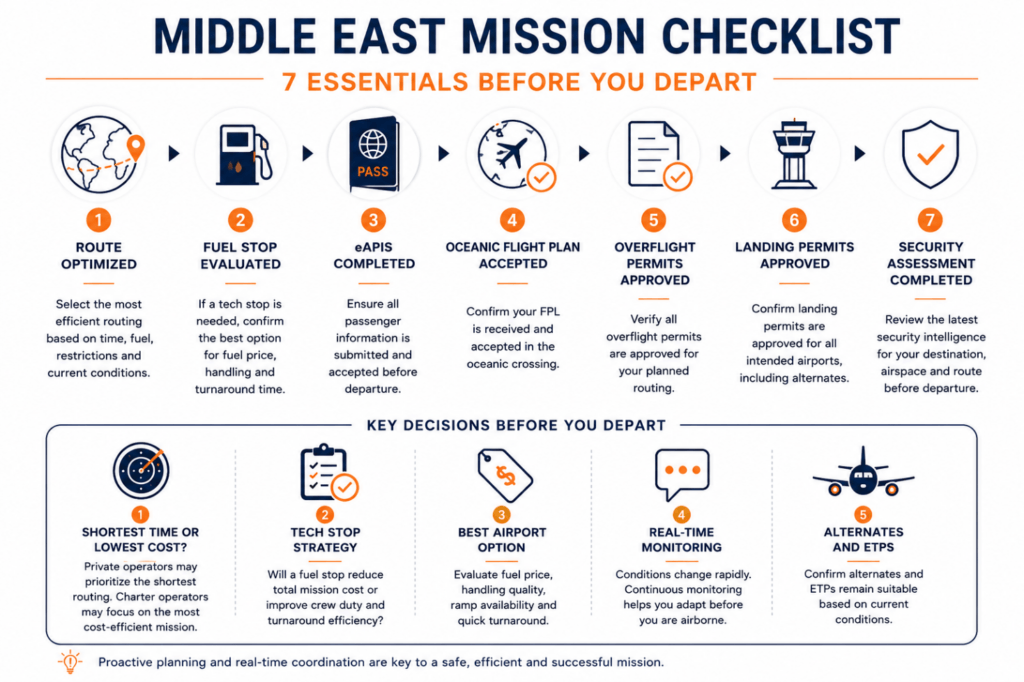
For U.S. crews departing for the Middle East, every international mission should include verification of several operational items before departure.
Some questions worth asking are:
- Is US crew compliance and eAPIS completed?
- Is the outbound clearance obtained for Part 135 operations?
- Is the oceanic flight plan accepted before entry into the North Atlantic airspace?
- Are the equal time points still suitable for the chosen routing?
- Have all overflight and landing permits been approved?
- Has the security assessment affected the chosen routing and alternates?
- If a technical stop is required under ETOPS and time in jeopardy planning, which airport is the most effective in terms of fuel pricing, handling efficiency and turnaround time?
These are the questions that become increasingly important when flying through regions with constantly changing situations.
Resilience has become business aviation’s greatest strength
From everything that happened in the last few months, it became clear that the greatest advantage of business aviation is its ability to adapt to the constantly changing circumstances.
The industry managed to operate despite the geopolitical conflict, fuel price fluctuations, and airspace restrictions thanks to sound planning and up-to-date operational intelligence.
In the current conditions, the success of the flight is no longer defined by the chosen route. It depends on the balance between operational efficiency, regulatory compliance, security considerations, and constantly changing airspace availability.
For U.S. operators, this means these decisions need to be made before crossing Europe. Route optimization, permit coordination, technical stop selection, security assessment, and monitoring are becoming as important as aircraft performance.
An experienced international trip support provider assists flight departments in making these decisions. In the constantly changing environment, it is one of the most important tools for any crew.
Questions
Middle East flights in 2026: questions the desk gets
Is it safe to fly a private jet to the Middle East in 2026?
Yes, business aviation operates to the Middle East regularly in 2026, but only with careful preparation. Airspace has reopened in many countries, though some direct routings remain closed or restricted. Crews must account for reroutes, security assessments and GPS interference during mission planning.
Has the Middle East airspace reopened for business aviation?
Partially. Several countries have reopened parts of their airspace, but some direct routings are no longer available or are too restricted to use. Flights are often rerouted through Egypt, Saudi Arabia, Oman, the UAE or the Caucasus, depending on the destination and operator approvals.
How much time do rerouted flights to the Gulf add?
For flights between Europe and the Gulf, current reroutes can add 20 to 30 minutes or more versus historic routings. Operators departing the United States are unaffected on the Atlantic portion of the flight, which does not change.
What is GPS spoofing, and how does it affect private jet navigation?
GPS spoofing and jamming feed aircraft false or degraded position data. It is now an operational reality in parts of the Middle East and elsewhere, including some US airspace covered by NOTAMs. Crews crosscheck systems, watch for abnormal indications and switch to alternative navigation methods.
Are overflight and landing permits still being approved for the Middle East?
Yes. Permits and airport coordination have stayed largely manageable despite regional instability, as authorities, handlers and ATC have adapted. Operators should still verify all overflight and landing permits early, since preparation and current operational intelligence are now critical to a successful mission.
Which private jets are best for Middle East missions right now?
Ultra-long-range aircraft such as the Gulfstream G700 and Bombardier Global 7500 are now preferred, because they can absorb routing changes without technical fuel stops or augmented crews, preserving operational flexibility when direct routes are unavailable.
Where this sits
The guides around this one
Get it filed
Flying into the Middle East in 2026? Filed from the desk
Send the dates, the aircraft and the stops. You get the permits filed, the routing checked against the current picture, handling confirmed, and a number you can hold us to.
Contact UsPrefer to talk? Call +1 888 277 7203 or email tripsupport@icarusjet.com. The desk is staffed 24/7.