
London Luton Tightens Operational Enforcement: What Changes for Operators
Effective January 1st, London Luton Airport has introduced a new operational enforcement framework that significantly raises the financial and procedural stakes for aircraft operators. The updated charging structure goes beyond slot compliance and now covers ground handling coordination, ramp usage, engine run-up activity, de-icing operations, technical washing, and diverted flights.
Reviewed by Kevin Singh, Founder · Fact-checked against Icarus Jet fleet and airport operations data · Last updated 10 September 2026
The guide
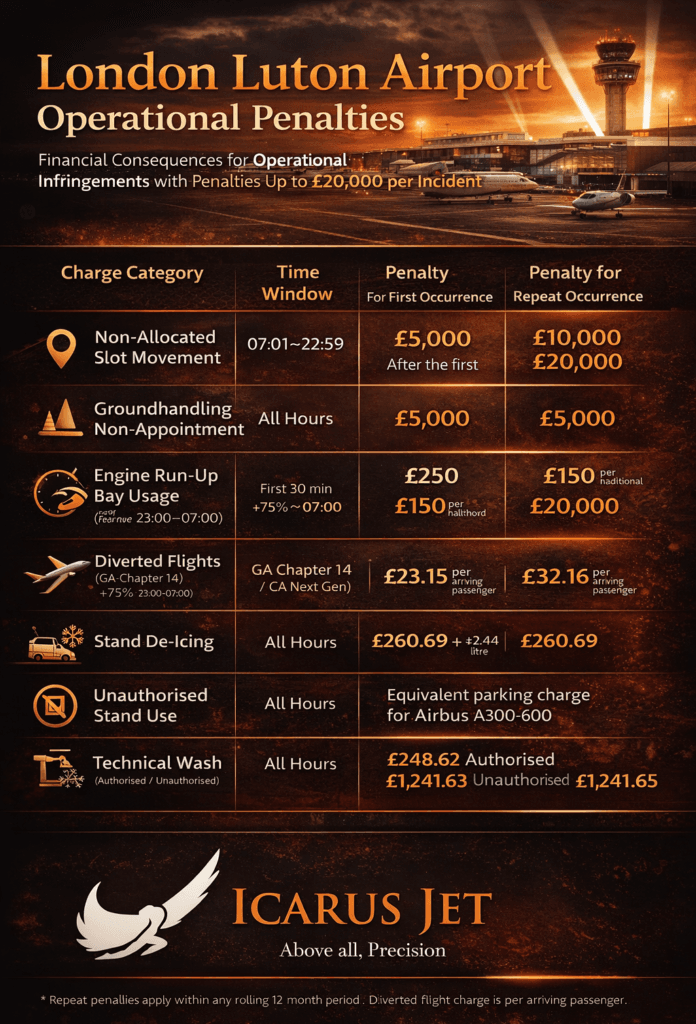
Landing without an Airport Coordination Limited slot costs £5,000 for a first daytime infringement and £10,000 for repeats within 12 months, rising to £10,000 and £20,000 between 23:00 and 07:00. Failing to appoint ground handling costs £5,000 per occurrence. Run-up bay use is £250 for 30 minutes plus £150 per extra 15 minutes. Diversions cost £23.15 or £32.16 per passenger, waived for GA using FBO services. Stand de-icing is £260.69 plus £2.44 per liter.
The new model ties repeated operational behavior to escalating penalties. With individual incidents now capable of triggering charges of up to £20,000, compliance is no longer an administrative formality.
Why London Luton is tightening operational controls
London Luton continues to operate at high capacity across both commercial airline and business aviation movements. Peak weekday demand, overnight cargo activity, and a growing volume of charter operations place sustained pressure on runway availability, stands, and ground handling resources.
From an airport management perspective, uncoordinated arrivals, late slot requests, unauthorized stand use, and poorly timed maintenance activities create operational congestion that affects safety margins and schedule reliability. The revised enforcement framework is designed to reduce these friction points by attaching direct cost consequences to non-compliant behavior.
Slot compliance remains central
The most visible element of the new framework remains the treatment of non-allocated slot movements. Any aircraft landing without a confirmed slot allocation from Airport Coordination Limited prior to departure is now subject to escalating charges based on time of day and frequency.
- During daytime hours between 07:01 and 22:59 local time, the first infringement carries a £5,000 charge. Any subsequent non-allocated movements within a 12-month period rise to £10,000 each.
- Night operations face significantly higher exposure. Between 23:00 and 07:00 local time, the first infringement triggers a £10,000 charge. Repeat occurrences escalate to £20,000 per incident.
This structure targets repeat behavior rather than isolated mistakes, and operators who treat slot compliance casually or rely on post-departure coordination face compounding financial risk over time.
Ground handling coordination carries direct penalties
Another major addition is the introduction of formal ground handling non-appointment charges. Any infringement tied to failure to properly appoint or coordinate ground handling services results in a £5,000 charge per occurrence.
This includes situations where aircraft arrive without confirmed handler arrangements, where service requests are incomplete, or where last-minute changes create ramp conflicts.
For flight departments and dispatch teams, this adds a new layer of accountability. Ground handling coordination must now be treated as a compliance requirement rather than a logistical courtesy. Documentation, service confirmations, and alignment between dispatch and local agents are essential.
Engine run-up bay usage becomes a cost-controlled activity
Engine run-ups, often required following maintenance or technical troubleshooting, are now subject to structured time-based charges.
- Operators will be charged £250 for the first 30 minutes of run-up bay usage, followed by £150 for each additional 15-minute increment or part thereof. Any use during night hours between 23:00 and 07:00 attracts a 75 percent surcharge.
This introduces a financial incentive to streamline troubleshooting activity and avoid prolonged run-up sessions. Operators coordinating maintenance activity at London Luton should carefully plan timing and ensure engineering teams are prepared to minimize bay occupancy.
Diversion handling now reflects aircraft category and passenger volume
Diverted flights landing at London Luton are now subject to passenger-based charges that vary by aircraft certification category.
- For GA Chapter 14 and next-generation commercial aircraft, the charge is £23.15 per arriving passenger. For non-Chapter 14 and older-generation aircraft, the rate increases to £32.16 per passenger.
An important exception applies to general aviation operators using FBO services at the airport. In those cases, diverted flight charges are waived.
This creates a strategic consideration for operators planning alternates during adverse weather periods. FBO availability and service arrangements may materially affect total diversion costs.
Stand de-icing moves to usage-based pricing
When stand de-icing is performed by the airport operator at the request of an aircraft operator or its appointed handler, charges now consist of both fixed and variable components.
- Each de-icing event carries a base charge of £260.69, plus £2.44 per liter of de-icing fluid applied.
During winter operations, this can add up quickly for larger aircraft or during prolonged icing conditions. Operators should factor this into seasonal operating budgets and evaluate alternative ground arrangements where available.
Resource: Standard and Additional Aircraft Charges at London Luton Airport
What this means for business aviation and charter operators
The cumulative effect of these changes is not simply higher fees. It represents a shift in operational culture at London Luton.
Slot management must be treated as a critical planning milestone. Ground handling appointments must be formally confirmed. Ramp activity, maintenance work, and cleaning operations require documented approval. Night operations carry elevated financial exposure.
For operators relying on ad hoc flexibility, the new framework introduces additional planning requirements. For those with established dispatch procedures and strong trip support partnerships, the changes reinforce best practice rather than disrupt it.
In practical terms, this encourages tighter coordination between pilots, dispatch teams, brokers, and local service providers.
Conclusion
With penalties reaching £20,000 per incident, London Luton has clearly signaled that operational compliance is now a top priority. Slot violations remain central, but the broader framework covering handling, ramp usage, maintenance activity, and diversion management represents a meaningful shift in how the airport manages traffic flow.
Strong planning, formal coordination, and disciplined procedures are now essential to operating efficiently at one of the UK’s busiest business aviation hubs. Partner with an experienced trip support partner to remain compliant in your next operation.
Questions
Luton enforcement: questions the desk gets
Operating into this airport? Icarus Jet arranges handling, fuel, and slots with 24/7 trip support, flight permits.
For charter pricing into Luton and the other London airports, see our London private jet charter rates.
What triggers the £20,000 penalty at London Luton?
The £20,000 charge applies to repeat non-allocated slot movements occurring between 23:00 and 07:00 local time within a 12-month period. It is part of an escalating penalty structure tied to repeated infringements.
Does this apply to private and charter aircraft?
Yes. The enforcement framework applies to all aircraft operators using the airport, including business aviation, charter operators, and commercial operators.
Are there any exceptions for diverted flights?
General aviation operators using FBO services at London Luton are exempt from diverted flight passenger charges. Other operators remain subject to the published diversion fee structure.
How can operators reduce compliance risk?
Operators should secure confirmed slot allocations before departure, formally appoint ground handlers, verify stand assignments, pre-approve engine run-ups and technical washes, and maintain close coordination with dispatch and local service providers.
Does this make London Luton less viable for ad hoc operations?
Ad hoc operations remain possible, but they now require stronger advance coordination. Operators relying on last-minute flexibility without formal approvals face higher financial risks than before.
What does the framework change for business aviation?
Slot management becomes a planning milestone, ground handling appointments must be formally confirmed, ramp, maintenance and cleaning activity needs documented approval, and night operations carry more financial exposure. Ad hoc flexibility at Luton is what the framework removes, and the desk plans every Luton movement as a scheduled one.
Where this sits
The guides around this one
Operating into Luton? Slots and handling from the desk
Send the dates, the aircraft and the stops. You get the permits filed, the routing checked against the current picture, handling confirmed, and a number you can hold us to.
Contact Us