

Operating into Innsbruck requires specific pilot familiarization, careful aircraft performance planning, and a detailed understanding of contingency procedures. Private jet pilots should pay particular attention to training requirements and single-engine missed approach and departure scenarios.
Innsbruck Airport (LOWI) requires pilots to prepare for the mountainous terrain, visual procedures, and aircraft performance. Specifically, the airport briefing notes that a pilot should be familiar with the procedures to be used, their minimums, and the performance and limitations of his/her aircraft.
That way, pilot familiarization and training are the first steps in preparing for an approach/departure at LOWI. Preparations must include the procedure to follow when an approach/departure fails and when an engine failure limits aircraft performance.
For private jet crews, knowledge of the training requirements and the differences between missed approach, balked landing, and one-engine-inoperative (OEI) procedures is essential.
What training does a pilot need for LOWI?
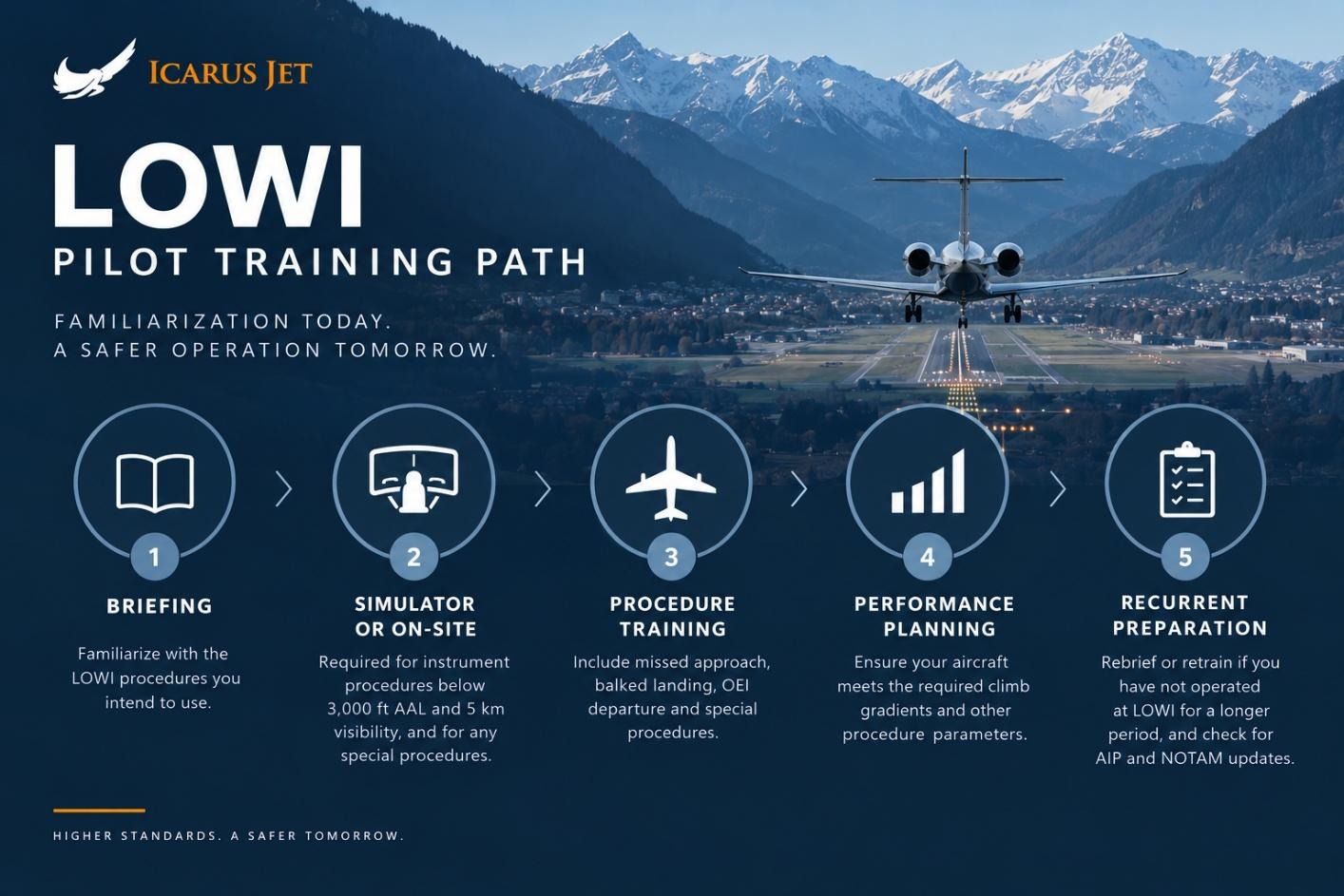
Pilot familiarization is mandatory at LOWI, but it does not mean that all pilots operating at LOWI will require the same simulator training.
According to Innsbruck Airport’s official Pilot Information, familiarization with the procedures intended to be used by means of adequate briefing materials is mandatory. The operator is responsible for preparing those materials for commercial flights, and the pilot in command for non-commercial flights.
Concerning instrument procedures, the flight operation in VMC conditions on site or in an appropriate flight simulation training device, an FFS or FNPT II, is required before the first use of instrument approach procedures in the weather conditions with a ceiling less than 3,000 ft AAL and 5 km visibility. The requirement also applies to the approval of a special approach or departure procedure.
In the LOWI briefing, it is mentioned that basic procedures can be used initially without the simulator training after the required briefing, but with higher weather minimums of a ceiling of 3,000 ft AAL and 5 km visibility.
Special procedures, however, require simulator training to use any special approach or special departure procedure.
Therefore, the first question is which procedures the crew will use. Based on that, the appropriate familiarization, training, and authorization requirements can be determined.
What should LOWI familiarization cover?
The LOWI briefing defines specific pilot familiarization and training cases.
These cases include the Runway 26 takeoff with engine failure after V1 and the LOC/DME East or Special LOC/DME East approach, followed by a missed approach from the lowest MDA.
The material also covers the same approach followed by a right-hand circuit and landing on Runway 08, the Runway 26 departure on the MOGTI 1R SID, which involves the engine-failure procedure, and the RNP Y Runway 08 approach, followed by a balked landing using the Runway 08 engine-failure procedure.
The briefing also requires including the contingency and balked-landing procedures in the pilot briefing.
Thus, LOWI familiarization includes more than just the normal approach and landing procedures. The procedures to follow when the approach/landing/departure fails are also explicitly mentioned.
Understanding the single-engine missed approach
The single-engine case is one of the most important parts of the LOWI preparation. At the same time, pilots should distinguish several scenarios.
The documentation includes separate descriptions of published missed approaches, balked landings, and engine-failure procedures. They are not interchangeable.
For the standard LOC/DME Runway 26 approach, the briefing defines the lowest MDA of 3,300 ft QNH and a 5% missed-approach climb gradient.
If you have not established visual reference at the missed-approach point, the procedure includes maintaining the localizer and making a left turn, subject to specific speed and bank-angle limitations.
Another example is the RNP E Runway 26 approach. The briefing mentions a lowest MDA of 3,300 ft QNH with a 7% missed-approach climb gradient.
The LOWI briefing does not include a universal missed-approach climb gradient for all procedures at Innsbruck Airport.
Missed approach and balked landing are different scenarios
The issue becomes especially important when the aircraft continues past the MDA.
For Runway 26, the LOWI briefing defines the possibility of a balked landing depending on the aircraft’s navigation capability. In case of sufficient RNAV capability, the route along the Inn Valley is described as similar to or equal to the OEI takeoff procedure from Runway 26 or corresponding RNP routes, including the lower climb gradient of less than 3%.
The briefing specifically notes that the balked landing procedure normally does not require consideration of the OEI case. However, it mentions cases when the procedure can be used OEI after a go-around over the runway threshold, provided the performance requirements are met.
Thus, the missed approach from MDA, the balked landing after passing the MDA, and the engine-failure procedure are related aspects of the LOWI preparation, but they are not the same procedure.
Why Runway 26 requires detailed OEI planning
The engine-out scenario is also important for Runway 26 departure planning.
According to the briefing, high terrain exists near the airport and along the departure route, so meeting the required climb profile is important.
The proposed early-left-turn engine-failure procedure illustrates the performance aspects well. After engine failure, the aircraft must have enough climb performance to reach the minimum turning altitude at D3.3 west of OEV.
The briefing states that it normally requires lower takeoff mass to cope with an initial climb gradient of about 6%.
For higher takeoff mass, other options exist if weather conditions are sufficient and the aircraft and crew can use the appropriate RNP waypoints and track.
As in the previous example, the 6% figure refers only to the specific engine-failure procedure. It should not be considered as a universal requirement for all LOWI departures.
Runway 08 has its own engine-out considerations
The briefing mentions that Runway 08 is the main departure runway, especially in marginal weather conditions, unless the operator can use the appropriate MOGTI SID and adequate contingency procedure from Runway 26.
In certain Runway 08 departure conditions involving the low cloud layer, the briefing provides an OEI climb gradient of at least 4.8% for the multi-engine aircraft, along with the other appropriate visibility and cloud requirements.
The brief also provides a proposed Runway 08 engine-out procedure, including the defined tracks, turns, speed, and bank-angle limitations.
Thus, the engine-out procedure has to be considered in the context of the actual departure.

Preparing for LOWI
LOWI preparation connects three components: the pilot, the aircraft, and the intended procedure.
The crew must determine which procedures to use and whether the appropriate familiarization, training, and authorization requirements have been met. Next, the briefing must include the relevant missed approach, balked landing, and engine-failure procedures, along with the aircraft’s current performance.
Finally, according to the LOWI briefing, pilots who do not operate at Innsbruck for a long period should be re-briefed or retrained in accordance with company/operator regulations.
Pilots must review the AIP and NOTAM changes. In addition, the Innsbruck Airport directs pilots to the AIP LOWI for detailed aeronautical information.
Thus, private jet pilots must consider that training is required for LOWI. The required preparation level depends on the procedures used, and the engine-out procedure is included.
FAQs
Is simulator training mandatory for every LOWI operation?
No. Familiarization is mandatory, but simulator requirements depend on the intended procedures and operating conditions.
Can a pilot operate into Innsbruck without simulator training?
The briefing allows initial use of basic procedures following the required briefing, with higher weather minimums of a 3,000 ft AAL ceiling and 5 km visibility.
Does LOWI have one missed-approach climb gradient?
No. The briefing specifies 5% for the standard LOC/DME Runway 26 procedure and 7% for the RNP E Runway 26 procedure.
Are missed approach and balked landing the same?
No. The LOWI briefing defines them separately and provides different procedures and performance requirements.
Why can takeoff mass matter on Runway 26?
For one proposed engine-failure procedure, a lower takeoff mass is normally required to cope with an initial climb gradient of about 6%.
What should pilots review before flying into LOWI?
The intended procedures, appropriate training and authorizations, aircraft performance, contingency procedures, and current AIP and NOTAM information.