
Flying Private Jets Across Africa: Every Country Is Its Own Operation
For private jet pilots, no single formula applies across Africa, where each country brings different permit requirements, timelines, authorities, and ground arrangements. Recent flights supported by our trip support team show why crews need to think beyond the departure and destination.
Reviewed by Kevin Singh, Founder · Fact-checked against Icarus Jet fleet and airport operations data · Last updated 21 September 2026
The guide
Africa may be one continent, but private jet crews cannot approach it as one operational environment.
Every border can introduce a new civil aviation authority, permit procedure, lead time, and method of coordinating an operation. With handling, fuel, catering, and passenger schedule changes, even a relatively simple flight can become complicated.
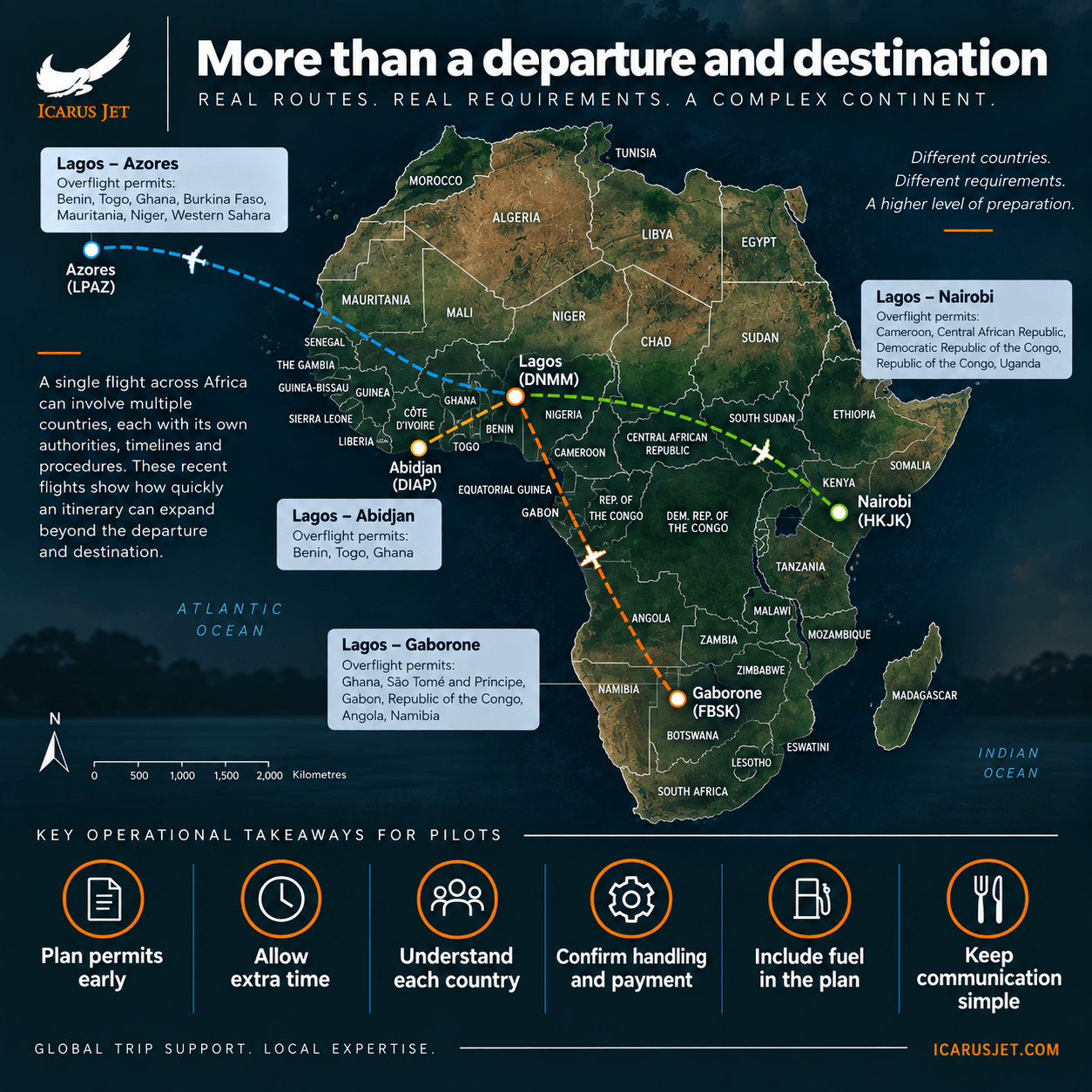
Take, for instance, the recently scheduled flight from Lagos (DNMM) to Gaborone (FBSK). The aircraft departed from Nigeria and landed in Botswana; yet the route passed over Ghana, São Tomé and Príncipe, Gabon, the Republic of the Congo, Angola and Namibia.
This mission clearly shows why pilots must consider an African itinerary country by country.
Every border can mean another permit process
One of the first aspects to be considered when building an African itinerary is overflight permission. The number of authorities involved can increase quickly, and the permit procedure in one country should never be assumed to apply to the next.
In one of our recent operations from Lagos to Nairobi (HKJK), we needed overflight permissions of Cameroon, the Central African Republic, the Democratic Republic of the Congo, the Republic of the Congo and Uganda.
Another flight from Lagos to the Azores (LPAZ) passed through the airspace of Benin, Togo, Ghana, Burkina Faso, Mauritania, Niger and Western Sahara.
Even shorter regional flights could include several authorities. For example, in case of Lagos to Abidjan (DIAP) overflight permission involved Benin, Togo and Ghana.
For pilots, the key point is not just how many permits to request, but how early they need to be considered.
Many African civil aviation authorities have limited availability outside regular working hours, especially during weekends and public holidays. Some permit requests might take about 72 hours of lead time.
This means that a Monday departure can cause the need for the start of the permit procedure well before the weekend. Considering only the planned departure date can give pilots an illusion of the real planning window.
An earlier departure can be harder than a delay
Business aviation schedules change. A meeting can finish earlier, passengers can want to change the departure time, or an overnight stay can become a same-day flight.
This possibility can become an obstacle when permits have already been issued.
The permit’s validity period can limit the options for changing a flight schedule. Thus, moving a flight earlier could sometimes be a more difficult task than a delay.
This fact is important for pilots because the readiness of the aircraft doesn’t always mean that the operation is ready.
When passengers suddenly decide to depart several hours earlier, the new scheduling could require checking the validity of the permit, airport arrangements, handling, fuel, and other services. In case of a flight passing through several jurisdictions, schedule changes could become a matter of coordination with multiple authorities.
Potential changes to the schedule should therefore be communicated as early as possible, not when the new ETD becomes definite. Even two extra hours of preparation can be valuable when several countries are involved.
Handling introduces another timeline
The differences between countries don’t end with overflight permits.
Ground handling introduces another element to consider when a request reaches an airport outside the handler’s normal business hours. Handling requests sent at night or over a weekend will not be answered immediately, as at other destinations.
Previous quotations should also be checked thoroughly. Even when the airport was recently used, the quotation may have been made for another aircraft. The requirements and handling charges can depend on the aircraft type and mission.
Another important point is payment. Depending on the handler and credit arrangements, it could become necessary to pay in advance. In some of our recent operations, the crew could pay directly by credit card as an alternative to the usual credit arrangement.
It sounds like an administrative detail, but this issue can eventually become operational if it remains unresolved close to departure time.
The key point for pilots is that they should not assume the arrangements that worked at the previous African airport would automatically work at the next one.
Fuel needs to be part of the plan
Furthermore, fuel is not just a service; it should be part of trip planning, not something requested only after landing.
It becomes especially important for multi-stop African itineraries or when passengers expect a short turnaround.
Pilots should let the handler know about the expected fuel uplift and turnaround requirements in advance in order to coordinate it with other ground services. The goal is to understand the situation before arriving at the destination.
As usual, schedule changes play a role here too.
If ETA or ETD changes significantly, pilots should not assume that the initial fuel arrangement will automatically change as well. Communicate revised schedules to arrange fuel availability and delivery.
For multi-sector itineraries, pilots should think about the next sector in advance. Requirements for fuel at the next stop should be known before the current sector departs.
Small schedule changes can have larger consequences
Catering gives a good example of how ETA or ETD changes can affect more than the permits.
During our recent African missions, caterers received requests at short notice. Increased direct communication between flight attendants and caterers allowed us to reduce the number of steps between the person specifying the requirements and the company providing them.
The principle extends beyond catering. In cases where the schedule is not fixed, handlers, fuel providers, caterers, and permit teams all need to work from the updated schedule. The more people involved, the higher the probability that one of them is working with an outdated ETD or ETA.
A two-hour passenger schedule change seems minor in the cabin. Operationally, however, it could affect the arrangements in several countries.
Think country by country
Perhaps the most useful mindset for pilots operating across Africa is to avoid carrying assumptions from one country into the next.
Lagos to Nairobi involves authorities of Central and Eastern Africa. Lagos to Gaborone introduces another chain of jurisdictions through West, Central and Southern Africa. Even the relatively short regional flight from Lagos to Abidjan includes several overflight permissions.
Every leg effectively resets the part of the planning process.
Before the departure, pilots should ensure that the complete itinerary, aircraft details, expected ETDs, possible schedule changes, turnaround requirements, fuel needs, handling and catering arrangements are all clear.
Above everything else, assumptions should not fly to the next country with the aircraft.
Understanding the differences between processes in different jurisdictions is essential to flying private jets in Africa.
Questions
Flying across Africa: questions the desk gets
Do all African countries use the same overflight permit procedure?
Not necessarily. Each country has its own civil aviation authority, procedures, working hours, and permit requirements. Thus, each jurisdiction along the route should be considered separately.
How much lead time should pilots leave for African overflight permits?
The requirements can differ by country, but some permit requests may need about 72 hours. Weekends, public holidays, and the working hours of CAAs can increase the planning time.
Can the overflight permit be changed on the day of the departure?
It could be possible, but pilots should not assume that a same-day revision will be accepted. Check the validity period and the authority’s procedures. Changing the departure time could be particularly difficult.
Why does a flight across Africa require so many permits?
Because a flight crosses the sovereign airspace of many countries. Our recent flight from Lagos to Gaborone required overflight coordination through six additional African jurisdictions before reaching Botswana.
Why should the fuel be arranged in advance?
Because it allows including fuel requirements in the ground plan, especially in case of short turnarounds. Significant changes to ETA or ETD should be communicated as well.
What should pilots prepare for an African mission?
The complete itinerary, aircraft details, expected ETDs, possible schedule changes, turnaround requirements, fuel needs, handling requirements, and catering requests should be established as early as possible.
Where this sits
The guides around this one
Get it filed
Flying across Africa? Filed from the desk
Send the dates, the aircraft and the stops. You get the permits filed, the routing checked against the current picture, handling confirmed, and a number you can hold us to.
Contact UsPrefer to talk? Call +1 888 277 7203 or email tripsupport@icarusjet.com. The desk is staffed 24/7.