Gulfstream G650 and G650ER Market Review: Inventory, Pricing and Transactions in 2026
The Gulfstream G650 remains firmly in seller's market territory, while rising G650ER inventory is creating a more balanced market for buyers. An analysis of aircraft availability, transactions, asking prices and values heading into 2027.
Market data and analysis by V1 Advisory · Published by Icarus Jet · Data as of October 2026
Market analysis
Of 596 G650 and G650ER aircraft in service, 18 were publicly listed in October 2026, against 21 sales in the previous six months: about 5.1 months of supply. The G650 sits at 1.7 months and stays a seller's market; the G650ER sits at 6.9 months as listings rose from 2 to 16 this year. Average asking prices: $39.98 million (G650) and $49.65 million (G650ER).
The pre-owned Gulfstream G650 and G650ER markets are moving in two very different directions in the final months of 2026. Inventory of the original G650 keeps falling, G650ER inventory is starting to rise, and transaction volumes are declining across both types.
Publicly listed aircraft total 18 units against a combined fleet of 596 aircraft. Over the last six months, 21 transactions took place, which works out at about 5.1 months of supply.
That headline hides a structural difference between the two types. The G650 shows just 1.7 months of supply, against 6.9 months for the G650ER.
The distinction matters when evaluating acquisition timing, aircraft values and competition between individual aircraft. It also suggests that acquisition strategies should differ by type, especially on supply, price negotiation and the timing of the transaction.
Gulfstream G650 and G650ER market trends
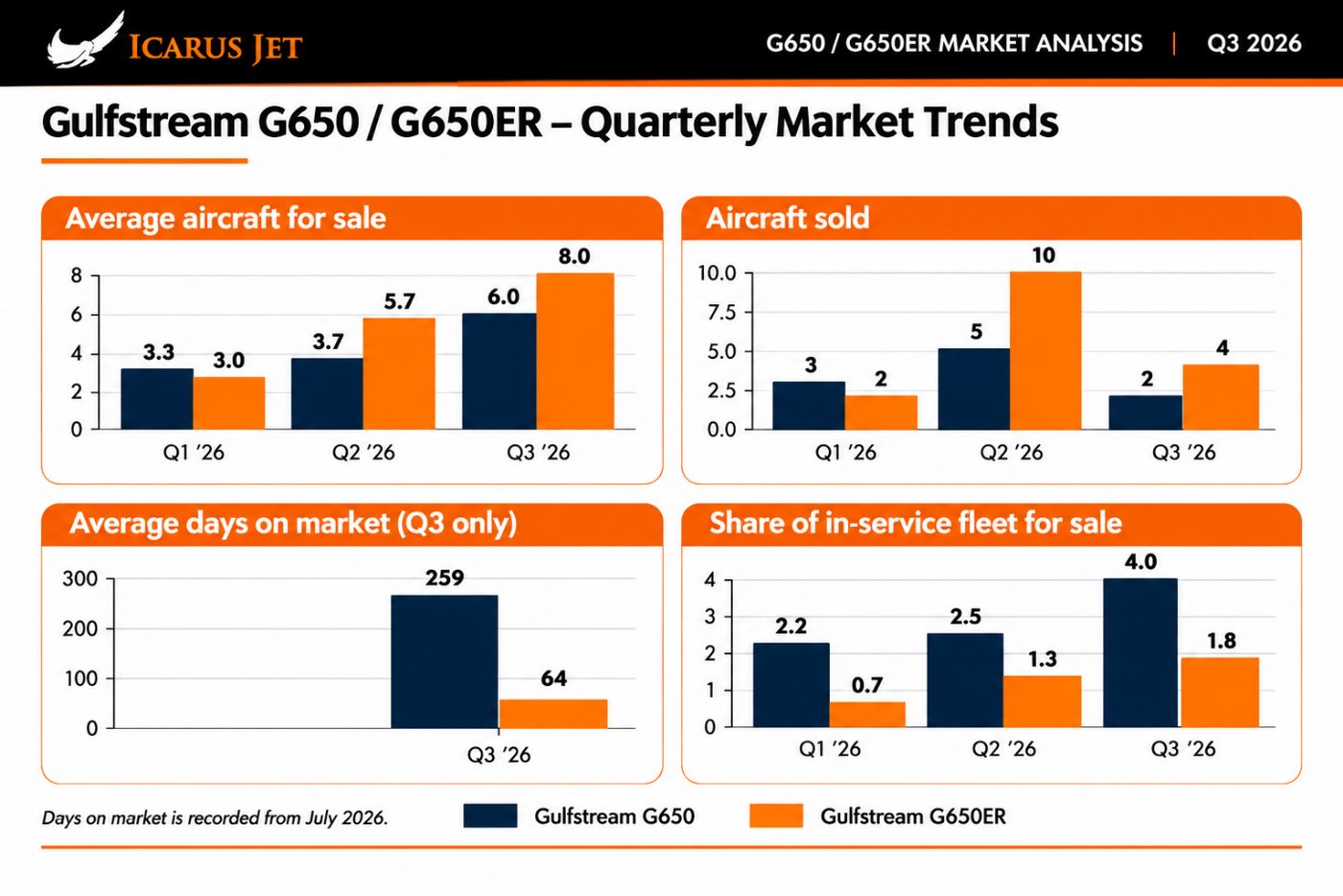
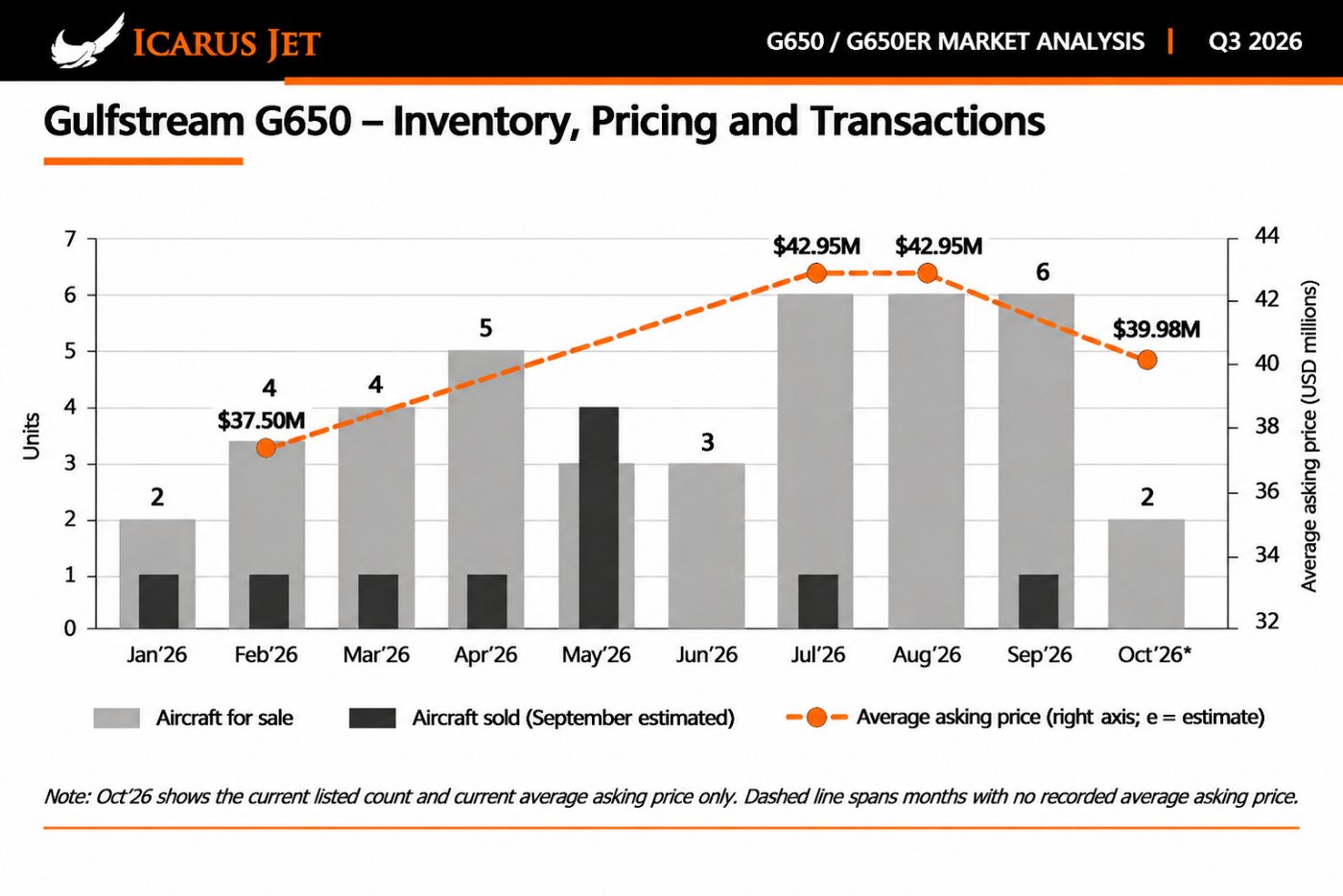
For the original G650, supply remains extremely low. Only two units were listed in October, down from six in September, and both are now reported to be under contract.
G650ER supply, by contrast, has expanded significantly. Listings grew from two units in January to 16 in October, and at least 12 remain actively for sale.
Transactions have slowed for both types. Seven G650s sold from April through September, against 13 in the previous six months. G650ER sales fell from 20 to 14 over the same periods.
Combined, that is 33 and then 21 sales over consecutive six-month periods.
This divergence matters most for the G650ER. As inventory grows, transactions are not keeping pace with the new supply.
What does this mean? For G650ER buyers, this creates an opportunity to compare more aircraft before committing to a purchase, potentially strengthening their negotiating position. For G650 buyers, limited public inventory makes identifying suitable aircraft and understanding off-market availability particularly important.
Current inventory and aircraft availability
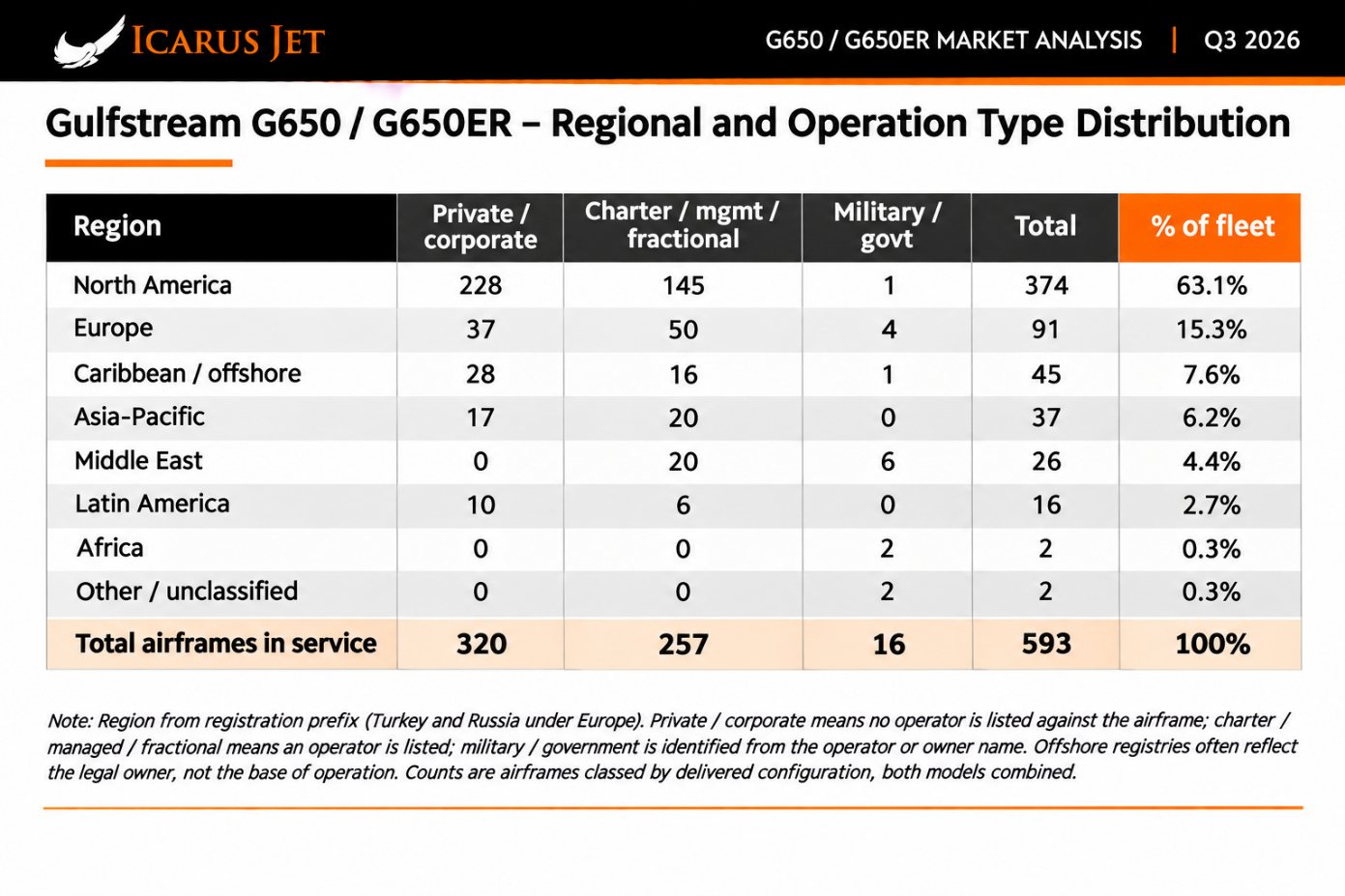
The two aircraft families total 596 units currently in service: 149 G650s and 447 G650ERs.
Overall, about 3 percent of the in-service fleet is listed for sale: 1.3 percent of G650s and 3.6 percent of G650ERs.
The listed aircraft themselves differ widely. The 16 aircraft captured in the October listings span model years 2014 to 2023. Reported airframe hours range from about 1,000 to 5,326 hours, averaging 2,867 hours per aircraft.
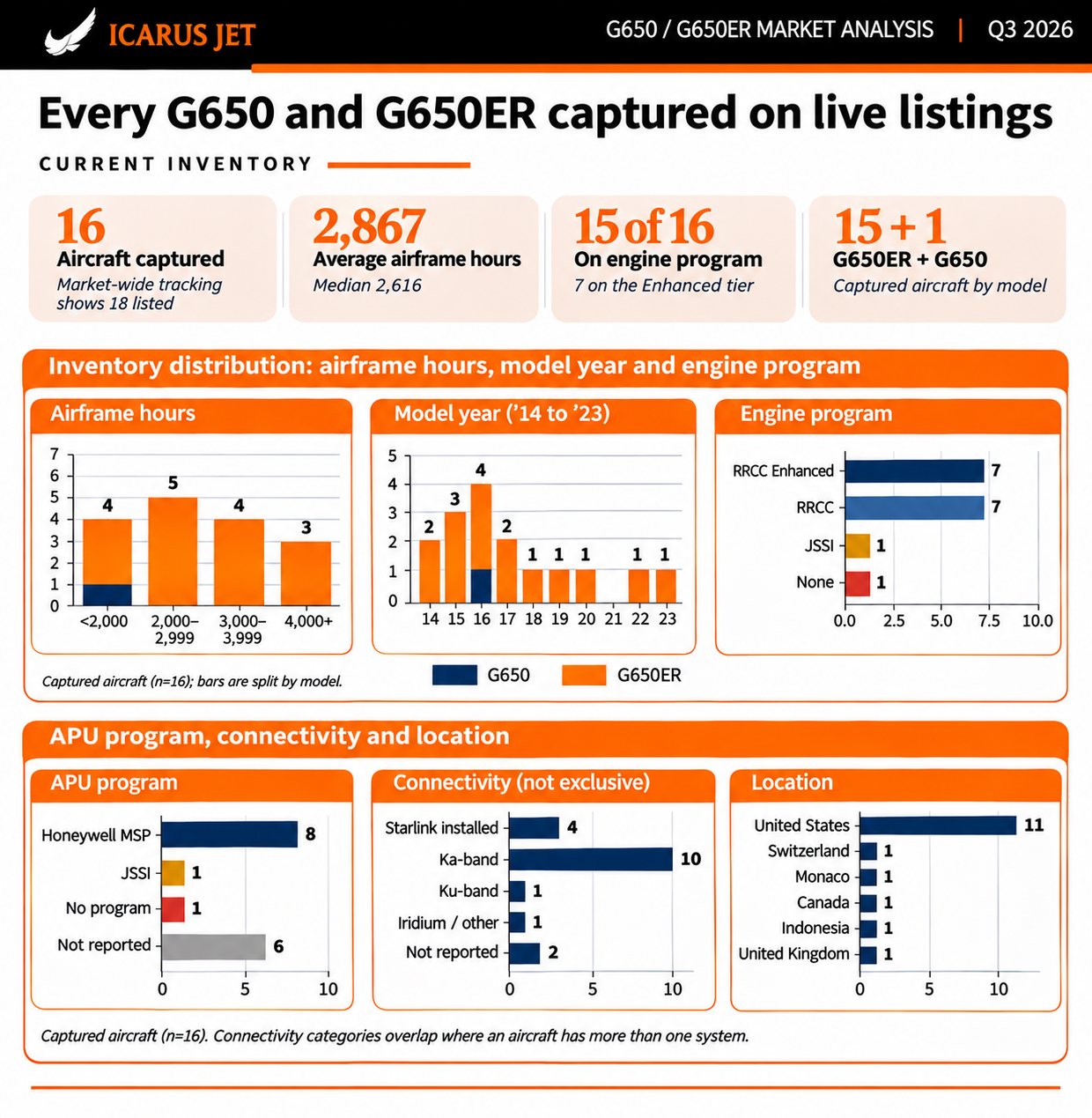
Engine maintenance programs add further variation: 15 of the 16 aircraft are enrolled on an engine program, seven of them on an enhanced tier.
Cabin equipment also varies. Four aircraft have Starlink satellite communications installed, one more was awaiting installation, and others had recently completed cabin refurbishments.
These differences matter because two aircraft of similar age can have very different maintenance needs, cabin equipment and operating costs. Buyers comparing two similar aircraft should not rely on asking price alone.
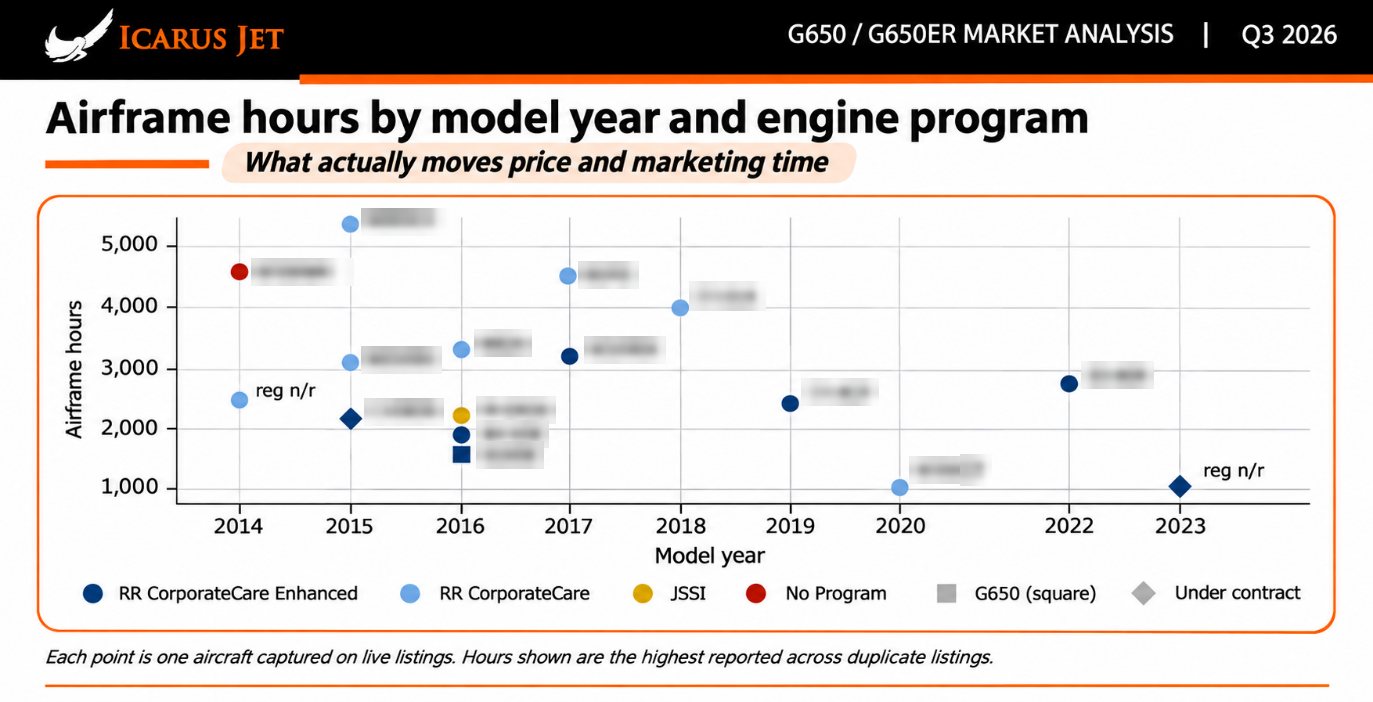
What does this mean? A lower asking price does not necessarily translate into a better acquisition. Buyers should consider the cost of upcoming maintenance, the transferability of engine program coverage and any necessary cabin or avionics upgrades when comparing available aircraft.
Recent sales and transaction activity
Transaction volume is an important indication of demand, although it has to be read alongside the number of aircraft available.
In the past twelve months, 54 sales closed: 20 G650s and 34 G650ERs.
Of the 21 transactions in the most recent six months, 12 were off-market sales: five of the seven G650 sales and seven of the 14 G650ER sales.
Off-market sales underline how limited public inventory is. Buyers looking for a G650 face a tight market and need a thorough understanding of privately marketed aircraft.
Transaction rates are falling. The average monthly G650 rate dropped about 46 percent, from 2.17 to 1.17 units a month.
The G650ER rate fell too, from 3.33 to 2.33 units a month. The 30 percent decline shows the market continuing to slow despite rising inventory.
The time needed to complete a sale also varies. Completed G650 transactions averaged 180 days on the market, against 88 days for completed G650ER transactions. Current G650 listings average 161 days on the market, against 58 days for G650ER listings.
Absorption rates give a different view of the same dynamics. Based on current supply, the G650 has 1.7 months of absorption and the G650ER 6.9 months. Neither figure determines how fast an individual aircraft will sell.
What does this mean? For buyers, these differences reinforce the importance of evaluating individual aircraft rather than relying exclusively on broader market averages. For sellers, understanding recent transaction activity and how competing aircraft are priced can help establish realistic expectations before entering the market.
Gulfstream G650 and G650ER asking prices
Prices remain reasonably stable amid lower transaction volumes. As of October, the G650 showed an average asking price of $39.98 million. Both listed aircraft carried an asking price, ranging from $35 million to $44.95 million.
The G650ER showed an average asking price of $49.65 million. Thirteen listed aircraft carried published asking prices, ranging from $42 million to $62.9 million.
That is a gap of about 24 percent between the two average asking prices. The gap reflects the specific aircraft on the market rather than an inherent difference in value between the two types.
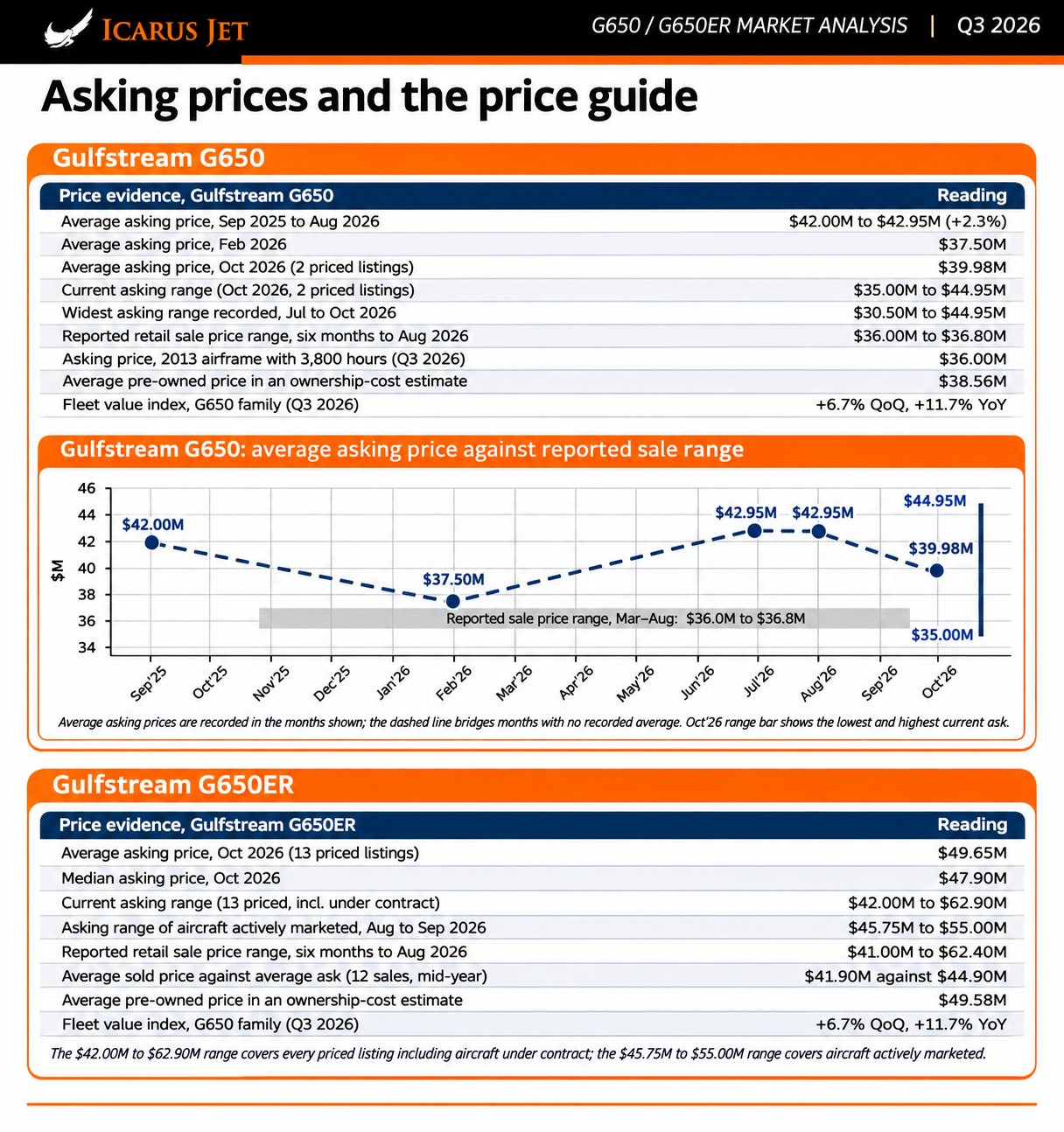
Reported transaction prices for the G650 ranged from $36 million to $36.8 million over the previous six months. G650ER transaction prices ranged from $41 million to $62.4 million.
A mid-year analysis found an average G650ER sale price of $41.9 million against an average asking price of $44.9 million. The 6.7 percent gap exists partly because the two figures refer to different sets of aircraft.
Estimates also suggest 8.3 percent growth in the retail value of a 2020 model year G650ER, from $48 million in the third quarter of 2025 to $52 million in the third quarter of 2026. Over the same period the fleet value index rose 11.7 percent.
The current slowdown is therefore showing up in transaction volumes, not in aircraft values. Price adjustments are tracking sales volumes and supply levels.
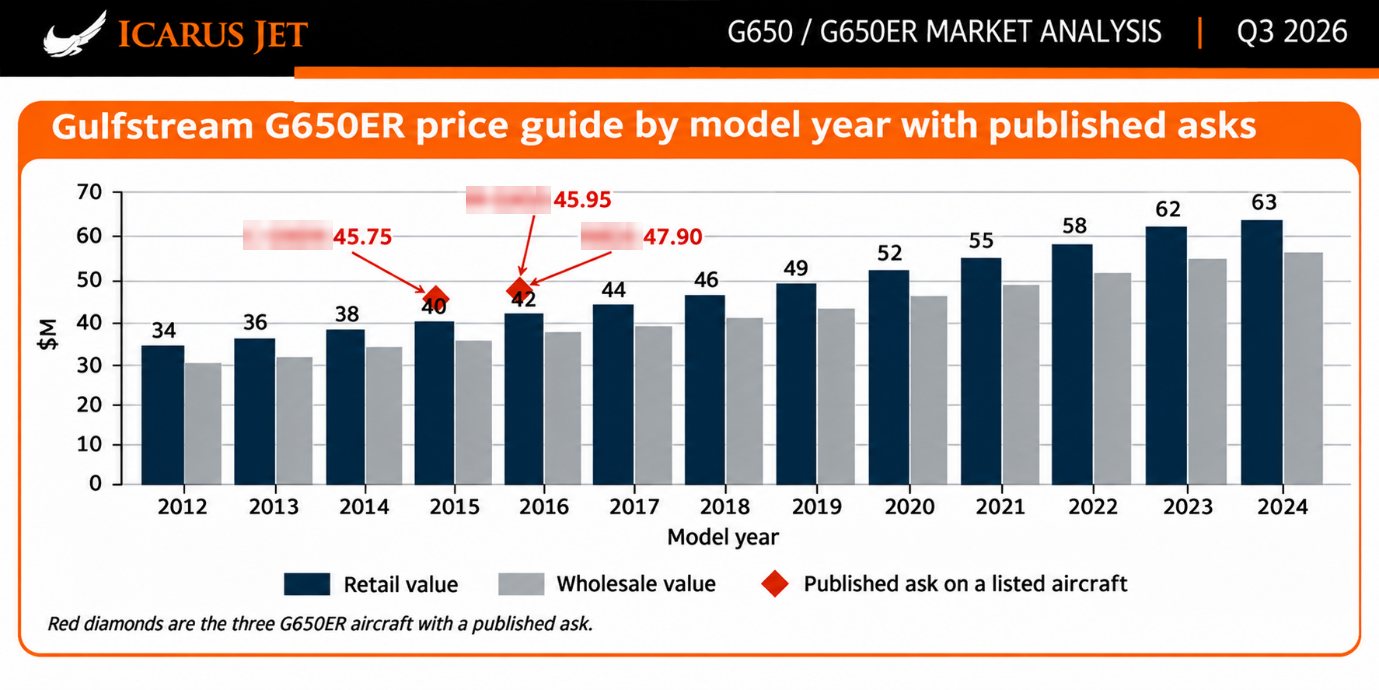
What does this mean? For prospective buyers, the distinction between asking prices and actual transaction values is particularly important. An aircraft's advertised price should be assessed against comparable sales, maintenance condition, model year and equipment rather than the market average alone.
G650 vs G650ER market positioning
Beyond values and inventory, buyers should weigh the operational differences between the two models. Maximum range is 7,000 nautical miles for the G650 and 7,500 nautical miles for the G650ER. The cabin, engines and avionics are the same.
The G650ER fleet is younger, with an average age of 7.2 years against 11.1 years for the G650.
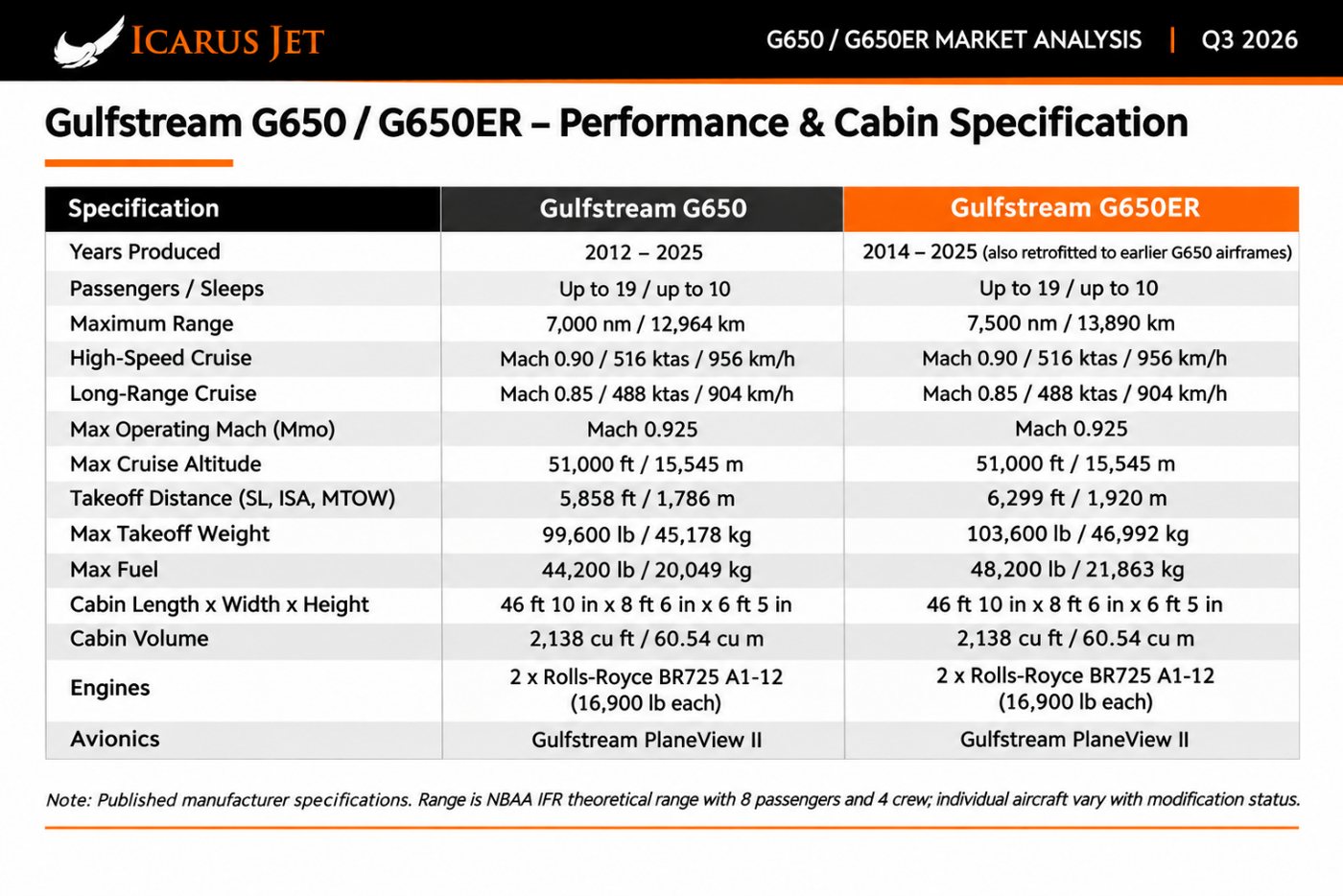
The choice becomes more involved once range is part of the decision. Buyers need to decide whether the extra range is needed for their typical missions, and weigh that against the difference in acquisition price.
Buyers should therefore start from their operational needs. The mission determines which type fits best.
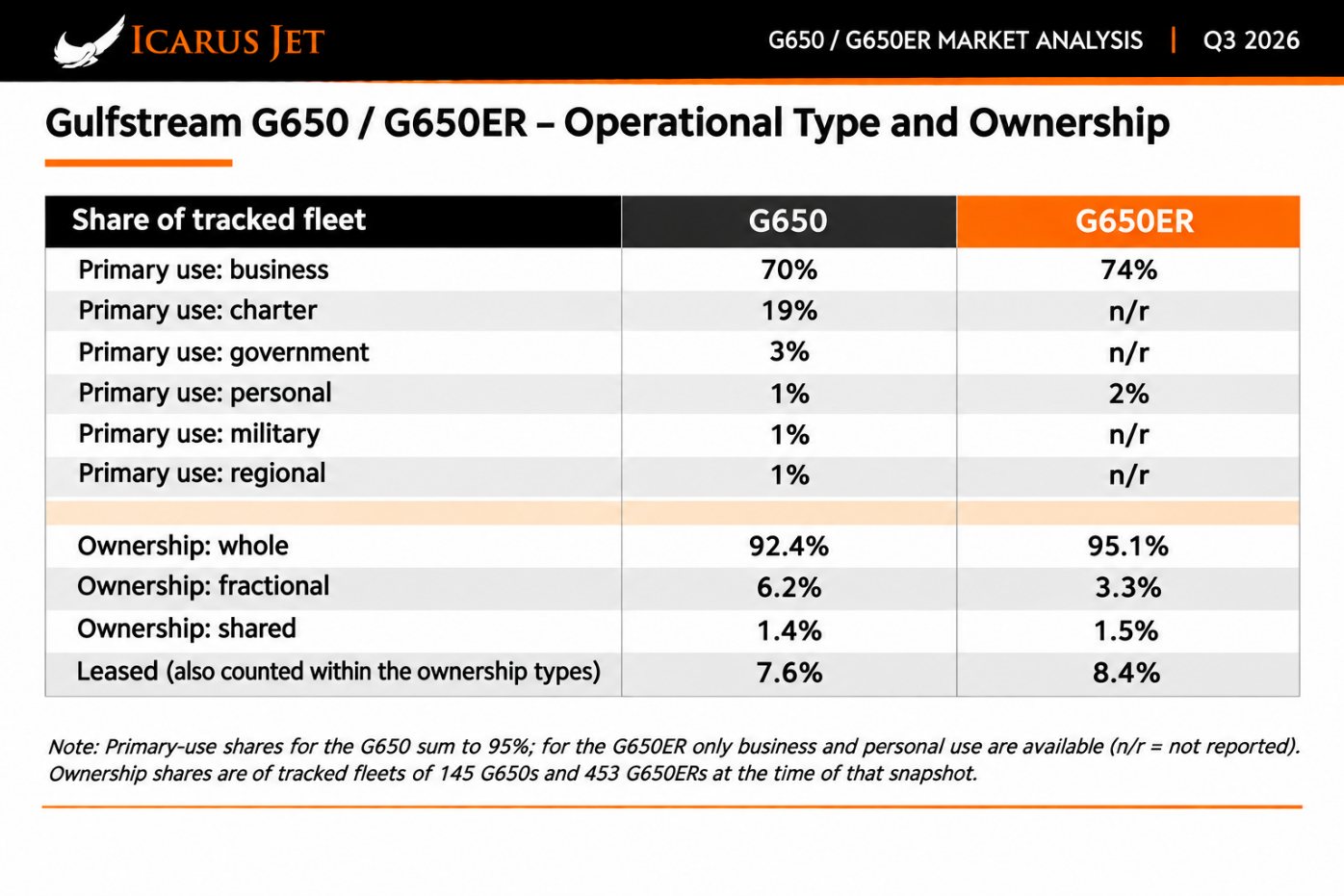
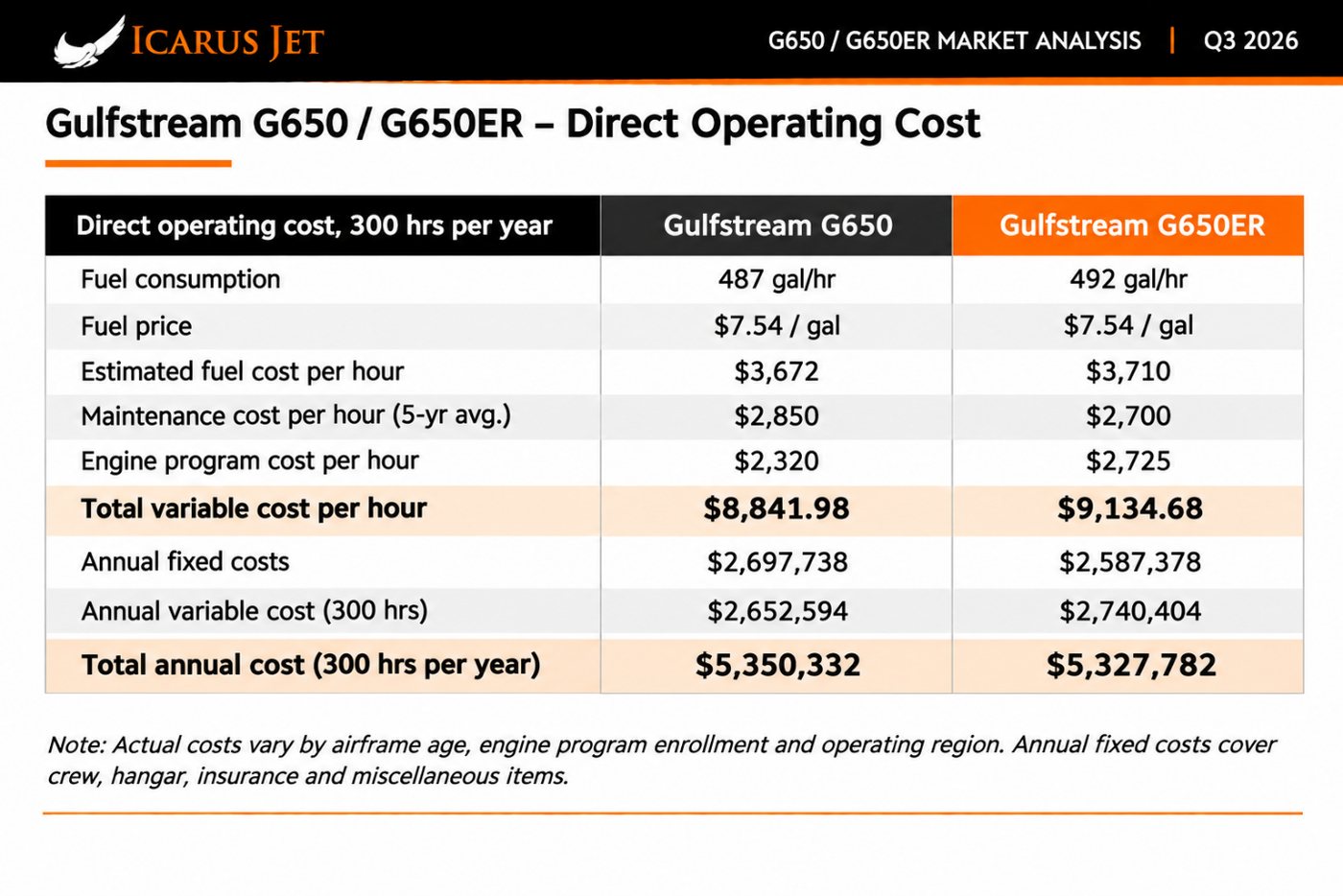
Ownership and operating cost estimates are similar for both types: about $5.35 million a year for the G650 and about $5.33 million for the G650ER, each assuming 300 flight hours a year.
Actual costs vary significantly with fuel prices, maintenance, crew salaries, hangar and other operating assumptions. Aircraft management arrangements also change the picture for owners.
Market outlook ahead of 2027
Inventory growth and transaction volumes will be the critical metrics for the market from here.
For the G650, pending transactions will drive the next sales. Two aircraft remain under contract, and further sales depend on new aircraft entering the market.
For the G650ER, the question is whether transaction volumes recover. If they stabilize around the recent average of 2.33 a month, inventory may settle near 6.9 months of supply.
New aircraft deliveries also affect both segments. New G700 and G800 delivery schedules reportedly extend to late 2028 and 2029.
Owners and prospective buyers considering either type should keep in mind how each metric shapes transactions. For now, supply is growing faster than transactions can absorb it.
Prospective G650ER buyers therefore have more flexibility thanks to larger inventory, while limited G650 availability continues to favor sellers and restrict buyers' options.
As the market moves toward 2027, inventory growth, actual transaction prices and the pace at which available aircraft are absorbed will remain the most important indicators for buyers and owners evaluating their next aircraft transaction. For the aircraft itself, see our Gulfstream G650 guide and the wider ultra-long-range jet comparison.
Disclosure and method
This report has been prepared by V1 Advisory from publicly available market data and referenced industry commentary on the Gulfstream G650 and G650ER and closely related large-cabin, ultra-long-range business jet peers, used for corroborating context only. Some values are V1 Advisory estimates, either interpolated between confirmed data points or modeled from typical large-cabin ownership and cost patterns, and are flagged accordingly. Values are for informational purposes only and do not constitute a formal appraisal or an offer to buy or sell.
Absorption rate is calculated as active listings divided by the average monthly transaction rate over the relevant period, and is intended as a directional liquidity indicator rather than a precise time-to-sale forecast for any individual aircraft.
Questions
G650 and G650ER market: common questions
Is the Gulfstream G650 market a buyer's or seller's market in 2026?
The original G650 is a seller's market, with about 1.7 months of supply and only two aircraft listed in October 2026, both reported under contract. The G650ER is more balanced, with about 6.9 months of supply and 16 aircraft listed in October.
What is the average asking price of a pre-owned G650 and G650ER?
As of October 2026, the average asking price was $39.98 million for the G650 (two listed aircraft, $35 million to $44.95 million) and $49.65 million for the G650ER (13 priced listings, $42 million to $62.9 million).
How many Gulfstream G650 and G650ER aircraft are in service?
About 596: 149 G650s and 447 G650ERs. About 3 percent of the combined fleet was listed for sale in October 2026.
What is the difference between the G650 and the G650ER?
Range. The G650 flies up to 7,000 nautical miles and the G650ER up to 7,500 nautical miles. The cabin, engines and avionics are the same. The G650ER fleet is also younger, at an average of 7.2 years against 11.1 years.
How much does a Gulfstream G650 cost to operate per year?
V1 Advisory estimates about $5.35 million a year for a G650 and about $5.33 million for a G650ER, assuming 300 flight hours a year. Actual costs vary with fuel, maintenance, crew, hangar and engine program enrollment.
How many G650s and G650ERs sold in the last year?
In the twelve months to October 2026, 54 sales closed: 20 G650s and 34 G650ERs. Of the 21 sales in the latest six months, 12 were off-market.
Where this sits
The guides around this one
Flying or managing a G650?
Charter, trip support and aircraft management for large-cabin jets, from a desk that works these aircraft every day.
Contact Us