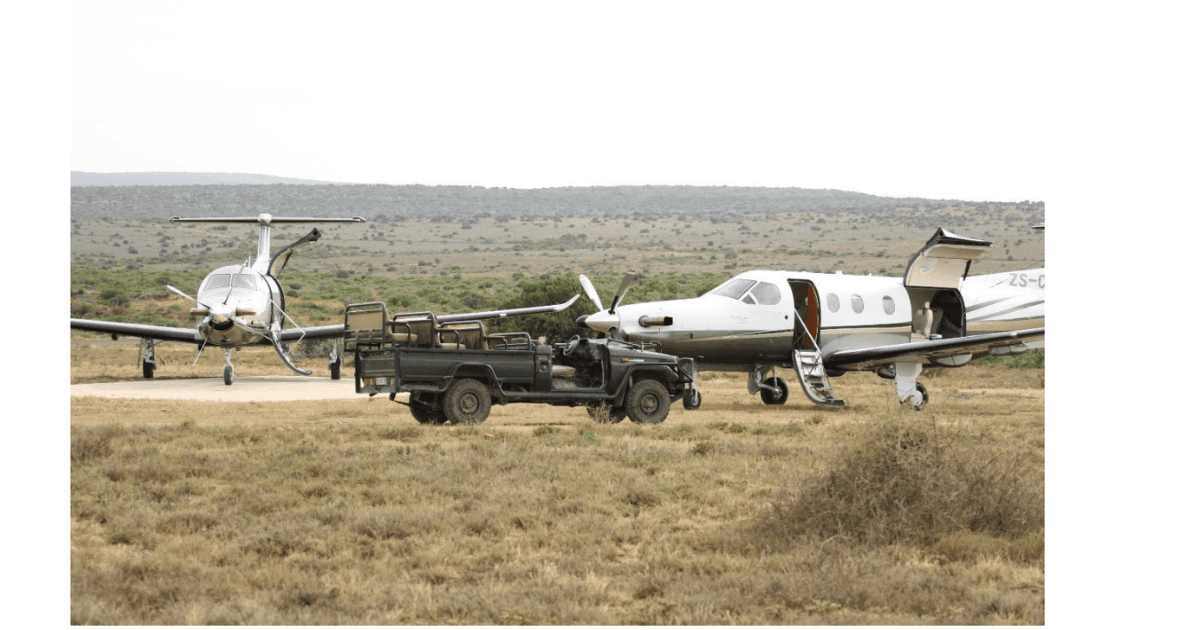
Photo: Pilatus PC-12 Centre Southern Africa
The way private aviation is used in Africa differs from that in Europe or America. In most cases, private jet charter is based on the concepts of time efficiency, convenience, or comfort. However, in Africa’s safari industry, it is more practical and fundamental.
The safari locations are, by nature, remote and intentionally not connected to any major infrastructure. They are in locations far from any major roads or airports. Reaching these locations can take several hours or even an entire day if done by land, directly influencing how a trip can be experienced.
Access defines the safari experience
The safari itinerary is rarely limited to one location. This is where access and logistics begin to play an important part in defining the travel experience. For starters, travelers arrive in Nairobi and then proceed to several destinations, including the Maasai Mara, the Serengeti, or private locations in both Kenya and Tanzania.
A private jet charter helps define this experience differently by eliminating several hours of transit. Flights can be shortened to under two hours. More importantly, it allows itineraries to be created with the safari as a priority rather than infrastructure. This, of course, does not always happen with scheduled flights or road transport.
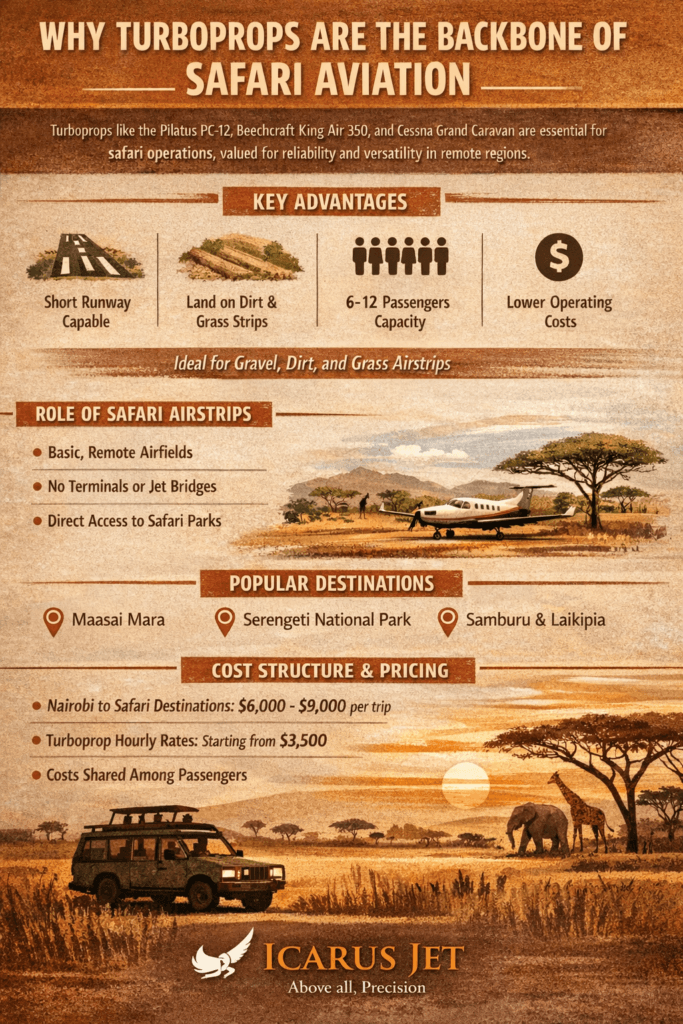
Why turboprops are the backbone of safari aviation
The aircraft used for safari aviation are not business jets, but well-suited turboprops for demanding operating conditions. The PC-12, Beechcraft King Air 350, and Cessna Grand Caravan are just a few of the turboprops that are common in safari aviation.
While their use might not be luxurious, their versatility is second to none, operating in a range of environments, making them a priority for safari aviation in East Africa.
First, the planes are well-suited for safari aviation because they can land on short runways with limited infrastructure. This means they can operate on dirt, grass, or gravel airstrips. They can also transport 6-12 passengers, depending on their configuration. Finally, they have lower operating costs than jet planes, making them a priority for safari aviation.
Furthermore, the airstrips used for safari aviation are not the same as those used for commercial aviation. While some of these airstrips might have a few amenities, they are typically simple strips of land located deep in the national park.
Despite their simplicity, these airstrips are highly effective within the safari environment, and this effectiveness stems from their strategic locations, which minimizes environmental impact while providing consistent access. This strategic placement allows the aircraft to drop off passengers just a few feet away from the area they want to discover.
The following are some of the places that are usually reached by these airstrips:
- Maasai Mara, Kenya
- Serengeti National Park, Tanzania
- Samburu and Laikipia regions
- Amboseli and Tsavo ecosystems
After arrival, passengers are picked up at the airstrips and taken to their lodge within minutes. This proximity removes the need for long secondary transfers and keeps the experience focused on the destination itself.
You might also like: Kenya’s Most Popular Private Jet Routes from Nairobi
Cost structure and what drives pricing
While the perception is shifting, private aviation in Africa is still often considered to be out of reach for most people. This may be true, but other factors also influence the cost of private flying. These factors are based on the aircraft type, the distance to be flown, the type of flight, and the number of passengers being carried. The structure of a safari experience makes private flying more accessible.
For instance, short regional flights, such as those from Nairobi to the coast or other safari destinations, range from $6,000 to $9,000, depending on the type of aircraft. The hourly cost of a turboprop aircraft starts at $3,500.
The following are some of the factors that influence the price:
- Aircraft type and passenger capacity
- Distance and flight time between destinations
- Number of stops within an itinerary
- Positioning of the aircraft before and after the flight
When costs are divided among several people, the overall price is much more reasonable. However, the value lies not only in the flight experience but also in the time saved and access to multiple remote locations.
Nairobi as the operational hub
Nairobi is a critical component in bringing international travel and safari operations in East Africa together. It acts as a hub, connecting international flights to regional charter flights to national parks and conservancies.
Jomo Kenyatta Airport and Wilson Airport are some of the airports that play a critical role in the operations of the safari ecosystem. Wilson Airport is a critical hub for regional aviation operations. A large number of turboprop aircraft operate from Wilson Airport to safari destinations across the country.
Private aircraft can fly to various locations across the country, including Tanzania, home of Mount Kilimanjaro. There is also demand from Nairobi to fly to Uganda, Rwanda, and even Zanzibar, providing critical connectivity for the regional safari industry.
Environmental considerations and operational limitations
Operating within a protected environment requires a specific approach. The fact that most safari destinations are within conservation areas means they are subject to regulations intended to protect the environment as much as possible.
This means most airstrips are operational only during the day. Noise is also an important consideration. In addition, other environmental factors could affect flight operations. These are not limitations but rather part of the environment, which shows that getting the right aircraft for the job and working with the right private charter partner paramount.
More than a means of transportation
Private aviation within the safari industry is not an added value to the experience but rather part of the infrastructure that makes this possible. This means that without private aviation, most of these places would be either inaccessible or much harder to reach.
It enables conservation areas to remain remote while still being connected to global travel networks. At the same time, it allows travelers to move efficiently between ecosystems without compromising the integrity of the experience.
In that sense, private charter aviation is not separate from the safari. It is integrated into how the safari is designed, planned, and ultimately experienced.
FAQs
What type of plane is most commonly used for safari flights?
Turboprops, such as the Pilatus PC-12, King Air 350, and Cessna Caravan, are most commonly used for short, unimproved airstrips and for transporting small groups.
Can private jets land in the safari parks?
Most business jets cannot land at these locations. Turboprops, however, are designed to land at or near these safari destinations, such as the Maasai Mara and Serengeti.
How much does a safari charter flight cost?
Costs vary by flight, but short flights within the region may cost between $6,000 and $9,000, while more complex flights may cost over $25,000.
Why not just drive to each safari location?
There are long distances to cover, and while driving is an option, flying saves time, which would take several hours by car, and reduce it to less than two.
Is a private charter just for large groups?
While private charters are often used by groups to split the cost, they are not limited to groups, and private charters may be available to individuals depending on the flight.