Private jet charter may seem simple at first glance. A passenger calls for a charter, a plane appears, and the flight is completed on schedule. However, beneath the surface lies a complex relationship between operators and brokers that influences every facet of the private aviation process, from safety and costs to availability and passenger expectations.
For the passenger, understanding the complex relationship between operators and brokers is not merely intellectual curiosity. It is essential to the overall quality of the passenger experience, the accuracy of cost estimates, and the feasibility of a private jet charter request.
The role of a broker versus an operator
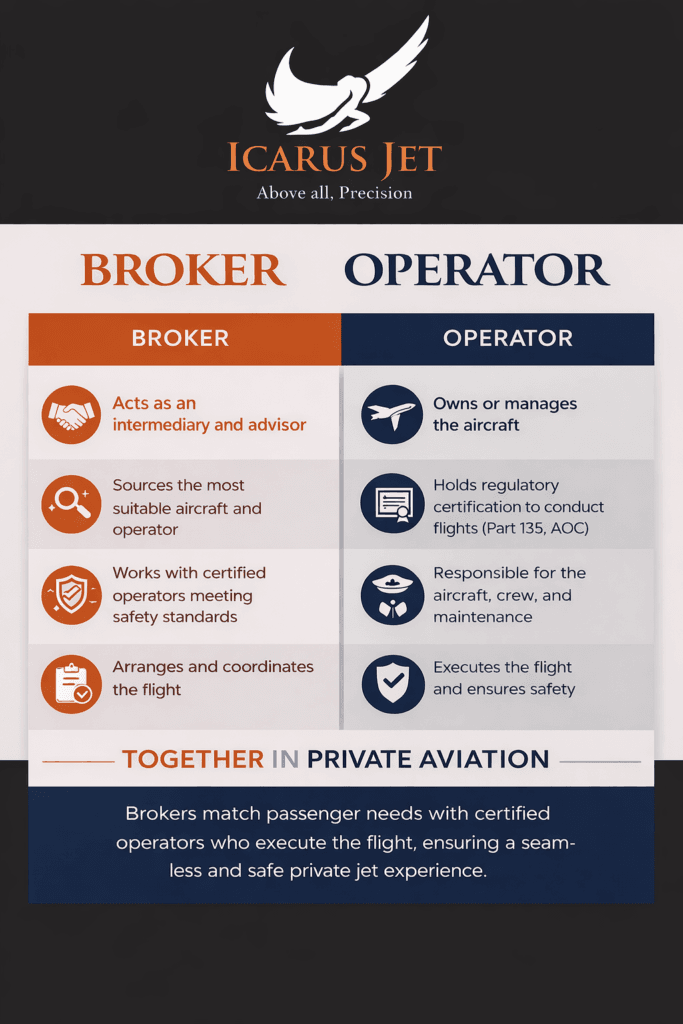
Private aviation is a process built on two fundamentally different roles.
The role of an operator is to own and/or operate an aircraft and possess the relevant and requisite certification for its operation. In the United States, this is a Part 135 certificate. In Europe, it is an AOC certificate.
The role of a broker is to act as an intermediary and an advisor and to find the most suitable aircraft and operator for a mission. While the broker does not operate the plane; it is the first point of contact for a private aviation passenger.
This distinction is significant, as it defines what constitutes accountability. A credible broker will only work with certified operators who meet safety, operational, and regulatory standards. The broker’s job is not to sell a jet, but to fill a mission with the right aircraft, crew, and operator.
How brokers select operators for each mission
Not all aircraft are suitable for a particular mission, despite their availability. Brokers will assess several variables before contacting operators to request a mission.
Variables include route distance, passenger count, airport infrastructure, runway length, weather conditions, baggage, and flexibility.
The brokers will then contact their network of operators who are capable of completing this mission.
This is where experience is key and working with a trustworthy charter team is paramount for the overall experience.
Furthermore, a good broker will not send a mission request to dozens of operators in the hope of getting a quote. Instead, they will send a mission request to those who are most operationally aligned with this mission.
The operators will then determine whether this flight is possible, while also determining crew duty times, aircraft availability, maintenance, and regulatory issues.
Once they determine whether this flight is possible, they will send a quote and determine their availability. This process is not always visible to passengers, but this is where most of the work takes place.
Why not every request is operator-worthy
One of the biggest misconceptions in private aviation is that not every mission request can be fulfilled.
Passengers will sometimes call in a flight with very little notice, unrealistic flight times, and/or aircraft types unsuited to this mission.
Sometimes airport restrictions, slot issues, and/or crew duty issues will make a mission unworkable.
Ultimately, it is the operator’s responsibility to ensure compliance and safety. Should the request not fit within these parameters, it will not be honored.
This is where the broker comes in. They take the request and refine it. They may recommend different departure times, aircraft types, and airports.
This can be frustrating for the customer. It is actually the broker’s way of ensuring the flight is both safe and feasible.
Cost transparency and fund allocation
One of the biggest misconceptions in the world of private aviation is the way costs work. Many people do not understand the role the broker plays in the cost.
One misconception is the fees charged by the broker. Many people assume the broker charges high fees. They do not. Typically, the broker's fees are 5 to 10 percent of the total cost.
The biggest cost factor is operator costs. These include:
- Aircraft costs, including fuel, maintenance reserves, and depreciation
- Crew costs, including salary, duty constraints, and overnight costs
- Airport costs, including landing fees, parking fees, and handling fees
- Navigation costs and overflight fees
- Catering costs, ground transportation, and other fees
Another cost factor is the positioning of flights. Should the plane need to fly to the destination empty, this cost is included in the overall cost.
A transparent broker will break this cost down and show the customer exactly what is included. It is not about negotiating the cost; it is about showing the customer exactly where the money is being allocated.
You might also like: How Private Jet Pricing Works: Hourly Rates, Positioning, and Fees Explained
The advisory role of a broker
The value of a broker is not limited to arranging the aircraft. Much of a broker’s value lies in the advisory role they play for the passenger throughout the entire process.
This starts at the quoting stage. Brokers can help passengers understand the trade-offs involved in different aircraft types, timing, and cost. For example, leaving a little earlier can save on positioning costs. Choosing a different airport can increase aircraft availability.
As the trip is being planned, brokers can work closely with the operators to manage slots, permits, handling, catering, and other requirements. Brokers can act as a single point of communication for all parties involved.
Finally, on the day of the trip, brokers should remain involved. If there are weather changes, delays, or other issues, the broker can work closely with the operator to resolve these.
What this means for the passengers is that they have a single point of contact who understands the request and the realities of the operation.
How operators guide passengers behind the scenes
The brokers are the ones who are in front of the passenger. However, operators play a significant role in shaping the passenger experience.
The operators must consider every aspect of the trip from a technical and legal perspective. They have to look at weight and balance, fuel, crew, and compliance with local aviation authorities.
The operators also play a role in the trip, though this is not necessarily visible to the passenger. For example, the operator can advise on changes to the departure time to avoid congestion, changes to the alternate airport in case of weather, and changes to the baggage load for performance considerations.
In many cases, they also affect service factors such as catering feasibility and cabin configuration.
This partnership between a broker and an operator guarantees not just a flight, but a flight done right.
Managing expectations in private aviation
Private aviation is a unique means of transportation, with many advantages but certain constraints. The relationship between a broker and an operator is designed to work through these limitations.
Passengers who are aware of these dynamics are better positioned to make informed decisions, and are more likely to have realistic expectations, unlike those who think they are getting a better deal than they are.
Rather than seeing brokers as salespeople, they are more like advisors who help interpret passenger needs in a manner that is viable for flight operations.
Final thoughts
The relationship between the broker and the operator is the lifeblood of the private aviation industry.
Brokers supply access, guidance, and coordination. Operators supply the aircraft, crew, and flight. Together, they control the entire passenger experience, from the initial request to the final landing.
This is important to the passengers because it helps them understand the process and the people involved. It can help them make informed decisions and ensure the best possible experience.
FAQs
What is the main difference between a broker and an operator?
A broker arranges the flight and finds the aircraft, while the operator has the aircraft and conducts the flight.
Do brokers charge high fees to charter the plane?
No, the broker does not charge high fees. Their fees are low, only a percentage of the entire cost.
Why can’t every flight request be honored exactly as requested?
Due to constraints, the request may not be possible. These constraints include crew duty restrictions, airport restrictions, aircraft performance, and regulatory requirements.
How do the brokers select the operator to work with for the flight?
Brokers compare the requirements with the operators to determine which operator is best suited to fly the route.
Who is responsible if something goes wrong during the flight?
The operator is responsible for the execution and safety of the flight, while the broker remains involved in coordination and communication to help resolve issues.