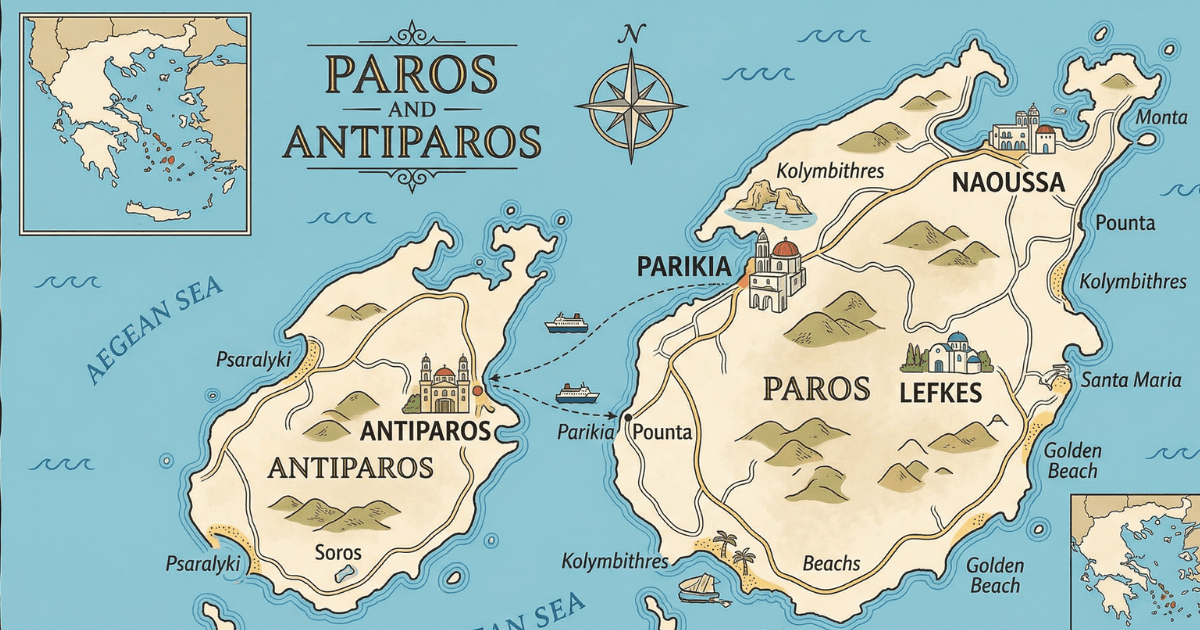
Despite the well-known popularity of Mykonos, Paros & Antiparos remain popular destinations among private aviation clients. Demand has grown steadily; however, access to both locations requires some careful pre-planning and understanding of limitations.
For starters, neither of the islands is set up for the direct international arrival of private aircraft. Arrival will require a combination of flight paths, realistic planning, and, in most cases, a secondary transfer.
Why Paros is not a direct international arrival point
Paros Airport (LGPA) operates with clear limitations that directly affect private aviation traffic.
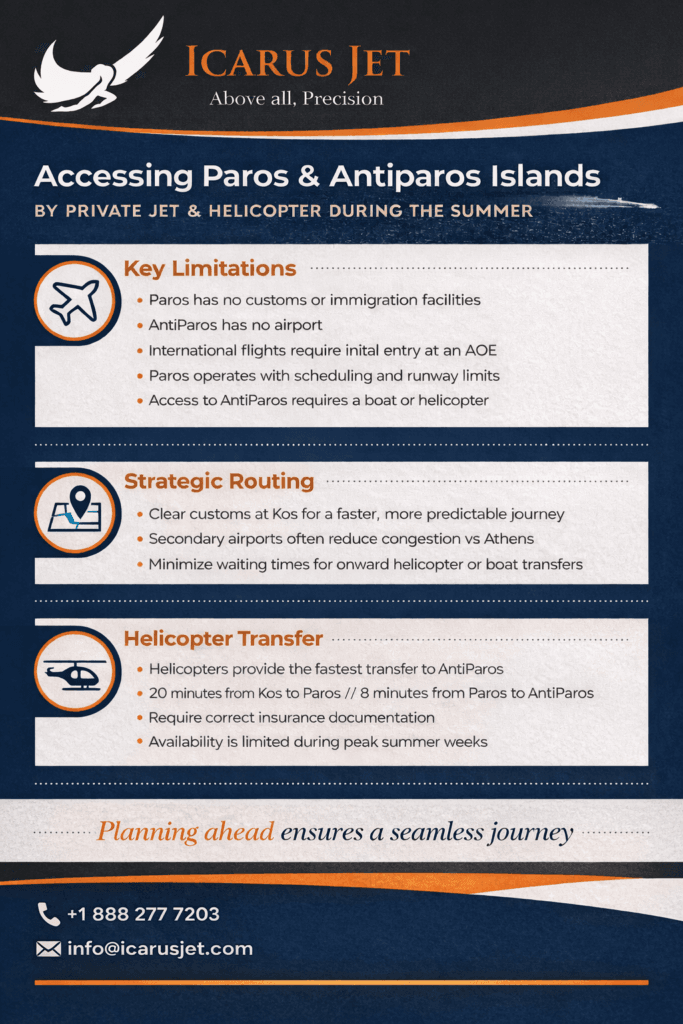
First, there are no customs and immigration facilities available in Paros (LGPA). This means that you can’t simply book an international flight to your desired destination and land at LGPA. In other words, any international flight must go through another approved airport first before continuing domestically.
Paros Airport does permits landings only if both the departure and destination countries are EU and Schengen members. As you can understand, this will affect planning for many private jet routes into Greece.
As far as airport infrastructure is concerned, there are no dedicated facilities for private aviation in Paros. All passengers will be transferred through the regular commercial terminal, which may raise privacy concerns. Additionally, Paros Airport has limited ground-handling resources during peak seasons.
Antiparos: a destination without an airport
Antiparos is one of those islands that does not have an airport. For private jet passengers, this means the journey does not end upon landing in Paros. A second transfer is always required.
From an operational perspective, it will either require a helicopter charter transfer or a boat ride. While boats are relatively inexpensive and easily accessible, they take significantly more time and are subject to variables such as congestion and weather conditions.
Helicopters provide a more controlled option, especially for clients with tight schedules or a preference for direct villa access.
Rethinking the traditional route through Athens
Traditionally, Athens was the default destination for accessing private jet passengers to the Greek Isles and other popular locations in the region. While there is nothing wrong with it during regular periods, it becomes problematic during the summer.
For passengers continuing to Paros, this often results in additional waiting time or missed connections.
An alternative approach is to clear customs at secondary airports such as Kos before continuing domestically.
This route offers practical advantages:
- Reduced congestion during customs clearance
- More flexible slot availability
- Lower risk of delays affecting the onward leg
- A more predictable connection into Paros or helicopter transfer
For itineraries coming from outside Europe, the approach would be more convenient as well.
Helicopters as part of the itinerary
Helicopters are a key element of the entire travel experience in the Cyclades.
In particular, helicopter transfers from Paros to Antiparos take no longer than 8 minutes. Additionally, from Athens or other locations in Greece, helicopters may be used to avoid congestion and provide clients with more direct access to their villas or accommodation.
It is important to note that the use of helicopters in Greece and surrounding countries, such as Turkey, is subject to certain requirements. Namely, operators must ensure that all relevant documents and insurance policies are in order before operating cross-border flights.
This is crucial during the peak season, as helicopter availability tends to drop then.
Pricing for helicopter and jet flights
Below are prices for accessing Paros and Antiparos during the summer season. These are based on a 4-seater helicopter (Robinson R66) and a light jet (Premier 1A) and should be used as a general guide when planning itineraries.
Helicopter pricing to Antiparos (Robinson R66)
Mykonos to Antiparos: USD 2,475
Santorini to Antiparos: USD 2,400
Athens to Antiparos: USD 3,950
Kos to Antiparos: USD 5,450
Patmos to Antiparos: USD 3,800
Helicopter pricing to Paros (Robinson R66)
Athens to Paros: USD 4,200
Santorini to Paros: USD 2,600
Mykonos to Paros: USD 2,775
Rhodes to Paros: USD 6,000
Private jet pricing to Paros (Premier 1A)
Athens to Paros: USD 9,980
Mykonos to Paros: USD 14,600
Santorini to Paros: USD 12,200
These figures will vary depending on aircraft availability, exact route, fuel costs, and peak summer demand. Helicopter pricing is particularly sensitive to availability during high season, making early booking important.
Operational realities to consider
Accessing Paros Island by private jet or other aircraft requires consideration of several factors.
- Airport status and handling procedures
Paros is not an Airport of Entry for international flights. As a result, all clients arriving on private planes will go through LGPA’s main terminal and follow regular procedures.
- Landing restrictions
As mentioned earlier, Paros Airport doesn't allow certain aircraft due to insufficient runway length. As a result, operators may have to modify the initial flight plan in order to deliver clients to their destination on time. This is also one of the reasons many itineraries include a secondary destination for customs clearance.
- Limited operating hours schedule
Generally speaking, during the peak summer, LGPA opens its gates for aircraft between 02:30 and 17:15 to 17:30 UTC. Exact times may differ each day depending on the number of operations.
Operating on a limited schedule and lacking flexibility requires taking them into account when designing itineraries.
- Limited ground support and handling capabilities
Ground handling services are available; however, there are no dedicated facilities for private aviation. This factor must also be considered while designing flight plans and setting up the client's expectations for ground operations.
- Boat vs. helicopter for the final transfer
The final segment from Paros to Antiparos typically comes down to a choice between boat and helicopter.
- Helicopter: the fastest and most predictable method.
- Boat: affordable and easy to arrange; however, it may add additional waiting times during the peak summer months.
For clients prioritizing efficiency and privacy, helicopters are generally the preferred solution during peak summer periods.
Planning in advance makes a difference
Getting to Paros or Antiparos Island by private jet isn’t complicated. It involves several steps and careful planning to ensure that clients enjoy their stay and the trip goes smoothly.
These include:
- Choosing the right airport for the customs clearance procedure
- Arranging slots and ground handling services beforehand
- Making sure that the aircraft will arrive in time for the helicopter pick-up
In a high-demand environment with limited infrastructure, these details define the experience as much as the destination itself.
FAQs
Is it possible to fly to Paros Island directly from outside Europe? Is Paros Airport ready for this type of operation?
No. Paros Airport is not equipped to handle the landing of private jets from outside the EU/Schengen Zone. Therefore, any international flight will have to go through another approved airport and continue domestically.
Which airports can I use to clear customs before connecting to Paros Island?
While the most commonly used option would be Athens, an alternative approach is to clear customs at secondary airports such as Kos before continuing domestically.
What kind of transportation will be needed in order to transfer between Paros and Antiparos?
Clients will have two options for accessing Antiparos: a helicopter transfer or a boat ride.
Are there special requirements for helicopter services within the region?
Yes. If a helicopter transfer is planned, it is important to arrange appropriate insurance documentation in advance.