
Private jet operations into China are now subject to ever more stringent landing permit requirements, especially in terms of aircraft documentation. Operators and crews need to be aware that the Civil Aviation Administration of China (CAAC) now demands that certain approvals be in place prior to any permit application even being made, a development that’s already delaying operations industry-wide.
The most notable change is that aircraft must be properly documented and approved by Chinese authorities at least five business days before filing any landing permit request. This step is now mandatory, and failure to do so in a timely manner has resulted in delays with missions, particularly for time-sensitive flights or those scheduled near weekends or public holidays.
Permit submission guidelines
Prior to this, most operators could apply for permits in parallel with the review of aircraft documentation. That is no longer possible. The Chinese authorities have tightened their procedure, mandating that comprehensive aircraft records are received, reviewed, and accepted prior to a landing permit request even being entertained.
This clearance must be submitted through a licensed trip support agent like Icarus Jet and takes a minimum of five full business days, Chinese holidays and weekends excluded. This timeframe resets if documentation is incomplete or not in the correct format.
What must be submitted
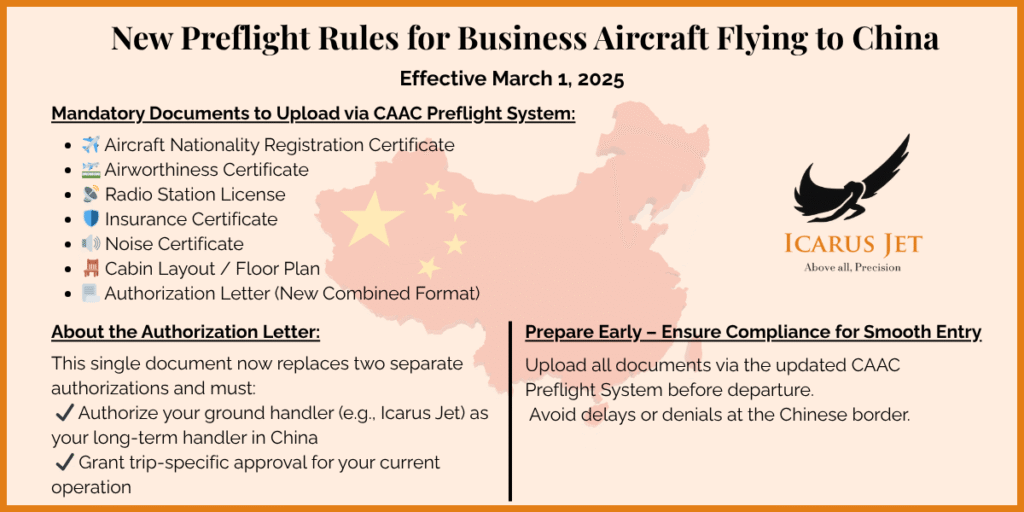
Effective March 1, 2025, all business aircraft operating to China must provide the following documents through the updated CAAC Preflight System:
- Aircraft Nationality Registration Certificate
- Airworthiness Certificate
- Radio Station License
- Insurance Certificate
- Noise Certificate
- Cabin Layout / Floor Plan
- Authorization Letter
The Authorization Letter combines two previously separate authorizations for the following specific purposes:
- Authorize your ground handler (e.g., Icarus Jet) as your long-term handling agent in China
- Provide trip-specific authorization for your upcoming operation
All documents must be valid, legible, and consistent. Minor discrepancies, like unmatched formats of aircraft registration or insurance expiry, will result in processing delays or outright rejection.
No exceptions for short notice or urgent missions
In the last few months, a number of operators have been refused or delayed entry due to poor aircraft documentation. Delays have affected:
- Business-critical flights
- Medical and air ambulance services
- Aircraft-on-ground (AOG) recovery missions
- Charter requests with short lead times
Even flights carrying diplomatic staff or emergency cargo have been delayed if the correct paperwork wasn’t filed and cleared well ahead of time. For crews, it means that there is essentially no way around it once within the five-business-day window.
Weekends and Chinese National Holidays
It’s worth mentioning that Chinese aviation authorities only process documentation and landing permits on weekdays, Monday to Friday, excluding public holidays. This creates serious planning challenges around busy travel periods such as:
- Chinese New Year (January-February, variable dates)
- Qingming Festival (April)
- Labor Day (May 1-5)
- Dragon Boat Festival (June)
- Mid-Autumn Festival (September)
- National Day (October 1-7)
At these times, timeframes tend to be longer, and capacity for processing is lowered. Operators need to allow for a minimum of two weeks’ worth of lead time for travel around a public holiday.
How Icarus Jet Trip Support can help
Icarus Jet offers end-to-end documentation and permit management for flights to and within China. We make sure your aircraft documents are filed in the proper format and well within the time frame necessary. We can assist with the following for a seamless operation into China:
- Inspect and verify all necessary aircraft documentation
- Identify and rectify errors or outdated documentation
- Coordinate filing and tracking with Chinese authorities
- Keep your plane’s status on record for upcoming operations
- Support with slot and parking allocation
Following approval of aircraft documentation, permit applications are typically processed in three to five business days – assuming airport slot availability and other requirements are met.
What impacts timelines?
Aside from aircraft documents, various other factors determine how fast permits are issued:
- Airport slot coordination: Airports such as Beijing Capital (ZBAA), Shanghai Pudong (ZSPD), and Shenzhen Bao’an (ZGSZ) need coordinated slots prior to the finalization of permit applications.
- Type of operation: Private and charter flights follow different approval routes, and charter operators typically must make further filings.
- Crew documentation: Crew medicals, passports, and licenses need to be up-to-date and properly formatted.
- Itinerary accuracy: Any routing change, aircraft replacement, or crew change may require resubmission.
- Delays in any of these aspects can add several days to the permit process, so early planning is necessary.
Tips for preventing delays
For ongoing seamless operations into China, Icarus Jet recommends:
- Get your aircraft paperwork registered long before you plan to travel
- Check expiry dates for insurance, crew licenses, and noise certificates
- File landing permit requests 7-10 business days ahead of time, particularly during holidays
- Utilize a reputable trip support services provider with experience in Chinese regulatory complexities
- Maintain a dedicated folder of pre-approved documents for quick deployment
For flights that have short lead times, having your aircraft already listed with Chinese authorities can be the difference between completing or not making a trip.
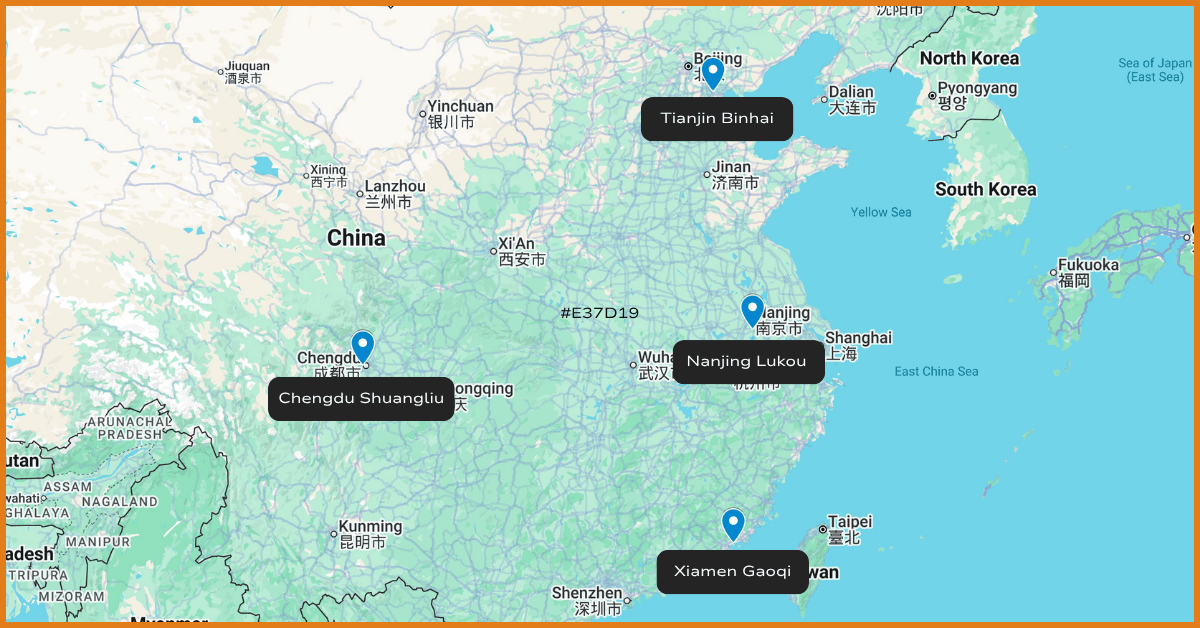
Secondary airports and alternative
While Tier 1 airports like Beijing, Shanghai, and Guangzhou often face congestion and stricter parking rules, alternative airports may offer more flexibility.
These include:
- ZBTJ – Tianjin Binhai (Beijing alternative)
- ZSAM – Xiamen Gaoqi (Guangzhou alternative)
- ZSNJ – Nanjing Lukou (Shanghai alternative)
- ZUUU – Chengdu Shuangliu (hub for westbound operations)
Parking area, slot availability, and customs clearance procedures vary from location to location, so consult with the Icarus Jet Trip Support team before choosing an airport.
Summary: Plan lead time in every mission to China
China remains a primary source of demand for private jet flights, ranging from corporate meetings in large cities to intercontinental charters throughout Asia. However, the regulatory landscape is much less tolerant today than it has been in the past.
Failing to prepare documentation in advance can delay, even derail, critical missions. The safest approach is to maintain active aircraft records in the system ahead of time. With proper planning and the right support team, China remains fully accessible for compliant operators. To assist with planning your next China mission, contact Icarus Jet Trip Support.
FAQs
How far in advance should I begin making preparations for a private jet flight to China?
Ideally, you should begin at least 10 business days ahead of time. Five days are required for approval of aircraft documentation, and an additional 3–5 days for processing of the landing permits. Take weekends and holidays into account.
Can I ask for a landing permit when my aircraft documents are still in the process?
No. The documents must be approved first. Landing permits will not be issued unless the aircraft has already been inspected and accepted by the relevant authorities.
What happens if a document is expired or not in the right format?
The whole submission is held up. That is to say, your documentation approval – and hence your landing permit – will be postponed until the corrected documents are submitted.
Is there any leeway for medical flights or urgent missions?
Not at the moment. Even essential missions have been postponed because of lack of or unapproved documents. That’s the reason it’s important to have aircraft documents on file well ahead of time.
Should my aircraft be re-registered for each flight to China?
Not always. After being approved, your aircraft can be kept in file for a specified amount of time, which allows you to more easily plan future flights. Changes to documentation, crew, or operator information can prompt a requirement for re-submission, though.