
ETOPS, Private Jets, and the Time in Jeopardy Myth
Private aviation is often compared to commercial airlines, especially when it comes to long-range flying over oceans or remote regions. One of the most common assumptions is that private jets operate under the same ETOPS framework as airlines. This belief is widespread among passengers and even within parts of the industry, yet it does not reflect how private jet operations are actually regulated.
Reviewed by Kevin Singh, Founder · Fact-checked against Icarus Jet fleet and airport operations data · Last updated 10 September 2026
The guide
No Global, Gulfstream or Falcon is ETOPS certified; business jets plan to a 180-minute time in jeopardy limit. Part 91 flights are not bound by it, but Part 135 beyond 180 minutes needs formal ETOPS approval. Arcs come from AFM single-engine data, such as 342 KTAS for a Global 6500 at 85,000 lbs, ISA and 27,000 ft. Atlantic crossings lean on Gander, Keflavik and Shannon, and KVNY to Brisbane routes via Hilo and Nadi.
Private aircraft, which operate under Part 135, are often assumed to be ETOPS (Extended-range Twin-engine Operational Performance Standards) certified. It’s easy to understand why this myth continues. The airlines tout ETOPS approval as a benchmark of reliability on lengthy oceanic or polar flights, and passengers naturally assume that private airplanes must be in the same position. The situation is more nuanced.
The reality is straightforward: there are no ETOPS-certified private flights. No Bombardier Global, Gulfstream, or Dassault Falcon is ETOPS certified. What these airplanes have instead is a concept known as “time in jeopardy”: the maximum number of minutes a jet can be from a suitable diversion airport should it experience an engine failure or other crisis. For business jets, that figure stands at 180 minutes. Any farther than that, the operator would require full ETOPS certification, which no business aircraft currently has.
Why private jets are not ETOPS-certified
The reason is not simply regulatory necessity; it is founded on cost, infrastructure, and operational reality. ETOPS certification requires far more than paperwork alone. It requires a maintenance program committed to it, for dedicated training cycles, and for inventorying additional spare parts in strategic locations worldwide. Airlines such as the Boeing 787, 757, or 767 fleets do so because their long-haul flights demand it, and because their volume of operations justifies the investment.
Private planes, on the other hand, would be economically burdened by such requirements. For an operator with a limited number of long-range planes, the added cycles, checks, and training would make ETOPS certification economically unviable. The private use and charter business model just does not scale to the economics that the airlines enjoy.
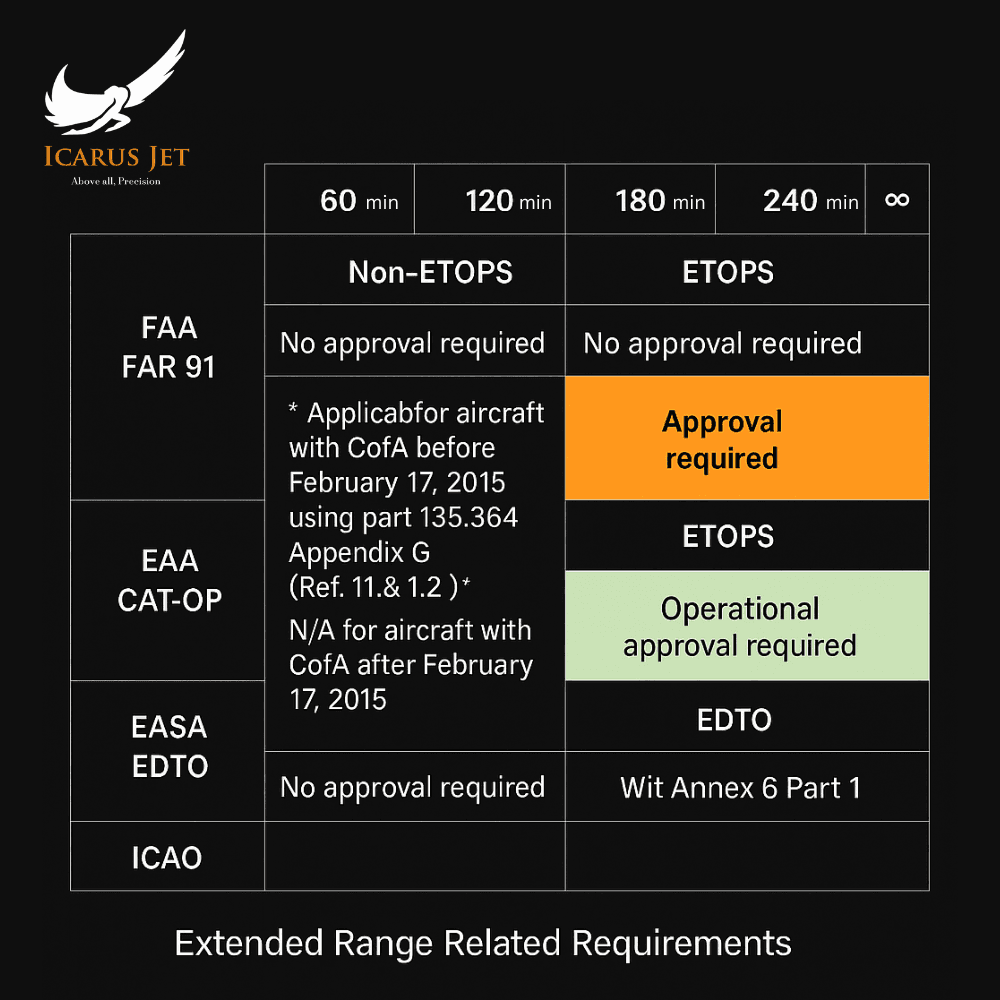
This is also where Part 91 vs. Part 135 makes a difference. Under Part 91 (private, non-commercial operations), none of this applies, with the operator only risking the life of the owner and their aircraft. Under Part 135 (commercial charter), however, the picture changes. By holding themselves out to the public – “pay me money for point A to B service” – operators must comply with rules that protect passenger safety. For Part 135 operations, staying within 180 minutes of a diversion airport means NOT ETOPS; more than 180 minutes requires formal ETOPS operational approval, including stricter maintenance tracking and limits on life-limited parts.
Consequently, private operators use the 180-minute rule. Pilots and flight dispatchers plan routes so that they are never more than three hours of single-engine cruise time from a diversion airport at any point. That is what makes the “time in jeopardy” so important: it is literally the outer limits of private jet flights over oceans, polar regions, or deserted areas.
It is crucial to note that the calculation of ETOPS applicability is separate from day-to-day operational planning. In order to determine whether ETOPS rules apply, the calculation must use data from a manufacturer-produced and FAA-approved documents (the Airplane Flight Manual). This includes single-engine performance, drift-down profiles, and realistic operating weights.
For example, on the Bombardier Global 6500, the Airplane Flight Manual specifies that at 85,000 lbs. gross weight, ISA (International Standard Atmosphere) temperature, and 27,000 ft, the single-engine cruise is 342 KTAS. With this number, operators calculate how far the jet can travel in 180 minutes, drawing circles to ensure no point of the route falls outside that arc. If the entire routing remains within the circles, then 135 ETOPS does not apply.
This same logic often comes into question when comparing different long-range aircraft types. In recent months, there has been increased discussion around the Dassault Falcon 8X and the Gulfstream G700, particularly in the context of ETOPS. The Falcon 8X, as a three-engine aircraft, is frequently perceived as having greater flexibility for overwater operations compared to twin-engine jets like the G700 or Global 6500.
However, from a regulatory and operational standpoint, the distinction is less significant than it may appear. Regardless of engine configuration, business jets operating under Part 135 are still bound by diversion planning requirements, and the 180-minute “time in jeopardy” framework continues to define how routes are constructed.
ICAO and EASA: The regulatory foundations
International standards support this philosophy. The International Civil Aviation Organization (ICAO) formally establishes extended-range operations for twin-engine aircraft, defining the program that airlines must satisfy to obtain ETOPS approvals. ICAO’s Annex 6 on Operation of Aircraft requires that extended diversions require extra consideration, not just in crew training, but also in maintenance and reliability data gathering.
The European Aviation Safety Agency (EASA) mirrors this in their specifications. EASA explicitly states that business jet operators under Part-NCC or Part-OPS are subject to diversion requirements and cannot fly more than 180 minutes from an adequate alternate.
Practically, it is the invisible network of arcs – pilots’ common mental images of “ETOPS circles” – which encompass each oceanic crossing.
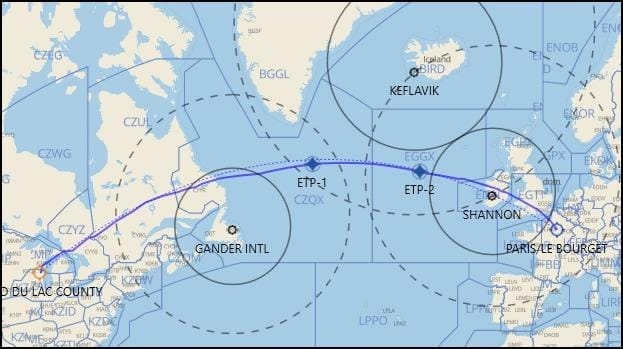
Image: ETOPS arcs for Atlantic crossings: CYQX (Gander), BIKF (Keflavik), EINN (Shannon).
These circles are real. They dictate what airports are usable alternates, what routes are flown and what routes are not. The charts that most dispatchers keep show precisely how the 180-minute arcs link Gander to Keflavik to Shannon across the North Atlantic. They are the lifeblood of long-range capability for business aviation.
The Atlantic reality
Take, for example, the familiar Atlantic crossing. A Gulfstream that leaves Teterboro or Van Nuys for Paris, Geneva, or London has to stay constrained to alternates like CYQX (Gander International), BIKF (Keflavik International), or EINN (Shannon International). These airports, which are frequently skipped by airlines equipped with ETOPS authorization, are a lifeline for private crews. They keep a single-engine diversion within range.
When I flew to Tivat, one captain remembered a winter crossing when intense headwinds were going to place the “time in jeopardy” beyond 180 minutes. The dispatch crew had to divert via Gander and Keflavik, adding a stop, fuel top-off, and hours to the flight. “The passengers couldn’t figure out why we couldn’t simply fly directly like the airlines,” he told me. “But that’s the rule – those circles are important.”
The Pacific and beyond
The Pacific crossing is even more dramatic in contrast. North American flights to Asia or Oceania highlight the dependence on diversion airports. A flight from Anchorage (PANC) to Sapporo (RJCC) threads the needle of appropriate alternates, barely avoiding Russian airspace where ETOPS provisions do not apply.
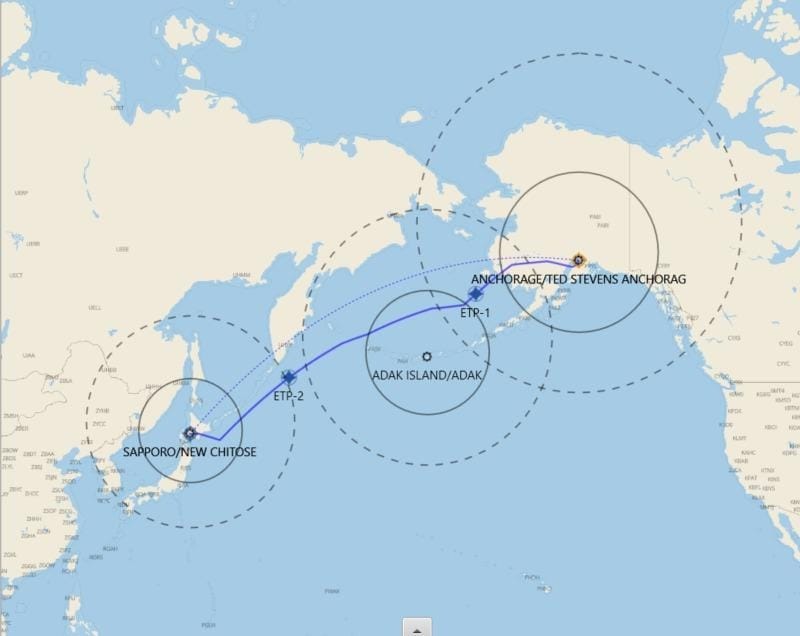
Image: Anchorage–Sapporo route via Adak Island, with ETOPS arcs showing diversion coverage.
On the flights from Van Nuys (KVNY) to Honolulu (PHNL), the 180-minute arcs dictate both the feasibility and safety of the flight.
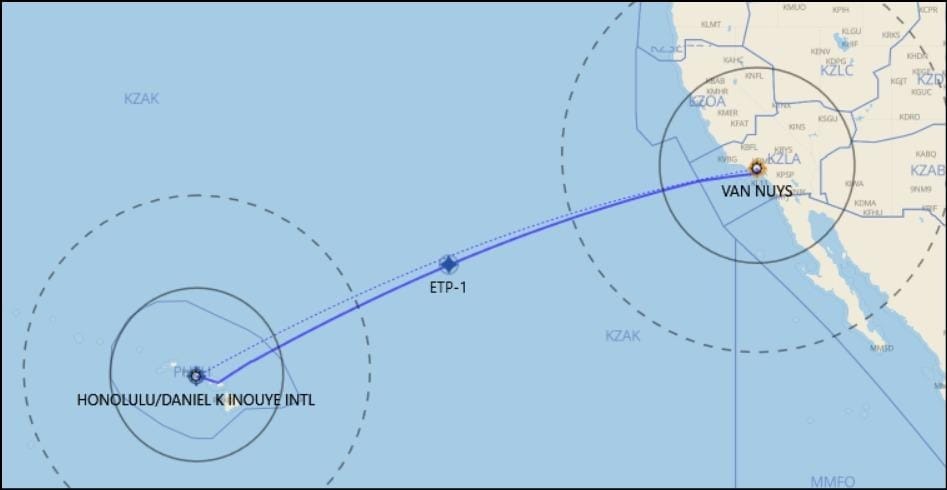
Image: Example KVNY-PHNL crossing showing 180-minute “time in jeopardy” compliance.
And for longer legs such as KVNY to Brisbane, operators must route through Hilo (PHTO) and Nadi (NFFN) before reaching YBBN (Brisbane International). These airports are not just points on a map; they are compliance lifelines that dictate the rhythm and viability of private jet intercontinental flights.
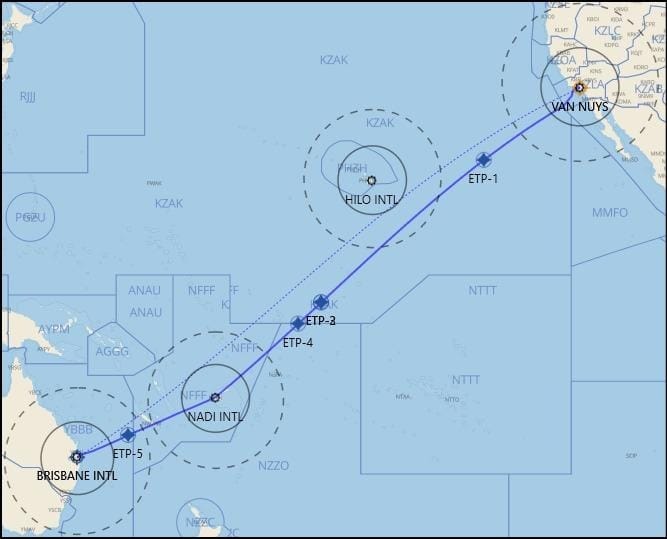
Image: KVNY–Brisbane via PHTO (Hilo), NFFN (Nadi), and YBBN (Brisbane), shaped by diversion availability.
These stops are inconvenient but are the measures that make private jet flights over the world’s largest oceans possible. Otherwise, these missions wouldn’t be feasible.
Bridging the knowledge gap
What took me by surprise at Tivat was not just that pilots occasionally disseminate the ETOPS myth, but that so many believe it. Business aviation training courses don’t tend to look into underlying regulatory distinctions in operational procedures. For captains who are used to simplifying complex technicalities for passengers, “ETOPS” is a handy shorthand – if technically flawed.
That is where education comes in. Pilots, operators, and passengers alike benefit from a higher level of knowledge regarding what regulates private jet flights. An industry point needs to be made: ETOPS is an airline requirement, not a private jet requirement. What we have is “time in jeopardy,” and adherence to that maximum is what maintains long-range business aviation both compliant and safe. This is what we educate crews and passengers at Icarus Jet.
This knowledge also extends into operational terminology used by dispatchers and regulators:
- LOE (Loss of One Engine): the baseline assumption behind diversion planning.
- DP AEO (Depressurization, All Engines Operating): planning for depressurization emergencies with both engines available.
- DP OEI (Depressurization, One Engine Inoperative): the worst-case scenario of structural failure plus engine loss.
- MED (Medical Emergency): dictates routing to ensure timely access to a suitable facility.
- PSR (Point Safe Return): the last point where you can return with 30 minutes of fuel overhead.
- PNR (Point of No Return): the point after which turning back is no longer possible.
Each of these factors can redefine the meaning of “time in jeopardy” in practice, even when staying within the 180-minute arc.
Training organizations, associations, and regulatory authorities have a role to play here. ICAO definitions and EASA operational requirements cannot be permitted to lurk in the pages of technical manuals. They need to become the everyday vocabulary of flight operations, of charter briefings, and even of client meetings.
When passengers ask why an extra fuel stop must be made, or why their flight bends north towards Keflavik instead of following a great circle across the ocean, the answer needs to be more than a cryptic reference to “ETOPS,” but an explanation of “time in jeopardy” and related operational considerations like LOE, MED, or PSR.
By bridging this knowledge gap, we not only comply but also foster more client-operator trust. Transparency in clarifying the 180-minute rule transforms a cause of frustration into comfort: travelers can see that their safety is not being compromised for convenience.
Looking ahead: The human factor
Will private jets ever receive ETOPS certification? In theory, yes. In practice, the hurdles are high. To gain ETOPS, a manufacturer would have to invest in more testing and certification, and operators would have to develop the maintenance and training infrastructure that the airlines already have in place. For a fleet of only a few dozen long-range airplanes, it’s a hard investment to make.
What we can expect to see is a clarification of how “time in jeopardy” is applied. As private aviation pushes into farther markets – Africa’s west coast, the South Pacific, or polar flights – the need to exceed the 180-minute model will grow. Regulators can be pushed to alter existing standards, but until then, the line is drawn.
Back in that Tivat morning, the conversation between the two captains’ cuts to the chase. One pilot offered that ETOPS is a marketing term, a way of reassuring clients. The other corrected him, and said the truth is not so straightforward, and transparency trumps reassurance. Their exchange suggests the balance that private aviation must find reassuring passengers and being true to the operational nuances that keep them safe.
This is not simply a regulatory issue, but a human one. Pilots, dispatchers, and operators have to make judgment calls in life’s most inhospitable environments on Earth. Whether the icy North Atlantic, the wide Pacific, or the desolate polar routes, the “time in jeopardy” rule is not a hindrance, but a lifeline.
Conclusion
What regulates those flights is the 180-minute “time in jeopardy” rule, which is mandated by ICAO, EASA, and national authorities around the globe. It’s not a number, it’s the unseen halo around each flight, the safety net that keeps crews and passengers always within range of safe landing.
Sitting with those two captains in Tivat, it was clear that the ETOPS myth persists within private aviation because it is convenient. Convenience, though, cannot replace clarity. The task for private jet pilots is to embrace the reality of our operating world, to inform passengers accurately, and to navigate the skies not with myths, but with the precision and honesty that are the profession’s hallmarks.
Questions
ETOPS, Private Jets, and the Time in Jeopardy Myth: questions the desk gets
Flying this route or region? Icarus Jet provides 24/7 trip support, flight planning, flight permits for private jet operators worldwide.
For how oceanic crossings and their fuel stops have changed since 2005, written from the flight deck, see the paradigm shift in tech stops for Atlantic crossings.
What is ETOPS in aviation?
ETOPS stands for Extended-range Twin-engine Operational Performance Standards. It is a certification that allows commercial airlines to fly long distances over water or remote areas beyond a certain distance from diversion airports.
Are private jets ETOPS certified?
No. Private jets are not ETOPS certified. Instead, they operate under the “time in jeopardy” rule, which limits how far they can be from a suitable diversion airport.
What is “time in jeopardy”?
It is the maximum time a private jet can fly on one engine to reach a diversion airport. For most operations, this limit is 180 minutes.
Why do private jets sometimes make extra fuel stops?
Fuel stops are often required to remain within the 180-minute diversion limit. Weather, winds, and routing constraints can make direct routes non-compliant.
Is flying without ETOPS less safe?
No. Private aviation follows a different safety framework. The 180-minute rule ensures that aircraft are always within range of a safe landing option, maintaining high safety standards.
How do operators work out whether a route stays inside the 180-minute limit?
The calculation uses manufacturer data from the FAA-approved Airplane Flight Manual, including single-engine performance, drift-down profiles and realistic operating weights. Operators take the single-engine cruise speed, work out how far the aircraft travels in 180 minutes, and draw circles around candidate diversion airports. If the whole route sits inside those arcs, Part 135 ETOPS rules do not apply.
Where this sits
The guides around this one
Flying this region? Filed from the desk
Send the dates, the aircraft and the stops. You get the permits filed, the routing checked against the current picture, handling confirmed, and a number you can hold us to.
Contact Us