
Brazil is one of the most active business aviation markets in Latin America, but it is also one of the most layered from an operational standpoint. For international crews, planning a private jet flight to Brazil is less about complexity and more about sequencing. Permits are efficient. Fuel is available. Airports operate 24 hours in key cities.
The real challenge lies in airport selection, slot management, privatized ramp structures, and understanding how administrative and tax components affect final cost exposure. Our trip support team is here to help.
This guide focuses on the primary executive gateways of São Paulo and Rio de Janeiro, providing a full operational lens for crews evaluating SBGR, SBKP, SBGL, and SBSP.
Understanding the Brazilian operating environment
Brazil’s civil aviation authority, ANAC, oversees permit issuance and regulatory compliance. The country supports turbine and piston fuel availability across major international airports, and there are currently no active COVID-related restrictions affecting operations.
Where Brazil differs from other markets is in:
- Privatized apron management at certain airports
- Mandatory PPR and slot controls
- Layered administrative fees and sales tax
- Limited hangar capacity during peak periods
The key to efficient operations is early coordination of parking and ramp access, separate from permit approval.
Permit structure and lead times
Permit issuance in Brazil is relatively fast compared to other international destinations.
- Single landing permit: Up to 2 hours once all required documentation is submitted correctly
- ANAC multiple landing permit: Up to 48 hours
Crews should ensure all aircraft documents, insurance, and operator certifications are valid and correctly formatted before submission. Permit speed does not guarantee parking availability, so both processes must run in parallel.
São Paulo: The operational center
São Paulo is Brazil’s financial and corporate hub. Crews typically evaluate three airports: SBGR, SBKP, and SBSP.
SBGR - Guarulhos International Airport
SBGR is the most operationally flexible airport in São Paulo.
- Airport hours: 24/7
- CIQ: 24/7
- PPR: Required
- Fuel: Turbine and piston available, no shortages
- Parking and hangar: Must be confirmed in advance
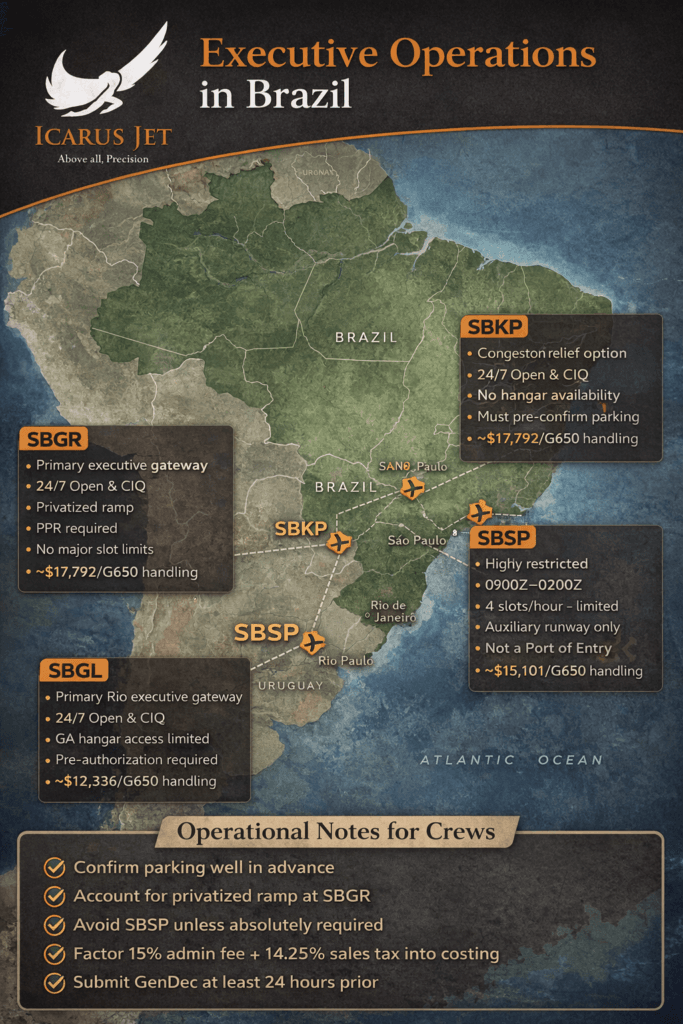
SBGR is the preferred executive gateway due to continuous operations and fewer slot restrictions than Congonhas. However, crews must understand that the apron is privatized, and this introduces additional parking and towing charges beyond standard airport landing fees.
SBGR parking and towing structure
For aircraft staying beyond 2 hours (domestic) or 3 hours (international), parking per 24 hours:
- Up to 6 tons: USD 390
- 6-12 tons: USD 515
- 12-24 tons: USD 1,050
- 24-48 tons: USD 3,465
- 48-100 tons: USD 4,410
Towing fees:
- Up to 24 tons: USD 215
- Above 24 tons: USD 270
These charges apply in addition to DAT landing fees and handling services.
For a G650 operation at SBGR, total handling and related services can reach approximately USD 17,792, inclusive of administrative fees and taxes.
GATGRU - General Aviation Terminal at SBGR
Crews have two options:
- Main terminal, 24 hours, no extra cost
- GATGRU, by request
GATGRU costs:
- USD 2,450 per operation plus administrative fee and sales tax
- Arrival and departure combined USD 4,900 plus administrative fee and sales tax
Operational requirements:
- Reservation 24 hours in advance
- Prepayment required
- Complete GenDec submitted 24 hours prior
- CPF numbers required for Brazilian nationals
- Changes within 24 hours must be reported immediately
For high-profile passengers, GATGRU provides privacy but adds measurable cost.
SBKP - Campinas Viracopos
SBKP functions as a strategic alternative to SBGR.
- Airport and CIQ: 24/7
- PPR: Required
- Fuel: Available
- Hangar: Not available
- Parking: Must be requested in advance
SBKP typically presents less congestion risk. For a G650, total handling costs are approximately USD 1,869, excluding airport fee if applicable.
For crews seeking operational predictability and lower congestion exposure, SBKP is often the practical choice.
SBSP - Congonhas Airport
SBSP is centrally located but operationally restrictive.
- Airport hours: 0900Z–0200Z
- Not a Port of Entry
- Slots required
- Only four GA slots per hour
- Slots released 120 hours prior
- Operations limited to auxiliary runway
Additional constraints:
- Flight plan must be filed 4 hours and 30 minutes prior
- Aircraft must remain on ground 1.5 to 2 hours for DAT and flight plan process
Due to heavy commercial traffic priority, slot allocation cannot be guaranteed.
Estimated G650 operational cost at SBSP: approximately USD 15,101 depending on overnight stay and services.
Recommendation: Use SBGR or SBKP when schedule flexibility is critical.
Rio de Janeiro - SBGL Galeão
SBGL is the primary international gateway for Rio.
- Airport and CIQ: 24/7
- PPR: Required
- Fuel: Available
- Parking and hangar: Must be confirmed in advance
General Aviation Access options:
- Main terminal 24 hours, no additional cost
- Hangar access USD 2,663 per operation
- Arrival and departure via hangar USD 5,326 plus tax
Pre-authorization required for international GA hangar use.
Estimated total handling and service cost for G650 at SBGL: approximately USD 12,336.
Understanding Brazilian fee structure
Brazilian invoices typically include:
- DAT landing fee
- Airport usage fee
- Privatized apron charges
- GA terminal access
- Handling services
- 15 percent administrative fee on third-party services
- 14.25 percent sales tax on final amount
Exchange rate fluctuations can materially affect final totals.
Fuel and reliability
Across SBGR, SBKP, SBGL, and SBSP:
- No reported fuel shortages
- Turbine and piston fuel available
- 24-hour operations at SBGR, SBKP, SBGL
Operational reliability is strong. The primary risk factors remain parking confirmation and slot allocation.
Planning strategy for international crews
When planning operations to Brazil:
- Confirm parking before permit submission
- Evaluate SBGR vs SBKP based on congestion
- Submit complete GenDec early
- Account for administrative and tax components in budget
- Avoid SBSP unless slot timing aligns perfectly
Brazil rewards structured planning. Delays are typically administrative rather than regulatory.
Conclusion
Brazil is not a difficult destination for business aviation. It is a structured one. With permits issued quickly and fuel reliably available, most operational friction comes from airport selection and layered cost structures.
SBGR remains the most flexible gateway for São Paulo. SBKP offers congestion relief. SBGL supports full Rio access. SBSP should be evaluated cautiously due to slot restrictions.
With disciplined trip support coordination, Brazil can be operated efficiently and predictably.
FAQs
How quickly can Brazil landing permits be issued?
Single landing permits can be issued within 2 hours once documents are correctly submitted. Multiple landing permits require up to 48 hours.
Which airport is best for São Paulo?
SBGR is generally the most flexible. SBKP is a strong alternative. SBSP is highly restricted.
Are there fuel shortages in Brazil?
No current shortages reported at major executive airports.
Are parking charges significant at SBGR?
Yes. The privatized apron structure can result in parking charges up to USD 4,410 per 24 hours for larger aircraft.
What additional fees should be expected?
In addition to airport and handling fees, expect 15 percent administrative charges on third-party services and 14.25 percent sales tax on the final invoice.