
Is It Safe to Overfly Iranian Airspace?
The dynamic world of geopolitics and private aviation in the western hemisphere is more than simply dizzying. Economies have evolved globally, leaving men no time to dawdle within their workday. Private aircraft travel emerges as a compatible adjustment to strategize business schedules. Iran receives its fair share of rumors in the media, so US civilians wonder about the nature of its airspace. Fellow aviators and industry resources paint a somewhat different picture than what an average person might expect.
Reviewed by Kevin Singh, Founder · Fact-checked against Icarus Jet fleet and airport operations data · Last updated 10 September 2026
The guide
Is it really safe?
Overflying Iran is a usual occurrence for several commercial airlines and air carriers. The US, however, does not permit its air services to enter Iranian skies. The political tension between the two nations makes the rules predictable. The situation suggests that safety is not the guiding element behind the bans.
The Iranian Air-Traffic Control (ATC) specialists are skilled at communication in the English language. The staff is efficient, professional, and adequately trained for their tasks. Execution of duties is timely and orderly. Pilots who have flown legions of hours attest to the smooth and secure transition from the ATC of Tehran. Reportedly, their advisors offer appropriate consultancy to pilots, on par with any other ATC in the world.
US citizens should realize that the Iranian airspace is as safe as it gets. After all, many American nationals fly on internationally registered airplanes. Several American pilots navigate air carriers authorized from the Bermuda, IOM, and other foreign archives. Consider Etihad as an example; it transports a significant percentage of US nationals. However, it is required to traverse the Iranian ATC daily. So, US citizens are essentially crossing Iranian airspace without facing any safety risks as proposed by the media.
Route comparison from London to Dubai
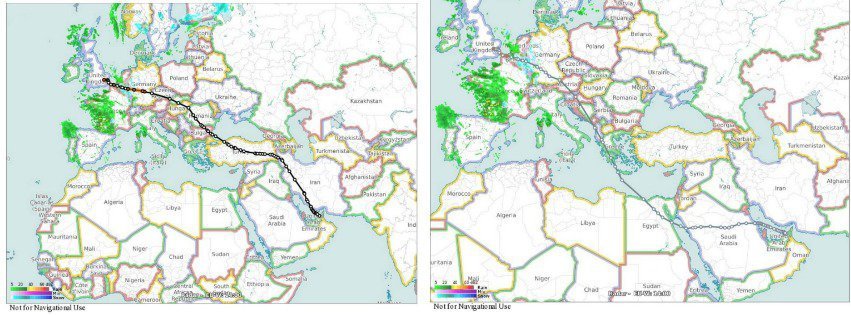
Emergency landings in Iran
In December 2018, a Norwegian Boeing 737 MAX 8 had to make an emergency landing in Iran with more than 160 passengers onboard. The flight route was originally from Dubai to Oslo. Engine failure caused the plane to divert to Shiraz International Airport. The passengers possessed no visas to enter the nation, but they were allowed hotel accommodation for the night. The crew and crowd on board were able to reroute to their destination after Iranian help.
Incidents similar to this reflect the nature of the Iranian airspace. In case of emergencies, assistance is granted to all aircraft in distress.
How did the US embargo on Iran affect aviation?
Iranian economic sanctions placed by the Trump administration severely affected aviation. The Biden presidency has refused to lift these bans. The process of repairing aircraft in Iranian territory is trivial. They made it impossible for any diverted airplane to undergo repairs in Iran. Emergency landings entail technical and medical reasons.
The ICAO has also campaigned for the removal of these restrictions because civilian aviation should remain independent of political disagreements. Maintenance equipment and component parts manufactured beyond 10% US origin are sanctioned from being carried by planes in Iranian skies. Problems like this caused the 2018 Norwegian plane to stay in Iran for 10 weeks, awaiting repair. However, if passengers still remain concerned, the Egyptian and Saudi airspaces are great alternatives. They offer embargo-free ATC for all flights destined for the UAE, Oman, or Asia.
Flying this route or region? Icarus Jet provides 24/7 trip support, flight planning, flight permits for private jet operators worldwide.
Questions
Overflying Iran: questions the desk gets
Can a US-registered aircraft overfly Iran?
No. FAA rules bar US operators from Iranian airspace and an N-registered aircraft would need diplomatic permits. Aircraft on other registers overfly daily on the published airways with an Iranian overflight permit.
Is Iranian airspace unsafe?
The bar on US operators is a political and sanctions decision rather than a safety finding, and foreign carriers cross it every day. The desk treats Iran as a permit, insurance and sanctions question, not an airspace-risk one, and checks the current FAA and EASA bulletins before every routing.
What happens if my aircraft diverts into Iran?
It can be stranded. Sanctions prevent the supply of parts with more than ten percent US-origin content, which covers most business jets, so a technical diversion cannot be repaired locally. In 2018 a Norwegian 737 MAX sat at Shiraz for ten weeks for that reason.
Which routes avoid Iran on a Gulf or Asia trip?
Egyptian and Saudi airspace to the south, or the Caucasus to the north. The detour adds about twenty to thirty minutes on a Europe to Gulf sector and changes the fuel and crew duty calculation, which the desk plans with the permits.
Does a non-US operator need a permit to overfly Iran?
Yes. An overflight permit from the Iranian civil aviation authority, filed ahead with the aircraft documents, with the approval number entered in Item 18 of the flight plan exactly as issued.
How does the desk decide whether to route over Iran?
Registration first, then the insurance wording, then the current FAA, EASA and operator bulletins. N-registered aircraft are routed around it; other registrations are planned case by case with war-risk cover confirmed.
Where this sits
The guides around this one
Get it filed
Routing around or through the Gulf? Filed from the desk
Send the dates, the aircraft and the stops. You get the permits filed, the routing checked against the current picture, handling confirmed, and a number you can hold us to.
Contact UsPrefer to talk? Call +1 888 277 7203 or email tripsupport@icarusjet.com. The desk is staffed 24/7.