
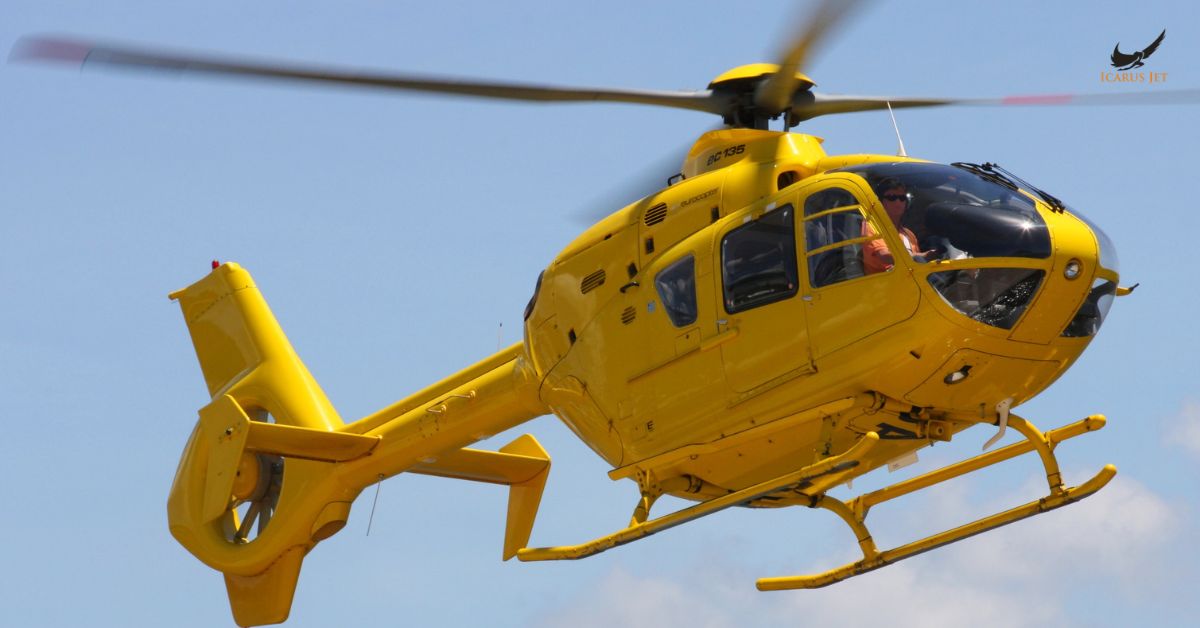
 4 to 12 seats · island and city
Helicopters
Short transfers that do not need a runway at either end: island hops, city and airport links, with three to seven passengers depending on the type and layout.
Reviewed by Kevin Singh, Founder · Specifications checked against manufacturer and type certificate data · Last updated 14 September 2026
The class at a glance
Helicopters in figures
Spans across the model guides below, from manufacturer and type certificate data. Individual aircraft vary with configuration, load and conditions.
Who it suits
The leg a jet cannot fly
The nine types in our guides seat three passengers (Robinson R44) to seven (Airbus H130 and Leonardo A109C, each with one pilot), with the AS350 and AS355 at five standard and four in private or corporate layouts, the Bell 407 at six and the H135 at six. Published ranges run from 327 NM (H130) to 395 NM (AS355), and several of those figures, including the AS355, Bell 407, H120 and both Robinsons, are quoted with no fuel reserve, so real transfers are planned well inside them.
Published cruise speeds run from 109 knots in the Robinson R44 and 110 in the R66 to 136 knots in the Airbus H135 and AS350. Baggage is the tightest limit in the class and is set by weight as much as volume: the H130's three holds total about 39 cubic feet with individual limits of 80 to 155 kg, the AS350's total about 35 cubic feet and the AS355's about 33, the R66 has a full-width 18 cubic foot compartment rated to 136 kg, the Bell 407 a separate 16 cubic foot compartment rated to 113 kg, and the R44 takes bags under the seats only, up to 23 kg per compartment.
Engines and weather decide the rest. The H135, AS355 and A109C are twins; the H135 is certified for single-pilot IFR when equipped with Helionix, the AS355 is certified for IFR with one or two pilots, the A109C for IFR when the IFR installation is fitted, and the Bell 407GXi has an optional IFR configuration approved by supplemental type certificate. The H120, H130, AS350, R44 and R66 are approved for visual flight only, day and night with the required equipment. On Greek island and Riviera transfers in particular, the desk plans the weather minima, the pilot's approvals and the landing site approval at both ends before it quotes.
Door to door on short sectors
No runway is needed at either end, only a landing site approved for the operation. That turns an airport connection, a harbour pick-up or an island hop into one direct flight, which is why these types sit alongside the jets in our guides rather than apart from them.
Twin-engine options over water
Airbus notes the H135's one-engine-inoperative capability as a plus for over-water island transfers. The AS355 is certified for Category A-equivalent operations, able to depart at maximum gross weight from a helipad up to 25C at sea level, and the A109C has Category A engine isolation in its certification basis.
Quiet types for sensitive sites
The H130's noise signature is 6 dB below ICAO limits and the H120's external noise 6.7 dB below, both using a Fenestron shrouded tail rotor, which also keeps the tail rotor away from passengers and ground staff.
The models
Helicopters guides
Our guide to each helicopter type, with verified seats, cruise speed, range and baggage figures and the variant every figure applies to.
Compare the class
Every helicopter guide side by side
How the nine types line up on seats, engines, speed and range. The H130 and A109C seat the most, the AS355 publishes the longest range, and the H135 and AS350 the fastest cruise; speed and range are not shown for the A109C because no manufacturer figure for that variant survives.
| Aircraft | Passengers | Range | Cruise | Engines | Luggage |
|---|---|---|---|---|---|
| Leonardo A109C | Up to 7 | n/a | n/a | Twin turbine | 150 kg |
| Airbus H130 | Up to 7 | 327 NM | 128 kts | Single turbine | 39 cu ft |
| Bell 407 | Up to 6 | 337 NM | 133 kts | Single turbine | 16 cu ft |
| Airbus AS350 Ecureuil | Up to 5 | 340 NM | 136 kts | Single turbine | 35 cu ft |
| Airbus H135 | Up to 6 | 342 NM | 136 kts | Twin turbine | n/a |
| Robinson R44 | Up to 3 | 350 NM | 109 kts | Single piston | Under-seat only |
| Robinson R66 | Up to 4 | 350 NM | 110 kts | Single turbine | 18 cu ft |
| Airbus H120 | Up to 4 | 383 NM | 120 kts | Single turbine | 28 cu ft |
| Airbus AS355 Ecureuil 2 | Up to 5 | 395 NM | 120 kts | Twin turbine | 33 cu ft |
Moving between classes
When a helicopter is not the right tool
Questions
Helicopters questions the desk gets
How far can a helicopter fly on one tank?
Published figures are 327 NM for the H130, 337 NM for the Bell 407, 340 NM for the AS350, 342 NM for the H135, about 350 NM for the R44 and R66, 383 NM for the H120 and 395 NM for the AS355. Several of those, including the AS355, H120, Bell 407 and both Robinsons, assume no fuel reserve. Real transfers are planned well inside them, with fuel stops if the routing needs one.
How many passengers fit in a charter helicopter?
From three in the Robinson R44 to seven in the H130 and the A109C, each with one pilot. Private and corporate layouts carry fewer: four in the AS350 and AS355 against five standard, and five in the Bell 407's aft club seating plus one front seat. Give the desk real passenger and baggage weights, because weight decides more in a helicopter than seat count does.
What is the seating like inside?
It varies by type. The Bell 407 has club seating for five in an 85 cubic foot aft cabin, the AS355 has a wide cabin with all seats facing forward and wide doors with boarding steps, and the H135 mixes forward and rear-facing seats in its two-pilot, five-passenger layout. The H130 has a fully flat floor, and Airbus describes its cabin as the widest in its class.
How much luggage can I bring?
Less than in any jet, and the limit is weight as well as volume. The H130's three holds total about 39 cubic feet with limits of 80 to 155 kg per hold, the AS350's about 35 cubic feet and the AS355's about 33, both with limits of 80 to 120 kg per hold. The R66 has an 18 cubic foot compartment rated to 136 kg, the Bell 407 a 16 cubic foot compartment rated to 113 kg, and the R44 takes under-seat bags only, up to 23 kg per compartment.
Why choose a twin-engine helicopter for island transfers?
Because a twin keeps flying on one engine. Airbus cites the H135's one-engine-inoperative capability as a plus for over-water island transfers, the AS355 is certified for Category A-equivalent operations and offers 2 minutes 30 seconds of maximum emergency power after an engine failure, and the A109C has Category A engine isolation in its certification basis. On Greek island and Riviera sectors the desk weighs that against the passenger count and the landing sites.
Can a helicopter fly in poor weather or at night?
It depends on the type and its equipment. The H120, H130, AS350, R44 and R66 are approved for visual flight only, day and night with the required equipment fitted. The H135 is certified for single-pilot IFR with Helionix avionics, the AS355 for IFR with one or two pilots, and the A109C and Bell 407GXi for IFR when the IFR installation is fitted. Even then the desk plans each transfer against the weather minima for the aircraft, the operator and the landing site.
Where can a helicopter land?
At airports and heliports, and at other landing sites where the operation is approved, including private sites when the owner and the authority allow it. The desk confirms the landing site approval and the pilot's approvals for both ends of the transfer before a quote goes out, and says plainly when a site cannot be used.
How fast do they cruise?
Published cruise figures are 136 knots for the H135 and AS350, 133 knots for the Bell 407 at 5,000 lb, 128 knots for the H130, 120 knots for the H120 and the AS355, 110 knots for the R66 and 109 knots for the R44, the last two at maximum gross weight. Speed on the day depends on weight, wind and the routing.
What is the difference between the Robinson R44 and R66?
The R44 Raven II is a piston helicopter with a fuel-injected Lycoming engine, carrying a pilot and three passengers, with baggage under the seats only. The R66 is a turbine helicopter carrying a pilot and four passengers, with a full-width 18 cubic foot baggage compartment rated to 136 kg and air conditioning standard on the current NxG. Both are approved for day and night visual flight only.
How does the desk choose the type?
It starts with passengers and bag weights, then the sector, the landing sites at both ends and the forecast. Over-water routes or the chance of instrument conditions point to a twin such as the H135 or AS355, larger parties to the H130 or Bell 407, and photographic work to the R44, which is approved to fly at up to 100 knots with the cabin doors removed.
Other classes
The rest of the Aircraft Guides
Get your number
Charter a helicopter
Send the route, the dates and the passengers. The desk matches the aircraft to the trip, checks range and baggage first, and comes back with an itemised quote.
Prefer to talk? Call +1 888 277 7203. The desk is staffed 24/7.
Comparing aircraft? Browse the Aircraft Guides in the Aviation Library, 600+ guides on chartering and operations.