Dallas has long been one of the most operationally capable aviation markets in the United States. Well before major global events entered the conversation, the city has functioned as a center of operations for corporate travel, sports teams, touring groups, government delegations, and large private movements, both domestic and international.
The upcoming FIFA World Cup 2026 will place Dallas in the global spotlight as a host city, but its role as a group charter hub is not new. What events of this scale do provide is a useful reference point to explain how group charter aviation actually works in practice, from aircraft selection and pricing to terminals, paperwork, and day-of coordination.
This guide uses Dallas as the operational base to explain the full group charter process, from the first quote request to passenger arrival.
Why Dallas functions as a group charter hub
From an aviation standpoint, Dallas offers a rare combination of infrastructure, fleet availability, and operational depth. Multiple large airports support high-capacity aircraft, a broad network of charter operators’ base aircraft locally, and year-round demand keeps crews and equipment positioned in the region rather than relocated on short notice.
For charter clients, this translates into three practical advantages.
Aircraft availability is more predictable than in many other U.S. cities. Crew availability is stronger, particularly for multi-day or international trips. Ground handling providers are accustomed to processing large passenger groups efficiently and privately.
These factors matter far more than major sporting events. They support routine group travel such as corporate offsites, incentive programs, production crews, sports schedules, and international delegations.
What qualifies as a group charter
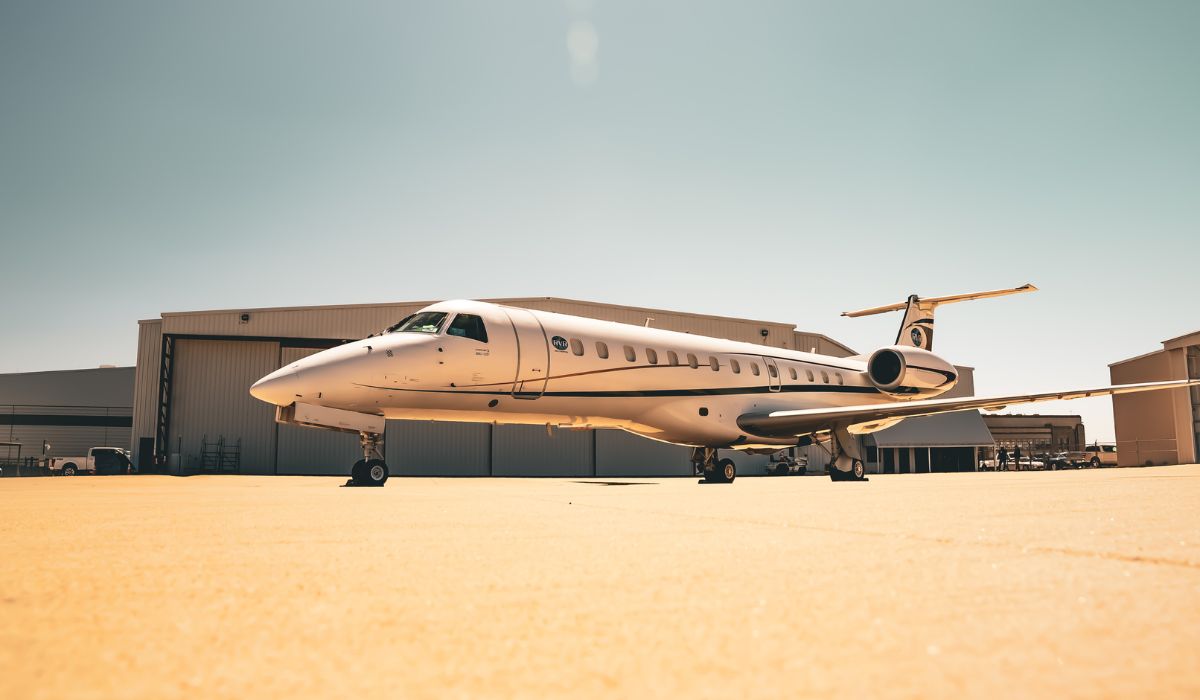
Group charter generally applies when passenger counts exceed the comfortable limits of traditional business jets. While large cabin business jets typically seat up to 14 or 18 passengers, group charter aircraft usually start around 30 seats and scale upward.
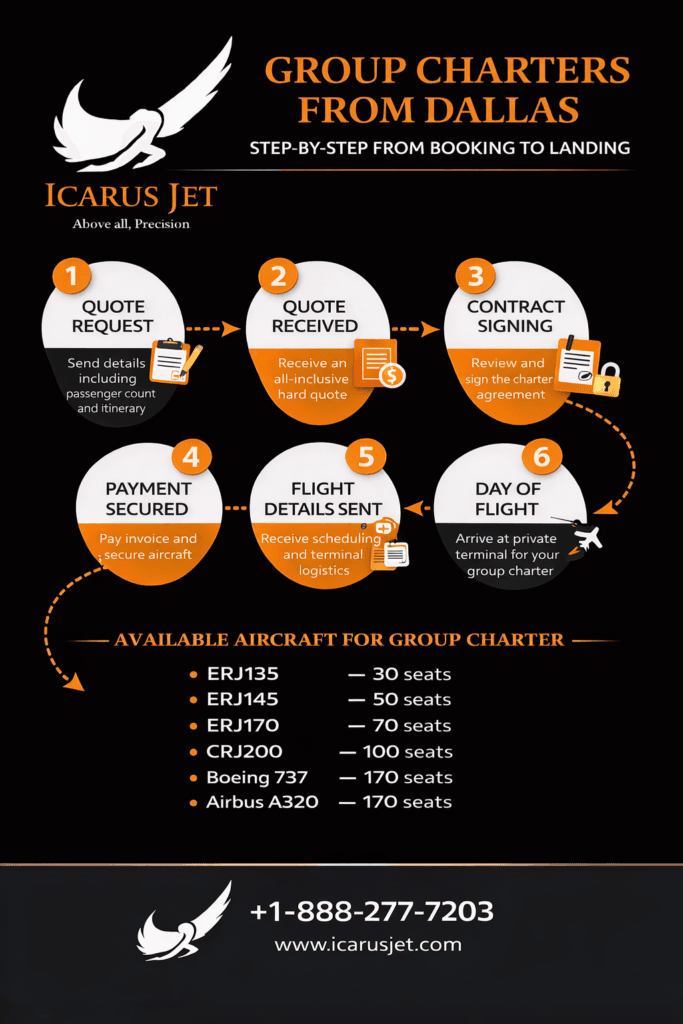
From Dallas, commonly arranged group charter aircraft include:
- ERJ135
- ERJ145
- ERJ170
- CRJ200
- Boeing 737
- Airbus A320
These aircraft allow operators to move anywhere from 30 to well over 100 passengers in a single movement, depending on configuration. Cabins are usually arranged for high-density seating, with overhead bins and limited checked baggage unless additional planning is incorporated.
Typical group charter pricing from Dallas
Group charter pricing depends on aircraft type, route length, total flight hours, crew duty limitations, airport fees, and international requirements where applicable. The following examples reflect typical market ranges and help illustrate how pricing scales.
- Dallas to Las Vegas round trip is typically around USD 63,000, with a flight time of roughly three hours each way.
- Houston to St John’s in Antigua and return to Houston is approximately USD 125,000. A fuel stop is required for this route.
- Dallas to Nassau and return generally prices around USD 70,000.
- Dallas to Nashville and return is commonly quoted around USD 52,000.
- Dallas to San Diego and return is typically around USD 73,000.
- For higher-capacity aircraft, pricing increases accordingly. On a 72-seat ERJ170, Dallas to Atlanta and return is approximately USD 160,000. Atlanta to Phoenix and return is typically around USD 112,500.
These figures are indicative. Seasonal demand, fuel pricing, aircraft positioning, and airport congestion all influence final costs.
Step one: quote request and aircraft matching
The group charter process begins with a detailed quote request. Passenger count is the primary driver at this stage, followed by routing, dates, and any specific operational constraints.
Once the request is received, available aircraft are identified based on capacity, range, and positioning. Unlike small jet charter, group charter availability is more dependent on crew schedules and block-hour commitments than on individual aircraft preference.
At this stage, pricing is still preliminary and availability is not yet secured.
Step two: receiving the hard quote
Once an appropriate aircraft option is identified, a formal quote is prepared. This quote reflects the operator’s pricing plus the broker’s commission and outlines the proposed aircraft type, routing, estimated schedule, and total cost.
This is the first point at which clients receive a firm number. However, aircraft availability is still subject to confirmation until the next steps are completed.
Step three: contract review and approval
If the client chooses to proceed, a charter contract is issued for review and signature. This agreement governs payment terms, cancellation policies, operational authority, and liability.
Group charter contracts are standardized documents and are not informal reservations. No aircraft is secured until the it is fully fulfilled.
Step four: payment and aircraft securing
Once the signed contract is received, an invoice is issued. Upon receipt of payment, funds are transferred to the operator, and the aircraft is formally secured.
This is the point at which the booking becomes operationally locked. Prior to payment, aircraft availability can change, particularly during peak demand periods.
Step five: operational details and documentation
After the aircraft is secured, full operational details are released. These include the aircraft tail number, FBO or terminal information, crew details, and a finalized flight schedule.
For international flights, this phase also includes overflight permits, landing permits, customs documentation, and coordination with handlers at the destination airport.
Clients receive a complete briefing once all elements are confirmed.
Step six: departure and arrival coordination
On the day of departure, the charter team coordinates directly with the operator, flight crew, and ground handlers. Clients are kept informed of timing updates, weather considerations, and any operational adjustments.
Arrival coordination follows the same process, particularly for international destinations where customs and immigration procedures must be synchronized in advance.

Where group charter passengers depart in Dallas
Group charter passengers typically do not use commercial airline terminals. Most departures operate from private terminals or FBOs designed to handle large groups discreetly and efficiently.
Security screening is private, lounges are dedicated, and group processing is managed away from public concourses. For larger aircraft such as the Boeing 737 or Airbus A320, departures may still operate through private charter facilities depending on airport infrastructure.
Passengers should plan to arrive earlier than they would for a small private jet but still avoid the volume and unpredictability of commercial terminals.
International group charters from Dallas
Dallas is well positioned for international group charter operations, particularly to the Caribbean, Mexico, and parts of Central America. Longer-range routes may require fuel stops depending on aircraft type and payload.
International group charter requires additional lead time due to permits, documentation checks, and crew duty regulations. These factors are managed operationally but influence pricing and scheduling.
Furthermore, large-scale events such as the World Cup do not create group charter capacity in Dallas; they serve as an opportunity to expose it.
The aircraft, crews, and infrastructure already exist because Dallas supports consistent group movement year-round. During peak periods, demand increases and availability tightens, making early planning more important.
Understanding this distinction helps clients set realistic expectations and secure better outcomes.
Dallas as a long-term group charter base
Dallas remains a dependable base for group charter operations not because of a single event, but because of its operational depth.
When managed properly, group charter offers control, privacy, and schedule certainty for large movements that commercial aviation cannot replicate. Dallas continues to be one of the few U.S. markets capable of delivering that consistently.
FAQs
How far in advance should a group charter be booked from Dallas?
Domestic group charters are typically booked two to four weeks in advance. During peak periods, earlier booking improves availability. International flights usually require more lead time due to permits and crew planning.
Do group charter passengers go through TSA screening?
Passengers do not use commercial TSA checkpoints. Security screening is handled privately at the charter terminal or FBO, following required regulations.
Can passenger numbers change after the contract is signed?
Small changes may be possible but increases or decreases that affect aircraft selection or weight limits can require re-quoting and are not guaranteed.
Is luggage included in group charter pricing?
Standard luggage is included, but aircraft have fixed capacity limits. Oversized baggage or equipment must be declared during the quote stage.
How are weather or operational delays handled?
Delays are managed by the flight crew and operations team, with real-time updates provided to the client. Safety and regulatory constraints always take priority.