Summer is a busy time of year for business aviation in Europe, with a high volume of flights driven by peak tourism, major sporting events, and overall increases in air travel. For private pilots and flight dispatchers, this can mean that what is normally a routine flight plan can become a complex, slot-constrained operation, with minor mistakes potentially resulting in major operational issues.
Some of the key cities that pilots will need to plan around during the summer months include Paris, London, Athens, Geneva, Amsterdam, and Zurich. Whilst not all of these locations will impose slot restrictions during the peak season, they will share one common factor: during peak weeks, demand for air travel exceeds the infrastructure to support it.
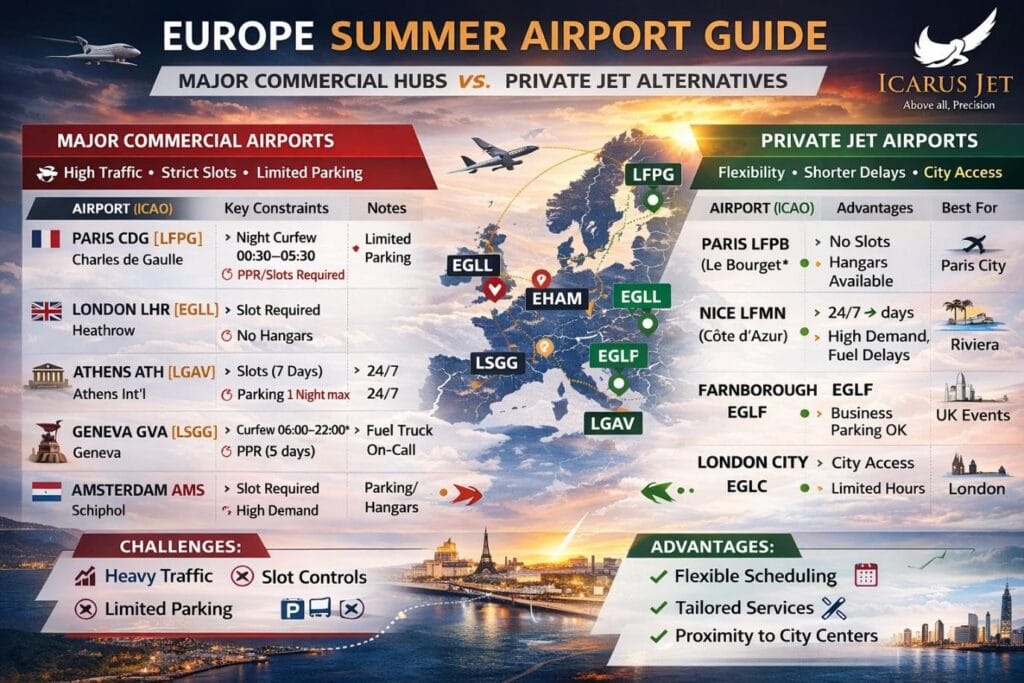
Paris Charles de Gaulle (LFPG): Night restrictions and parking slots
Paris is one of the most sought-after destinations in Europe during the summer months, with tourism, fashion shows, and high-net-worth travelers driving a high volume of air travel in the region. However, the region’s primary airport, along with the secondary airport, enforces strict nighttime operating restrictions that will impact pilots’ scheduling flexibility.
For Paris, arrivals are banned between 0030 and 0530 local time, and departures are restricted to the period between midnight and 0500 local time. This will effectively mean that pilots cannot operate late-night repositioning flights, with greater reliance on operating during daylight hours.
Whilst airport and CIQ services operate 24 hours a day, 7 days a week, access is still restricted during the time slots due to nighttime flight bans that restrict movement. Slots and prior permission required mean that pilots cannot operate a flight, even with a tech stop, during these hours.
However, the main challenge in parking is that availability during the summer months is uncertain until late in the season, and hangar space at major Paris airports, such as Charles de Gaulle, is not available for business aviation.
For Part 91 flights, landing permits are not required, which makes compliance with regulations easier.
London Heathrow (EGLL): Curfews and daytime operating windows
Although EGLL provides extensive private aviation services and unparalleled connectivity, it might not be the ideal airport for private jet operations. Typical operating hours at business aviation airports are 0600 to 2230 local time, which is quite narrow for arrivals and departures.
Slots are required for landing and takeoff, and hangar space is extremely scarce during the peak season. Fuel availability is unlikely to be a constraint, and ground times are likely to be the primary constraint even with technical capability.
Pilots should also be prepared for high traffic volume during sporting events, festivals, and transatlantic flights.
You might also like: Who should avoid flying a private jet into London Heathrow Airport?
Nice Côte d’Azur International (LFMN): Fuel delays and summer seasonal congestion
The Nice Côte d’Azur International Airport (LFMN) is considered one of the most capacity-constrained airports in Europe for business aviation flights during the summer season. The airport serves the French Riviera, Monaco, and seasonal events.
Currently, there are no movement bans in place, and the airport is open 24 hours a day with full CIQ. However, access is restricted through a PPR. The PPR is usually confirmed one week prior to departure during the summer season. A slot confirmation is mandatory before filing a flight plan.
Fuel delays are significant, especially in the summer season, due to high demand. Fuel is usually arranged through the handler’s own network. However, it is important to note that prices may vary.
Parking is also a problem, depending on the aircraft type, length of stay, and demand. Hangar space is unavailable. Apron space is usually full, especially during peak demand periods.
Slot tolerance is -10 minutes to +15 minutes. However, it is important to expect delays due to Air Traffic Control congestion. Delays may be experienced even if the flight is filed within the slot tolerance.
Handling costs vary depending on aircraft type, day of operation, and whether it is a peak or super peak day, which are typically defined closer to the season.
Paris Le Bourget (LFPB): BizAv hub with curfew restrictions
Paris Le Bourget (LFPB) is the premier business aviation airport in Europe and the main alternative to Charles de Gaulle for business flights.
For the summer season to come, no slots are currently required. However, the airport has strict curfew restrictions on departure times, and the earliest departure time is 0600 local time, and the latest is 2200 local time. Arrivals are permitted 24 hours a day.
Currently, no prior permission is required for the airport, making it easier to plan flights to LFPB compared to other European destinations. Fuel is normally available at the airport, with a turnaround normally around 20 minutes.
Parking is available at the airport, making LFPB a very accommodating airport for an extended stay. While restrictions are less stringent at LFPB than at LFPG, crews should still be prepared for congestion.
Farnborough Airport (EGLF): Premium access with some limitations
Farnborough Airport, or EGLF, is one of the major business aviation airports in the United Kingdom, renowned for its efficient handling and business aviation environment.
As of now, there are no parking restrictions for the 2026 summer season. However, the availability of the facilities will depend on demand, and the operators will be notified of any restrictions when submitting initial handling requests.
Another significant aspect of the airport’s operations this year is the Farnborough International Airshow, which will take place in July. Airport closures and operating hours will be restricted during the event. However, the exact time will be announced nearer the event.
Once the handling is approved, the airport will issue a PPR number that will serve as the approval for the operation.
EGLF generally provides good parking and service; however, as with all UK airports, the situation may change rapidly.
You might also like: Who should avoid flying a private jet into Farnborough Airport?
London City Airport (EGLC): Access to Central London
EGLC offers the most convenient access to central London but is still subject to certain operating controls because of its location and short runway.
Operators and aircraft are required to have prior approval based on the aircraft’s tail number prior to operating at the airport. The process takes up to 48 hours once the necessary documents are submitted.
The operating hours are limited to Monday to Friday from 0630 to 2200 local time, Saturday from 0630 to 1230 local time, and Sunday from 1230 to 2200 local time. Extensions are allowed for up to 30 minutes on the day of operation, pending airport approval.
Fuel availability is good with no expected fuel shortages, and there is parking available without any restrictions on the duration of stay, but no hangarage is available.
London City Airport is most appropriate for operators looking to gain quick access to central London and are geared to meet the airport’s unique operating requirements.
You might also like: Who should avoid flying a private jet into London City Airport?
Athens (LGAV): Short ground times and uncertain parking
Athens is the gateway to the Greek Islands and has one of the most dramatic seasonal increases in traffic in Europe. At LGAV, approval of slots and parking is required. In the summer months, slots may be requested up to 7 days prior to arrival, though the amount of time spent on the ground may be limited to approximately 90 minutes.
For overnight parking, approval may not necessarily be granted, and confirmation may not be given until one day prior to arrival.
Hours of operation at this airport are 24 hours per day, with full CIQ and fuel services available, so they are not a factor in flight planning.
If parking is not available, repositioning flights may be necessary and may utilize Thessaloniki (LGTS), Kavala (LGKV), and Ioannina (LGIO) as alternates, depending on their level of service and distance from major tourist destinations.
Hangar space is extremely limited, generally available only at apron positions near small hangars, and available on an as-available basis.
Geneva: Restricted hours and event-driven limitations
Geneva is one of the most challenging airports in Europe during the peak summer months, especially when an international political or economic event is taking place.
Runway operating hours are limited depending on flight category. Private and ferry flights may arrive between 0600 and 2159 local time and may depart until 2139 local time. Commercial flights have slightly extended hours; however, business aviation flights must plan within a more limited window.
Approval from PPR is generally granted five days before the operation, leaving little leeway for schedule adjustments. Lack of fuel shortages is not anticipated, and operators must plan ahead to ensure adequate service during peak hours.
International summits and meetings may impose further restrictions, and operators must always remain vigilant during these periods. Parking and hangarage are generally available but require early coordination and are generally at a premium.
Amsterdam (EHAM): Curfew-driven scheduling
Amsterdam Schiphol Airport operates under a night curfew, which affects all business aviation operations.
Operating hours are approximately 0500Z to 2200Z, and all operations must be scheduled during this period, regardless of the crew’s availability. Unlike some airports, where overtime operations are permitted, movements before or after the operating hours are not permitted.
Slots are mandatory, and parking and hangarage are generally more accessible than at some Mediterranean airports, making it an alternative for repositioning when the region is saturated with traffic.
Fuel is readily available, and no permits are required for normal operations, making it convenient for the operator.
However, because it is a busy commercial airport, business aviation operations are subject to commercial air traffic, especially during peak hours when commercial flights depart.
Zurich (LSZH): Precision slot compliance
Zurich Airport is an example of the Swiss approach to airport operations, executed with military precision.
Private operations are permitted between 0600 and 2200 local time, with the last slot issued at 2145 local time. The aircraft must land or depart by 2159 at the latest, with no extensions or flexibility allowed.
Commercial flights get a little more, but business aviation flights filed under private flight plans must adhere strictly to the earlier cutoff.
One of the most critical requirements is precise slot compliance, where the filed flight plan must exactly match the slot time, with zero tolerance for any deviation.
Night surcharges apply from 2200, and additional overtime surcharges apply later, further discouraging late operations.
Fuel is not an issue, and parking and/or hangar accommodation are readily available but become much more in demand during the summer.
The importance of early coordination
Coordination among flight crew, dispatch, handlers, and trip support service providers is a key determinant of successful summer operations.
Accurate information regarding the type of aircraft, maximum take-off weight, number of passengers, and intended schedule is sometimes needed before any quotes are provided, let alone any coordination beginning.
For private pilots, the key is to prepare in advance, since passengers will plan their schedules around their flights.
If they are not aware of the constraints, they will not be able to operate with confidence, especially during peak season. In peak season, preparation is not a requirement; it is a necessity, and experienced trip support teams like Icarus Jet are here to help.
FAQs
How far in advance should slots be requested for peak summer operations?
As early as possible. Some airports will take requests weeks before arrival, while others will only grant slots a day or two before arrival.
What happens if an aircraft misses its assigned slot time?
In airports across Europe, particularly highly coordinated ones, the slot may even be given up entirely. Delays, reroutings, or even denial of access until another slot is available may occur.
Is repositioning to another airport common during the summer season?
Yes. For heavily constrained destinations, drop-and-go operations with repositioning to other airports are common. Crew should plan alternates, fuel, crew accommodations, and transport.
Are fuel shortages a major concern at these destinations?
Fuel is not a problem at major European airports. Delays can occur during peak hours. It is advisable to plan fuel availability.
Do these restrictions impact Part 91 differently than commercial operations?
While there are regulatory differences, operational restrictions such as slots, curfews, and parking restrictions apply to all aircraft types. For private operations, operating restrictions at certain airports can be more stringent than those for commercial operations.