
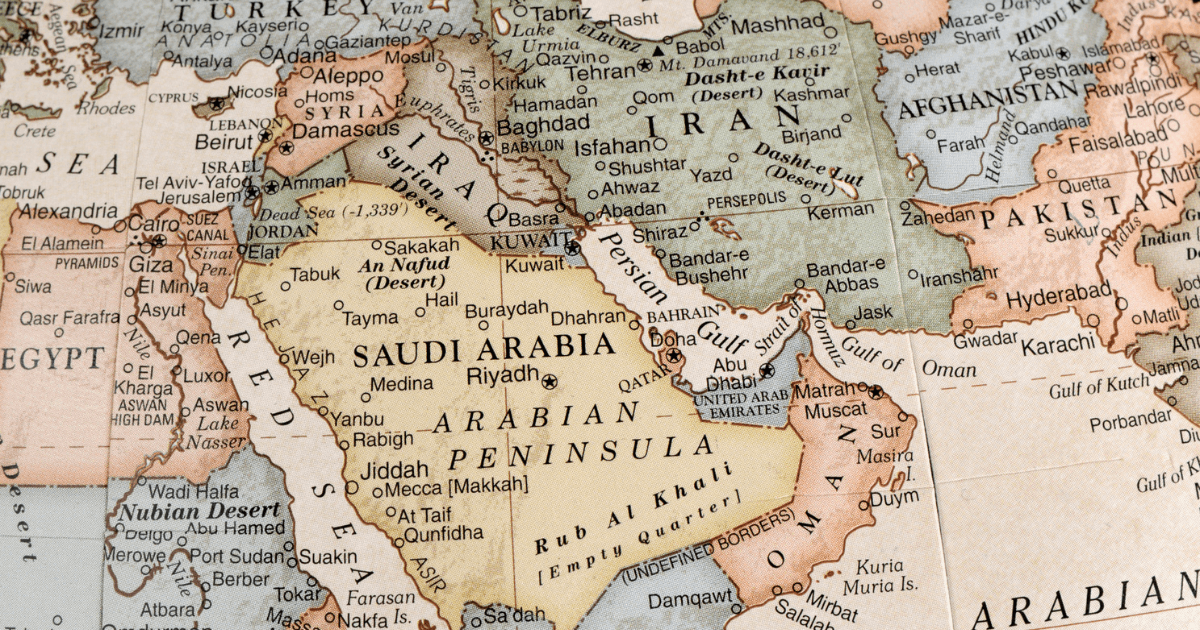
With aviation disruptions throughout the Middle East, passengers often assume that the only way to leave or move to another destination is by air. There are restrictions on air travel in various countries, and some airports are closed or have flight operations suspended or limited due to unrest in the region.
However, these issues don’t occur at all airports in the region at any given time. Therefore, for those in the area, another option is to travel to another international airport by road, which is commonly overlooked by most tourists or travelers.
As all countries in the Gulf region are connected by roadways, it is possible to travel to another nation by road and board a flight from an international airport without disruptions. The value of an experienced trip support provider like Icarus Jet with on-site experience is paramount in these situations.
Why driving is part of travel contingency planning
Air travel disruptions rarely affect every airport in a region equally. Restrictions often apply to specific airspaces, flight corridors, or airline schedules, while nearby airports may continue operating normally.
In the Middle East, this uneven impact creates an opportunity for alternative departure points.
The Gulf region offers several options for air travel, and some international airports in Oman and Saudi Arabia are known to be significant hubs for flights to Europe, North America, Asia, and Africa.
Trip support teams frequently build these driving routes into evacuation and contingency plans.
Instead of relying on a single departure point, they identify multiple airports across the region that can serve as alternatives if conditions change.
UAE to Oman: One of the most common alternatives
For travelers in the United Arab Emirates, Oman is one of the easiest travel alternatives.
Muscat International Airport is a major aviation hub, with regular flights connecting to European, Asian, and African destinations.
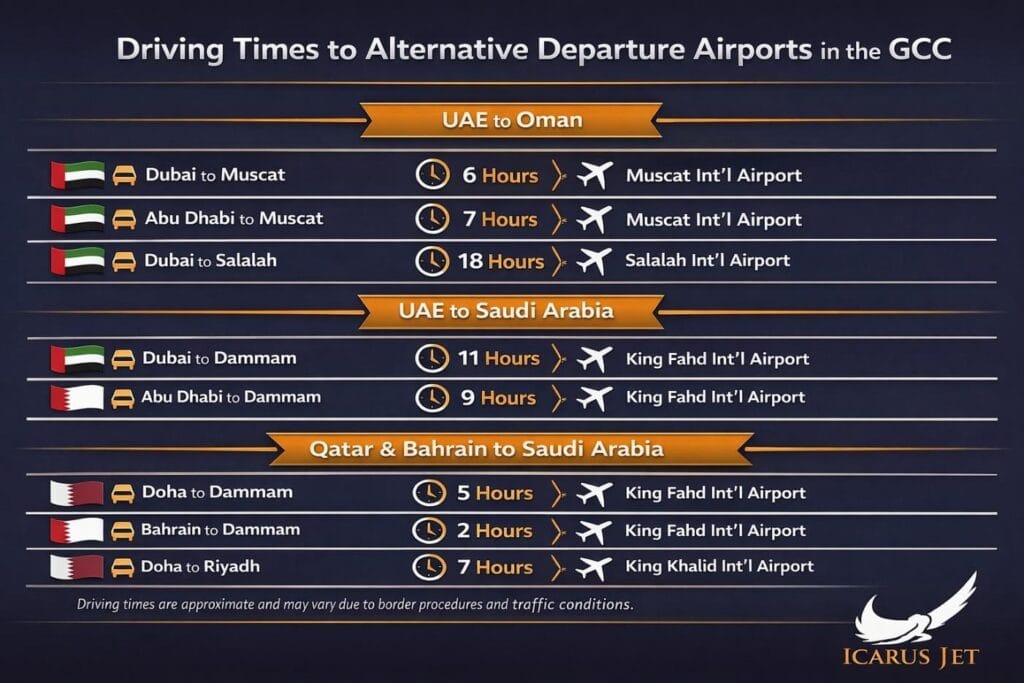
The airport often remains operational even when aviation activity shifts in different directions in the region. The land route from Dubai to Muscat takes around six hours in normal conditions.
For travelers from Abu Dhabi, it takes around seven hours to reach Muscat.
The route passes through the UAE-Omani border and then proceeds via well-maintained highway conditions to Muscat.
Considering the distance is within reasonable limits, Muscat emerges as a viable alternative when flights from the UAE change.
Another alternative in Oman is Salalah International Airport. The land route from Dubai takes around eighteen hours to reach Salalah. Considering this distance is only viable when all other airports in the region are challenged by operational conditions.
Saudi Arabia: A major alternative for departure
Another major alternative for travelers in need of international flights is offered by Saudi Arabia.
Two airports used for travel during times of disruption include King Fahd International Airport in Dammam and King Khalid International Airport in Riyadh.
Dammam is situated on the eastern coast of Saudi Arabia and has international air connections with many different destinations. Due to its proximity to many of the Gulf states, it is often one of the first alternative airports considered in the event of a disruption.
Driving from Dubai to Dammam takes around eleven hours. From Abu Dhabi, the trip can take around 9 hours, depending on border crossing conditions.
For the city of Riyadh, which is inland, international connectivity is even wider. It takes around thirteen hours to cover the distance from Dubai to Riyadh.
Though the distance is longer, the airport’s wider international connection makes the trip worthwhile.
You might also like: Which Permits Are Required for Private Jet Operations in Saudi Arabia?
Travelers from Qatar and Bahrain driving into Saudi Arabia
Travelers from Qatar and Bahrain can also access Saudi Arabia if they are affected by regional aviation disruptions.
Similar to the situation with Dubai and Abu Dhabi, Dammam is the best alternative for these travelers as well.
The distance from Doha, Qatar, to Dammam is about 5 hours by road. This is one of the shortest international trips in the region.
Travelers from Bahrain can even shorten the trip time. It takes about 2 hours to drive across the King Fahd Causeway. From there, they can access international flights from King Fahd International Airport.
If they still want to access additional flights, they can continue driving to Riyadh. It takes about 2 hours longer from Qatar and Bahrain to reach Riyadh than to reach Dammam.
Border crossings and visa considerations
Cross-border travel in the Gulf region can be easily facilitated because most of the countries have visa-on-arrival policies for different nationalities.
Travelers from the European Union, the United States, and Canada can easily access GCC nations, as visas can be issued upon arrival, subject to current regulations.
Citizens of GCC nations can access other GCC nations as long as they meet the requirements to enter the country.
However, it should be understood that border rules are subject to change during security alerts, and passengers and crews should confirm entry requirements before making travel arrangements that involve crossing borders.
At present, some borders between Kuwait and Iraq are closed due to security concerns, limiting them as travel options.
Regional airports with global connectivity
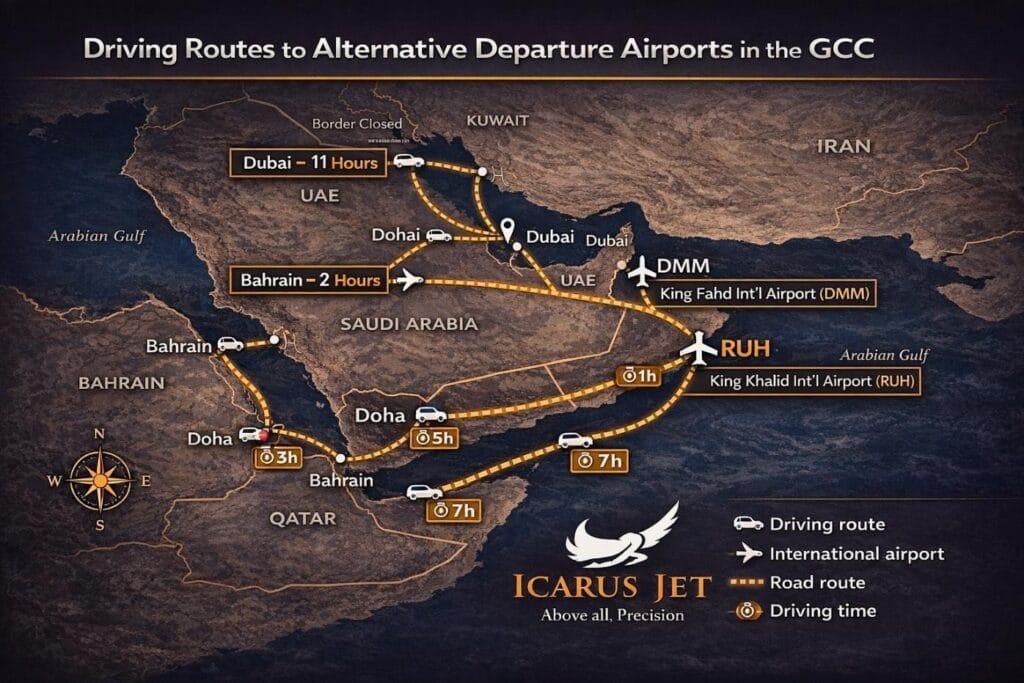
These driving routes are effective because several airports in the region are connected to global air routes.
For instance, Muscat International Airport, King Fahd International Airport in Dammam, and King Khalid International Airport in Riyadh are some of the air travel hubs connected to global air routes to destinations such as Europe, North America, Asia, and Africa.
Even when air travel is limited to these routes, it should be understood that once these tourists reach these airports, their chances of getting air travel are significantly higher.
Flexibility remains the key to leaving the region
While there are issues with air travel, it should be understood that flexibility remains key to leaving the region, and tourists may not be aware of this aspect of their travel plans.
Instead of relying on air travel from these airports, tourists may be able to explore other options for leaving these countries by driving to regional airports within driving distance.
Thus, in situations when air travel is limited or disruptions are reported, tourists from these countries in the Middle East may still be able to access global air travel routes despite issues in air travel from these countries.
When air travel disruptions are reported, it should be understood that the route to global air travel may begin on the road rather than at the airport.
FAQs
Can tourists leave the UAE by road in case of flight disruptions?
Yes. In the event of aviation disruptions, travelers in the UAE can drive to neighboring countries such as Oman or Saudi Arabia, where they can reach international airports still operating flights.
How long does it take to drive from the UAE to alternative airports?
It takes different amounts of time to drive to different places. For example, the drive from Dubai to Muscat takes six hours, while the drive from Abu Dhabi to Dammam takes approximately nine hours. The drive from Dubai to Riyadh takes thirteen hours.
Can foreign travelers cross GCC borders by car?
In most cases, yes. Travelers carrying European, American, or Canadian passports are issued visas upon arrival in several GCC nations.
Are international flights still operating from Oman and Saudi Arabia?
Yes, they are. Major international airports such as Muscat International Airport, King Fahd International Airport in Dammam, and King Khalid International Airport in Riyadh continue to operate flights to various parts of the world, including Europe, Asia, Africa, and North America.
Why do travelers drive to another country instead of waiting for flights locally?
Travelers drive to another country instead of waiting for flights locally because if flights are available from an airport near the UAE, they might be able to reach another international airport sooner, rather than waiting for flights locally, which might not be readily available.