
The 2026 World Cup will reshape business aviation traffic across North America. Unlike single-city events such as the Super Bowl or Masters Week, this tournament stretches across multiple countries, regulatory systems, airport authorities and fee structures. For private jet crews, that means planning cannot be reactive. It must be layered, structured and realistic.
This guide consolidates confirmed fee data, operational notes, fuel waiver structures and restrictions across all major host venues in the United States, Canada and Mexico. The objective is simple: reduce operational friction and prevent financial surprises before departure.
The fuel waiver factor in U.S. venues
Across most U.S. host airports, one number appears repeatedly. Approximately 940 to 942 gallons of fuel uplift is the threshold required to waive handling or facility fees. Houston, Kansas City, Seattle, New York area airports, Miami and Boston all operate under variations of this model.
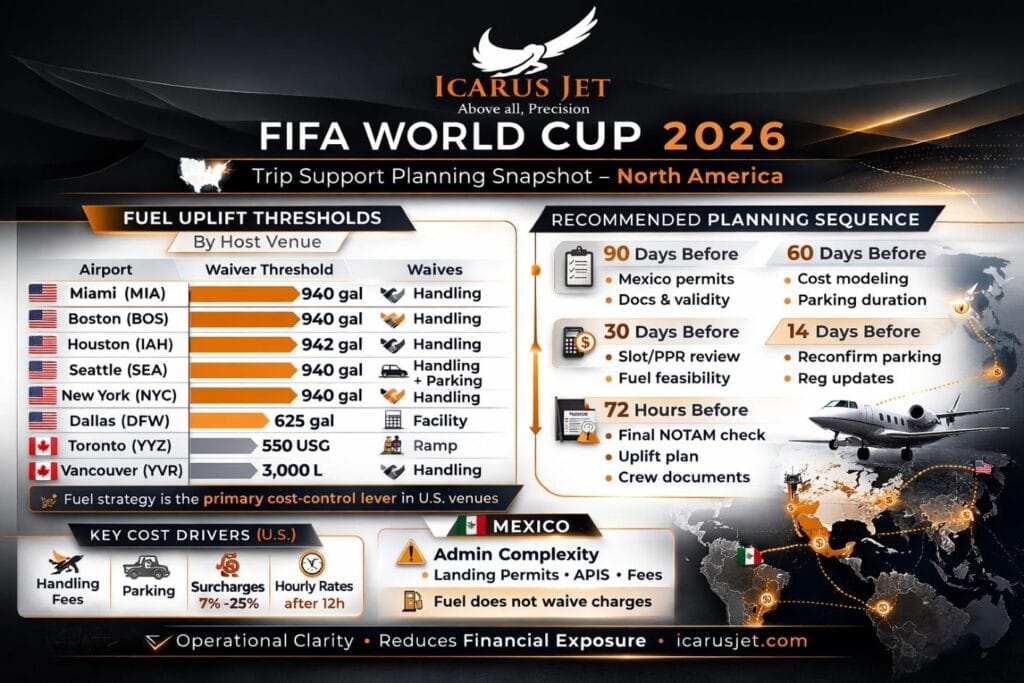
If uplift falls short, cost exposure escalates quickly.
In Miami:
- Handling: 3,670 USD, waived with 940 gallons
- Overnight parking: 2,642.52 USD
- Day parking over two hours: 1,233.48 USD
- 7 percent airport fee applied
- 25 percent processing fee for third-party vendors
- Escort fees for ramp vehicle access
In Boston:
- Handling: 5,550 USD, waived with 940 gallons
- Landing: 555.88 USD
- Massport GA: 220 USD
- Infrastructure: 63 USD
- Security: 155 USD
Philadelphia has already confirmed a special event fee:
- Special event fee: 5,248 USD
- Facility: 2,624 USD, waived with 942 gallons
- Landing: 502 USD
- Hourly parking: 140 USD first 11 hours, 75 USD thereafter
These numbers illustrate the importance of fuel strategy as a financial control mechanism. Without structured planning, exposure compounds across multiple fee categories.
Houston: operationally stable but layered
Houston reports 24/7 operations with no fuel shortages anticipated. The first hour of parking is free, and no drop-off fee is currently being applied.
However, fees include:
- Security: 55 USD
- Facility: 1,810 USD
- Parking hourly: 49 USD regular, 26 USD extended
- Hangar hourly: 75 USD
- Hangar entry: 905 USD
A 24-hour ramp stay can approach 3,000 USD before hangar use. With hangar positioning, total exposure increases further. The airport itself is stable, but the invoice structure demands attention.
New York and Seattle: traffic density will define the challenge
New York airports currently show no slot program in place, but handling of 2,260 USD is waived with 940 gallons uplift. Parking is 495 USD per night, and event fees may still be implemented.
Seattle presents a 3,172.50 USD handling and parking quote, waived with 940 gallons. Customs operates 24/7, but FBO hours are limited to 0700 to 2100 local time, and slot or parking restrictions remain unconfirmed.
In both markets, congestion and late-stage regulatory announcements are more likely risks than pure financial exposure. Crews should expect dynamic slot programs, TFR updates and short-notice procedural adjustments as traffic density increases.
Miami and Boston: stacked fee environments
Miami layers airport fees, vendor surcharges and escort charges on top of standard handling. Boston combines high handling with landing, security and airport authority charges.
These airports require structured communication with passengers or flight departments regarding total projected exposure. Ramp duration and fuel uplift discipline are central to controlling costs.
San Francisco and Dallas: moderate but sensitive
San Francisco lists:
- Facility: 3,271 USD
- Security: 65 USD
- Fuel: 10.65 USD
- Parking hourly: 191 USD first 10 hours, 103 USD thereafter
No slot program has been declared yet, but SFO congestion history suggests monitoring will be necessary.
Dallas appears comparatively manageable:
- Facility: 985 USD, waived with 625 gallons
- TSA: 40 USD
- Overnight ramp: 656 USD
- Hangar: 1,225 USD
No restrictions are currently reported.
You might also like: ESTA passengers on private jets: what U.S. crews need to verify before international arrivals
Canada: predictable structures with operational nuance
Toronto:
- Ramp: 1,139 CAD per 24 hours
- Hangar: 2,862 CAD per 24 hours
- Fuel waiver: 550 USG, 200 USG for CAA members
- Night noise restriction between 0030 and 0630 local
The noise restriction is operationally significant and requires coordination for late arrivals.
Vancouver:
- Handling: 1,200 USD, waived with 3,000 liters
- Overnight parking: 1,435 USD
- Hangar: 2,512 USD
- Security: 50 to 75 USD
FBO operations are not 24/7 unless advance notice is provided.
Mexico: administrative intensity over ramp exposure
Mexico introduces a different planning dynamic.
Guadalajara
Estimated base exposure is approximately 4,170 USD before fuel.
Charges include coordination, ramp access, AFAC fee, immigration fees, migratory service tax, non-immigrant fee, APIS, overnight parking, legal fee AIU and layered service charges.
Fuel uplift does not eliminate regulatory exposure. Documentation accuracy becomes critical.
Monterrey
Operating hours are limited to 0700 to 2200 local time. Fuel shortages are possible during peak traffic.
Fees include parking, handling, DNR, DSM, DSME, flight plan, landing, TUAS and a 10 percent airport surcharge.
Estimated exposure is approximately 2,550 USD before fuel.
Landing permits, crew documentation, insurance certificates and APIS filings must be properly sequenced.
Planning strategy for crews
1. Planning for a multinational event of this scale requires more than fee awareness. It requires disciplined sequencing and coordination.
2. Build fuel strategy into the flight plan, not the invoice. Determine waiver thresholds during dispatch planning and confirm uplift feasibility based on aircraft performance and sector length.
3. Model 24-hour and 48-hour exposure scenarios. Hourly ramp rates can quickly exceed flat overnight structures. Build alternate stay projections into your planning matrix in case departure schedules shift.
4. Monitor slot and PPR announcements continuously. Several airports have not finalized event procedures. Maintain regular contact with FBOs and airport authorities rather than relying solely on early published guidance.
5. Prepare documentation early in Mexico. Landing permits, insurance certificates, crew licenses, medicals and APIS filings must be complete and verified before departure.
6. Anticipate surcharges and layered fees. Airport percentage surcharges, vendor processing fees and security charges meaningfully alter final totals. Confirm all percentage-based add-ons before calculating final exposure.
Why partnering with an experienced trip support company matters
The 2026 World Cup is not a standard high-traffic week. It is a cross-border, multi-jurisdictional operation with evolving procedures.
An experienced trip support company like Icarus Jet provides more than coordination. It provides risk management.
A strong trip support partner:
- Monitors NOTAMs, slot programs and PPR developments daily
- Confirms fuel waiver alignment before uplift
- Validates documentation for international operations
- Coordinates landing permits and regulatory filings
- Provides real-time updates during congestion
- Clarifies airport authority procedures not yet formally published
- Models financial exposure scenarios in advance
In this environment, assumptions create cost exposure and operational delay. Active coordination reduces both.
FAQs
Will all host airports introduce slots or PPR requirements?
Not all have confirmed procedures yet, but high-traffic venues may implement slot or PPR programs closer to the event window. Crews should expect evolving guidance and monitor updates regularly.
Does fuel uplift eliminate most handling costs?
In many U.S. venues, approximately 940 to 942 gallons will waive handling or facility fees. However, this does not remove landing, security, parking or airport percentage surcharges. In Mexico, fuel uplift does not offset regulatory charges.
Which country requires the most regulatory preparation?
Mexico requires landing permits, crew documentation, insurance validation and APIS coordination. Administrative accuracy is critical to avoid delays.
How early should World Cup trip planning begin?
For major host cities, coordination should begin weeks in advance, especially where international permits, hangar space or extended parking are involved.
What is the biggest operational mistake crews can make during the tournament?
Underestimating cumulative exposure and waiting too long to coordinate. Fees stack quickly, slot programs can change, and documentation errors create delays. Structured planning prevents reactive problem-solving.