
Operating Private Jets During the World Economic Forum Davos 2026
Every January, Davos compresses too many variables into too little space. Weather, security, parking, traffic, and expectations. All at once.
Reviewed by Kevin Singh, Founder · Fact-checked against Icarus Jet fleet and airport operations data · Last updated 10 September 2026
The guide
The World Economic Forum runs January 19 to January 23, 2026. From an operational standpoint, that is not the important part. What matters is that special procedures are expected to be active from roughly January 13 through January 29. That is when the system tightens.
If you are planning flights inside that window, assume normal winter logic no longer applies. It rarely happens during Davos. This is not a destination overview. It is a working briefing, and some parts are blunt because they need to be.
Operational reality check
Davos week is not busy. Busy still has margins. Davos is saturated. In 2025, Zurich recorded days with more than 50 private jet arrivals, roughly 170 percent above typical winter levels. More than 300 private jets arrived during the core Forum days. Airport authorities estimate around 1,000 additional aircraft movements when business jets, state aircraft, and helicopters are counted together.
Those figures explain why planning discipline matters more than creativity this week.
Parking that would normally confirm in days becomes competitive months out. Drop-and-go stops being flexible. Alternates disappear from plans entirely. De-icing does not behave like a queue anymore. It behaves like a choke point.
If anyone is still treating this as a winter operation with extra paperwork, that is where trouble starts. Gladly, trip support companies like Icarus Jet are here to help.
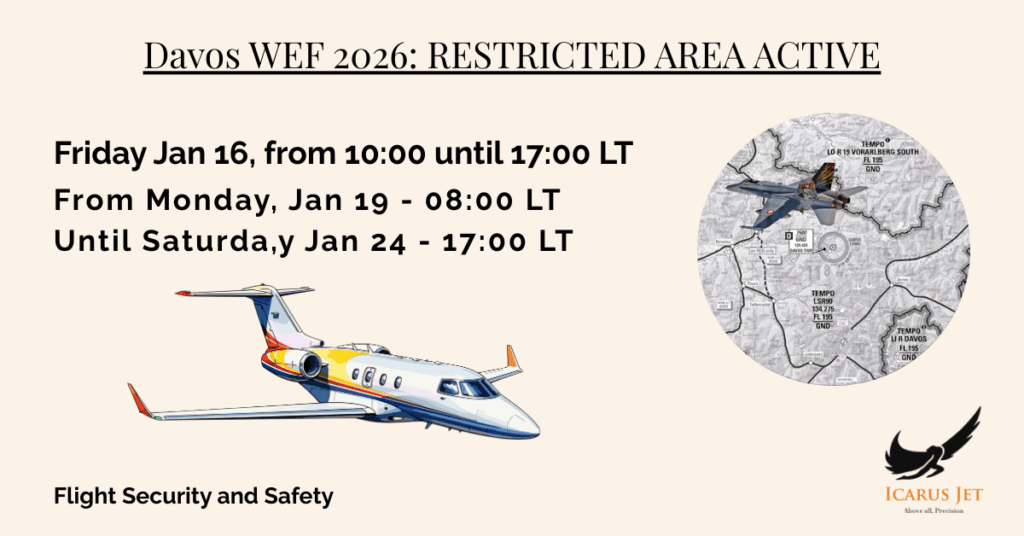
Airspace and security
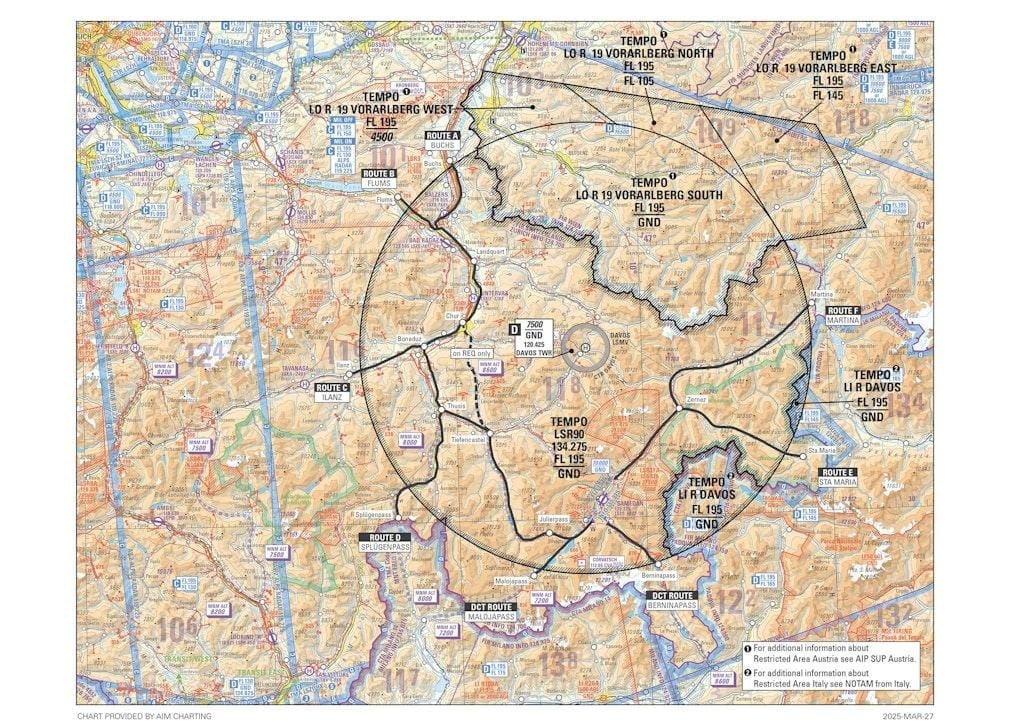
Swiss authorities impose reinforced airspace controls around Davos every year. A protected zone of roughly 25 nautical miles surrounds the area, with additional rules for aerodromes inside that radius.
In theory, this is straightforward. In practice, it removes room for interpretation.
Flights need prior authorization. Routing changes attract attention. Late documentation gets noticed quickly. There is little tolerance for improvisation once traffic peaks.
In a nutshell, this is not the week to test assumptions about flexibility.
Air traffic over territory of Switzerland and Liechtenstein will be restricted within a radius of 25 nautical miles (about 47 kilometers) from the center of Davos.
Geneva (LSGG)
Geneva is usually the first airport crews ask about. In our experience, it is also where misunderstandings show up early.
During the World Economic Forum, Geneva operates under mandatory Prior Permission Required conditions for non-scheduled traffic. Filing a flight plan is not approval. Parking confirmation through an approved handler is the gating item, and it must exist before departure.
One detail that still catches people every year is alternates. During Davos week, Geneva is typically removed as a planned alternate. Dispatchers cannot list LSGG as a fallback for other European destinations without specific authorization.
That matters more than it sounds. Crews accustomed to using Geneva as a safety net suddenly find it unavailable when plans shift.
If Geneva is your destination, it needs to be deliberate and locked in. Hoping for movement later is rarely productive.
Zurich (LSZH)
Zurich is where most Davos plans either hold together or start slipping.
Parking is the obvious constraint, so it does not need much explanation. If parking is not approved early, assume it will not appear later. Every year someone expects a cancellation to free space, and that usually does not happen.
Drop-and-go becomes the fallback. On paper, two hours on the ground sounds workable. In reality, it only works when timing behaves as planned. During Davos, timing often does not. Three arrivals within minutes, all needing de-icing, is enough to stretch that window immediately.
Wingspan limits matter more than people expect. Aircraft over roughly 17 meters arriving in the morning without approved parking tend to get pushed. Sometimes quietly, sometimes not. This is not always obvious from paperwork alone.
One point worth stating plainly, even if it sounds repetitive. Zurich stops being a safety net during Davos. If it is not part of the confirmed plan, do not expect it to rescue the plan later, because that assumption causes more stress than weather most years.
Secondary airports
Overflow airports exist, but they are not pressure valves. They are separate systems with their own constraints.
Dubendorf is commonly activated for parking relief, but it operates under strict permission requirements and movement controls. It solves one problem and introduces others.
Alternates such as St. Gallen-Altenrhein or Friedrichshafen can work, but only with planning. Customs availability, operating hours, weather exposure, and ground transfer complexity all matter. Treating them as simple substitutes is a mistake.
Secondary airports require just as much attention as primary ones, sometimes even more.
Ground transport and helicopters
The last leg into Davos is where schedules either recover or unravel.
Road transfers from Zurich normally take 90 to 120 minutes in winter. During the Forum, congestion and security checkpoints can extend that quickly. Plans that look reasonable on a timeline often stretch once vehicles hit the road.
Helicopter transfers are widely used for a reason. They offer predictability when weather allows. They also require advanced coordination inside restricted airspace. Helicopters are not a backup here. They are part of the primary logistics plan.
A one-way private ground transfer from Zurich to Davos during the Forum is commonly estimated around CHF 1,200. Pricing reflects demand and winter conditions.
Handling and de-icing costs
Cost assumptions should lean high during Davos.
An estimate at Zurich during the Forum includes approximately CHF 2,213 for handling, a WEF administrative surcharge around CHF 350, and de-icing costs near CHF 1,195 per event. That places a baseline estimate near CHF 3,758 per movement before fuel, parking, or additional services.
These numbers fluctuate, but the pattern does not. Davos is not the week where average costs apply.
| Cost item | Charging basis | Estimated amount (CHF) | Operational notes |
|---|---|---|---|
| Handling fee | Per flight | 2,213 | Standard handling charge applied by the FBO during WEF |
| WEF administration surcharge | Per flight | 350 | Additional coordination and security administration during the Forum |
| De-icing | Per event | 1,195 | Weather dependent, multiple events possible during extended ground time |
| Estimated total per movement | Per flight | 3,758 | Excludes parking, fuel, crew transport, catering, and additional services |
Environmental scrutiny
Private aviation during Davos draws attention every year. Regardless of how emissions figures are debated, crews should expect questions.
Many operators now plan for Sustainable Aviation Fuel where available, particularly in Zurich and Geneva. It does not change restrictions, but it changes conversations.
What usually goes wrong
Problems during Davos rarely come from a single failure. They come from a series of assumptions. Assuming alternates will be accepted. Assuming parking might open later. Assuming de-icing queues will behave normally. Assuming ground transport will absorb delays.
Those assumptions compound quickly. Davos punishes optimistic planning. Conservative, locked-in plans perform better, even if they feel inflexible.
Questions
Operating Private Jets During the World Economic Forum Davos 2026: questions the desk gets
Flying this route or region? Icarus Jet provides 24/7 trip support, flight planning, flight permits for private jet operators worldwide.
How early should parking and PPR be requested?
Six to twelve months is realistic, especially for large cabin aircraft or long stays.
Can Geneva or Zurich be used as alternates?
Often no. Both may be excluded during peak days.
Are drop-and-go operations reliable in Zurich?
They work when timing is seamlessly planned.
Is helicopter transfer dependable in January?
Yes, when weather allows and planning is done early.
Are costs higher across the board during Davos?
Yes. Handling, administration, and de-icing trend toward the upper end.
What restricted airspace applies around Davos during the Forum?
Swiss authorities restrict air traffic over Switzerland and Liechtenstein within a radius of roughly 25 nautical miles, about 47 kilometers, from the center of Davos, with additional rules for aerodromes inside that radius. Flights need prior authorization, routing changes attract attention and late documentation gets noticed. Special procedures typically run from about 13 to 29 January.
Where this sits
The guides around this one
Get it filed
Flying this region? Filed from the desk
Send the dates, the aircraft and the stops. You get the permits filed, the routing checked against the current picture, handling confirmed, and a number you can hold us to.
Contact UsPrefer to talk? Call +1 888 277 7203 or email tripsupport@icarusjet.com. The desk is staffed 24/7.