
Where It Goes: Aircraft Waste Systems Explained
While many passengers might prefer not to think too much about what happens after a trip to the lavatory, the truth is that, for crews and aircraft operators, it is an important issue. Not only do aircraft waste systems have clear practical implications for hygiene, but they are also a vital aspect of day-to-day operations and crew decision-making.
Reviewed by Kevin Singh, Founder · Fact-checked against Icarus Jet charter and operations data · Last updated 12 September 2026
The guide
This article takes a closer look at waste management aboard private jets, what really happens when you press that flush button, and how it all gets handled once the flight ends.
What happens when you flush
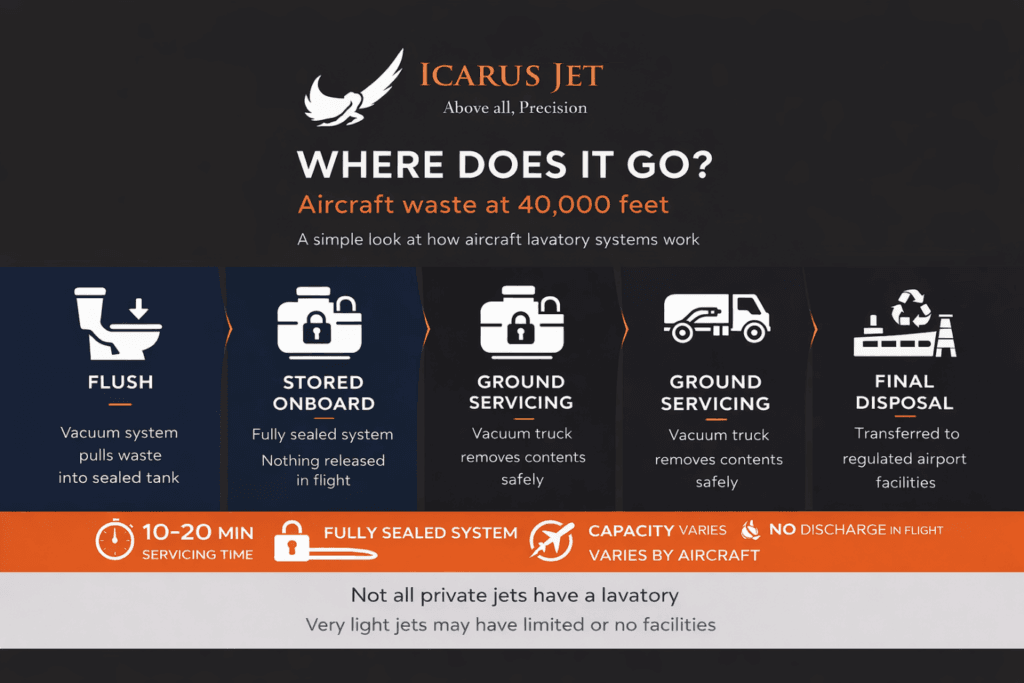
To begin with, modern aircraft toilets have little in common with their counterparts at home. There is no gravity-fed plumbing and no continuous water supply. Instead, most business jets rely on vacuum toilet systems.
For that reason, most private jets employ so-called vacuum toilets. They function by employing a suction system created through opening valves and using pressure differentials.
That is what creates the sound passengers hear when flushing in the lavatory. In addition, the system's design allows for minimal water use during flushing.
All of this is necessary to make aircraft lavatories efficient in terms of weight, minimizing water usage, and ensuring adequate hygiene.
In smaller aircraft, other methods may still be employed. In particular, chemical solutions are used as an alternative to vacuum-based lavatories. The result is always the same: any waste is stored inside the aircraft until servicing.
Not all private jets come equipped with a lavatory
It may seem that private jets inevitably come with their own onboard restroom, but this is not necessarily the case. Very light jets in particular may have no dedicated lavatory at all. On some aircraft, passengers will find themselves in an emergency lavatory, which is essentially an uncovered box offering little to no privacy.
For light jets, the situation changes somewhat. Some manufacturers equip this class of aircraft with a lavatory system. However, compared to larger aircraft, space and comfort remain severely limited.
For passengers, this means careful planning is required in advance, particularly for longer flights of two hours or more.
From the cockpit standpoint, it means managing passenger expectations, taking lavatory capacity into account when choosing an appropriate aircraft for a flight.
Lavatory waste storage at altitude
Once flushed, any waste is stored in the onboard tank. These tanks are located towards the back of the plane, right next to the lavatory itself.
It is worth considering the following points about these systems:
1. It is fully sealed: It might surprise some passengers that waste is never spilled or otherwise released from the aircraft during a flight. This is one of many myths associated with aircraft lavatories.
2. Capacity limits: Even though tanks vary in capacity, there is always a finite amount of room available for waste collection. Depending on the flight type, passengers, and aircraft size, it may become an issue, especially during longer trips.
3. Odor control: Most private jets use vacuum technology along with chemical fluids. This eliminates the possibility of unpleasant odors in the cabin, assuming the systems are functioning properly.
4. Temperature considerations: At cruising altitude, temperatures outside the aircraft fall far below zero. Lavatory systems and tankages are designed to work in such conditions.
What happens after landing
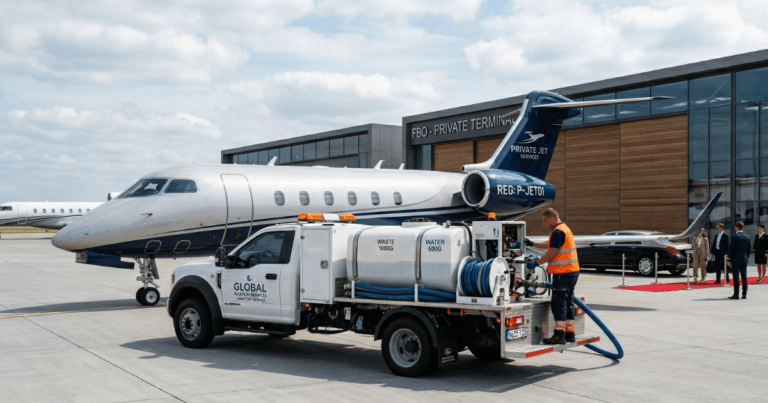
Once an aircraft lands, it must be connected to specialized equipment that safely removes waste stored on board. Such specialized equipment is known in the industry as a lavatory service truck. Depending on the specific manufacturer and airline policies, it may differ significantly in size and appearance.
The process itself is carried out as follows:
Positioning and safety checks: The truck is positioned near the aircraft and secured to ensure safety during the operation.
Connection to the service panel: Most commercial and private aircraft have an access point designed for servicing.
Vacuum extraction: The vacuum pump in the lavatory service truck sucks out the contents of the holding tank.
Rinse and recharge: After the tank is emptied, it is often rinsed with water or a cleaning solution. Fresh chemical fluids may be added depending on the system type.
Transportation: Finally, the waste is transported to specialized airport facilities, where it is properly disposed of in accordance with applicable environmental regulations.
In most cases, lavatory servicing takes between 10 and 20 minutes per aircraft. The exact duration depends on the aircraft size, how full the tank is, and how efficiently ground services are coordinated. While it is usually completed alongside fueling and cleaning, delays in servicing or equipment availability can still affect turnaround times.
You might also like: Potable water on private jets: a closer look from the ground
Why this matters operationally
For crews and aircraft operators, the servicing of lavatory systems has several implications. The serviceability of these systems directly impacts turnaround times, as aircraft must be attended to quickly to allow for timely take-off and boarding.
At the same time, reliability is a key concern, since a malfunctioning lavatory system can affect the ability to conduct a flight as planned. Passenger satisfaction also plays a role, as complaints about the lavatory's condition can reflect negatively on the operator’s image.
Furthermore, for ground handling personnel, lavatory servicing is one of the duties that must be performed precisely and accurately. Their responsibilities include ensuring the safe connection and disconnection of hoses, preventing any spillage or contamination, performing quality control after servicing, and cooperating with the crew to check the condition of the system.
Misconceptions about aircraft waste
There are a few persistent misunderstandings about aircraft lavatory systems that are worth addressing.
“Waste is dropped mid-flight”: This is completely false. Modern aircraft use sealed systems that keep waste inside the tanks.
“The blue liquid is just for color”: In some private jets, the blue liquid is used to break down waste and eliminate bacteria.
“All aircraft have the same lavatory setup”: As explained previously, lavatories vary based on the aircraft class.
Practical tips for briefing passenger
Passengers themselves can play a significant role in ensuring the effective operation of lavatory systems.
- Using only approved products in the lavatory
- Inappropriate products, like wet wipes, can obstruct drainage pipes
- Being mindful of lavatory capacity, especially when dealing with smaller aircraft without an onboard restroom
- Understanding that lavatory service is normal
- Lavatory service occurs on the ground before or after the flight
By keeping these points in mind, passengers can help maintain aircraft lavatory systems.
A system that works because it is managed
When things go according to plan, aircraft lavatory systems are something nobody wants to think about. For aircraft crews and operators, however, they represent yet another system that needs to be maintained and monitored.
For crews, it is another system to monitor. For ground teams, it is a task that requires precision and discipline. For passengers, it is a reminder that even the least visible parts of aviation rely on well-coordinated processes.
Questions
Questions about the cabin systems
Is the waste released from an aircraft in mid-flight?
No. Aircraft use sealed systems that store any waste onboard for later servicing.
Why do some aircraft use blue fluid in toilets?
It is a substance used to break down waste.
How often is the aircraft lavatory tank drained?
This varies depending on the type of aircraft, mission, and flight frequency, but typically occurs every time an aircraft lands.
Can the lavatory system fail during a flight?
While uncommon, it is possible. Passengers may be restricted from using it, or crews may choose to alter the flight path.
Where is the waste transferred from the aircraft?
After servicing, waste is transported to special facilities designed for this purpose.
Do all private jets have a toilet?
Most above the smallest category do, but the arrangement varies enormously, from a curtained seat to a fully enclosed washroom with a door. Light jets can have restricted access that is awkward for taller passengers. If it matters for a long sector, confirm the layout of the specific aircraft.
Where this sits
The guides around this one
Pricing a real trip?
Send the dates, the passengers and the stops. You get a named aircraft, itemised pricing, the operator checks done and a number you can hold us to.
Contact Us