
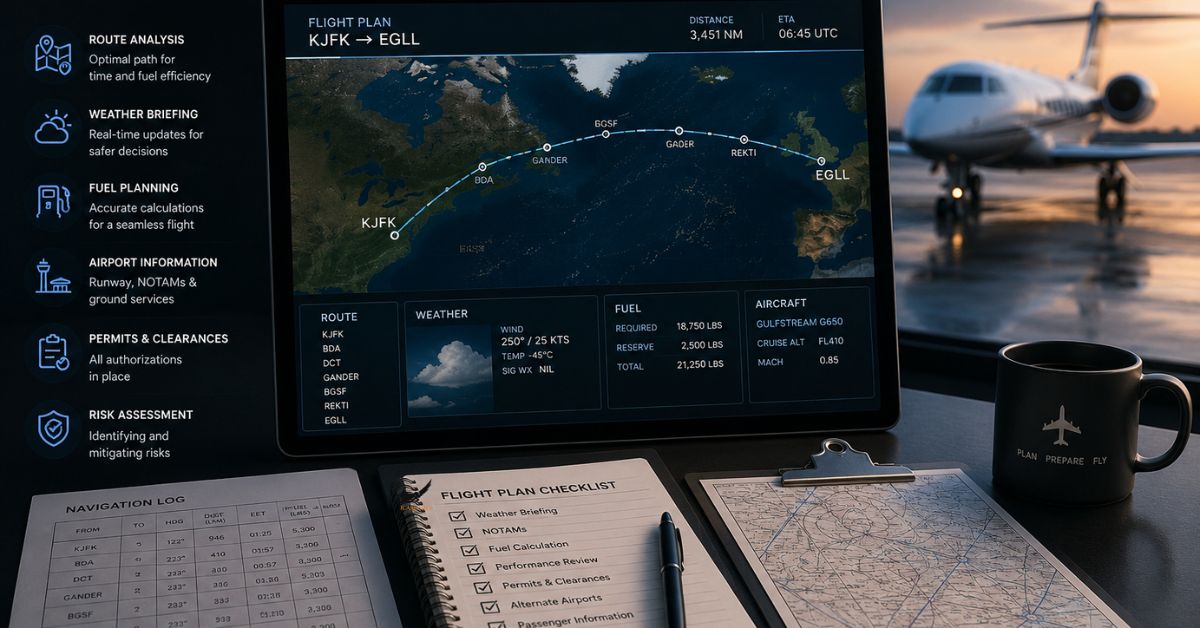
How the expectations of today’s private jet captains are redefining trip support.
Every captain knows that a flight plan is only one part of preparing an international mission.
The route might be complete, fuel calculations verified, performance and alternate airports selected, but the operation is far from being ready. An international flight is a set of connected tasks, most of which lie outside the cockpit but greatly affect the aircraft’s departure time and how it arrives at its destination.
For modern flight departments, the choice of a trip support provider is no longer based on the services offered but on the provider’s ability to manage the entire operation with the same degree of accuracy and thoroughness expected on the flight deck.
Meeting the operational expectations of today’s private jet pilots
The role of a trip support provider has evolved alongside business aviation itself.
Nowadays, captains operate in an environment of constantly changing schedules, constrained airport capacity, and a growing number of regulations, while passengers in private aviation expect flexible options, which is why they change their plans right up to the moment of departure.
As a consequence, captains expect the trip support team to look beyond individual services and manage the entire mission. Filing permits, coordinating fuel supply, arranging parking and ground handling, and monitoring airport restrictions – these are parts of a single operation that need to stay connected and synchronized throughout the mission.
Moreover, captains expect a proactive approach. They would like to know that the changed departure time was already notified to the handling agent, that the catering was redirected to the new FBO, that the driver’s details were adjusted, and that the customs requirements remained in compliance after the last-minute change of passengers.
The fewer operational issues that reach the flight deck unresolved, the more time crews can dedicate to preparing and operating the aircraft safely.
In the end, the best trip support providers understand the captain’s thinking. Every decision made prior to departure should make the operation easier and allow the crew to fly without any worries about what is going on around them.
You might also like: ETOPS, private jets, and the “Time in Jeopardy” myth
Every change creates a chain reaction
Private aviation operations are based on flexibility, but every change has operational consequences.
Changing the departure time affects airport slots, ground handling schedules, crew transportation, and fuel uplift. The addition of a passenger might require changes in eAPIS submission and customs documents. Changing the destination might require amending overflight permits, parking and handling arrangements, and operational briefing.
None of the above-mentioned events is uncommon. These things happen every day in private aviation.
The difference lies in how quickly these changes are identified, notified, and corrected before they become a problem for the crew.
Experienced captains know that most operational delays are caused by administrative details rather than technical ones. The missing permit, outdated passenger information, or incomplete handling arrangements can become obstacles to a mission that would otherwise have gone smoothly.
Flight planning extends well beyond the route
Preparation for an international flight is not limited to selecting the most efficient route.
Every mission requires the precise coordination of handlers, airport authorities, permit offices, fuel suppliers, customs agencies, security companies, and many other organizations that must operate under different procedures and timeframes.
Good trip support providers understand that the above-mentioned services cannot be managed in isolation. One delay affects many services. Changing the arrival time affects passenger transport. The parking restriction might require the repositioning of the aircraft. A runway change might affect fuel planning and departure performance. Airport operating-hours restrictions might require changes to the entire itinerary.
The goal is not only to perform a specific task, but also to ensure continuous operation from the moment of the request until the aircraft’s return.
Local partnerships make the difference
Not all operational challenges can be handled through systems and procedures.
When a passenger requests a revised catering order prior to departure, the aircraft is repositioned to another FBO, or the meeting runs over for several hours, the success of such situations usually depends on the local partners.
Good relations with reliable local partners make it possible to order additional catering, adjust the delivery location, rearrange crew transportation, obtain additional services, or respond quickly to changes in the airport situation.
The same applies to the fuel providers, handling agents, and airport authorities. Good relations developed over years of collaboration make it possible to solve problems quickly, often even before they come to the attention of the flight crew.
For captains, such relationships mean that it is possible to manage the operational changes without jeopardizing the mission.
You might also like: Europe’s summer slot constraints: what private jet pilots need to know
Communication is part of operational excellence
Captains should not spend their time obtaining permits, handling requests, or confirming with suppliers during aircraft preparation.
Captains want concise, clear information and timely updates in case operational changes require their attention. All other issues should already be sorted out.
Experienced trip support teams become the focal point of communication for all organizations involved in supporting the flight, ensuring that everyone works with the most recent data and that changes are made consistently throughout the mission.
That level of coordination reduces workload on the flight deck and allows crews to remain focused on aircraft preparation, performance calculations, weather and safety.
Why captains choose partners they can trust
Every captain signs for the flight.
It is obvious that responsibility influences how flight departments assess the companies that support their operations.
Reliability, responsiveness, and understanding of international procedures are valued more than a long list of services. The captains appreciate providers who can anticipate problems before they arise and proactively communicate when circumstances change.
Trust is earned during flights when everything does not go as planned.
Trust is earned when the revised permits are already approved before the captain asks for them. When the handling agent gets the adjusted schedule. When the additional catering is delivered to the right FBO despite the last-minute change. When the passenger transport waits for the crew, and all operational partners work with the most recent itinerary.
These are the moments that determine the partnership’s destiny with the trip support provider.
Behind every successful mission is exceptional coordination
The private aviation industry continues to develop, as do the expectations of the flight crews and the providers who support them.
The captains need not only individual services but also the certainty that every operational aspect of the mission is managed precisely, communicated proactively, and adjusted quickly in the event of changes.
Because passengers see the journey, while captains are responsible for the operation.
The best trip support providers understand the difference and strive for the same goal as the flight crew – providing a safe, efficient, and seamless operation from engine start to shutdown.