To the inexperienced charter customer, the final bill may seem disproportionate to the flight time. The final bill may be five figures for a two-hour flight. The immediate reaction may be to compare it to the cost of an economy seat on a commercial airliner. The comparison is understandable, however, it is at this point that confusion begins.
Pricing in private aviation is not per seat. It’s based on the entire aircraft and the entire mission. Once one understands this concept, the pricing structure of chartering an aircraft is clear and consistent.
The aircraft’s hourly economics
Every aircraft charter begins with the aircraft’s hourly costs. The aircraft’s hourly costs are the total costs required to keep it in the air and ready to fly.
The most obvious expense is fuel. Fuel is not the only expense. Engine programs, maintenance reserves, replacement parts, crew salaries, recurrent training, insurance, hangarage, and financing are among the costs. These costs are required whether the aircraft carries passengers or not.
As aircraft increase in size, so do fuel consumption, maintenance complexity, and crew requirements. Therefore, these aircraft increase in hourly costs.
Regional differences in charter pricing
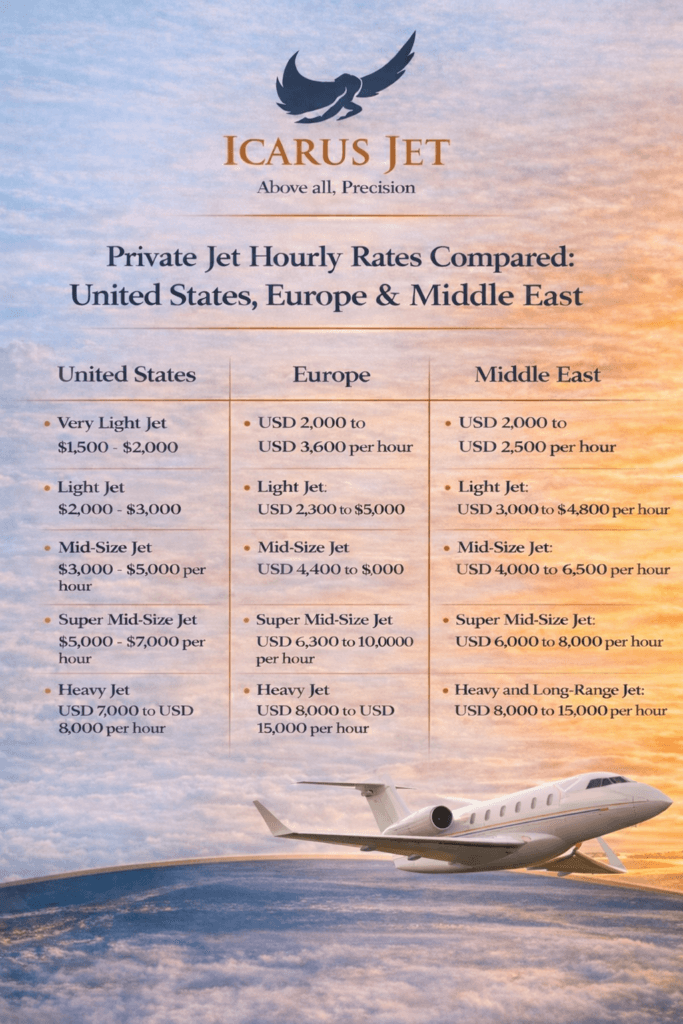
Charter pricing varies across regions of the world.
The United States enjoys favorable conditions, with a large fleet, high operator density, and extensive secondary airport infrastructure. Fuel costs are also lower than in Europe, making domestic flights easier to operate.
Europe faces slot restrictions, higher airport fees, crew duty restrictions, and possible VAT exposure. All these add layers of complexity to flight costs, extending beyond flight time.
The Middle East uses long-range aircraft given its geography and flight mission profiles. The need to operate over borders, coupled with premium airports, increases hourly rates.
Understanding the region’s overall regulatory and infrastructure landscape helps explain price differences across regions, given the same flight times.
Furthermore, charter flight pricing is also dependent on demand, timing, and availability. During peak season, aircraft availability may be lower, leading to higher prices.
Flexibility in departure times, alternative airports, or aircraft category can sometimes help with cost efficiency. Timing is relevant to practical total cost missions.
Why the final price is more than hours multiplied by rate
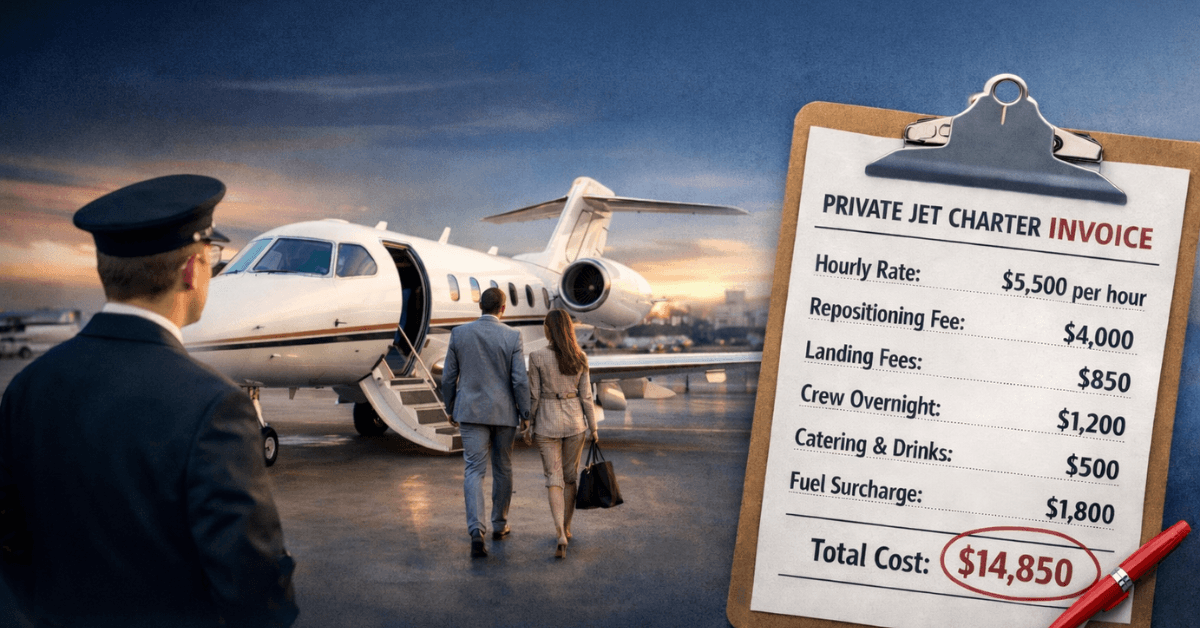
The client normally multiplies the flight hours by the number of hours flown and expects that to be the final price. However, other operational costs are factored in.
The first is the aircraft’s positioning. If the aircraft is not based at the airport from which you are departing, it has to travel from its base to the airport where you are departing to come and get you. After dropping you off at your destination, the aircraft can return to its base.
The second one is the minimum usage. This normally varies between two hours every day. Even if the flight takes one hour, the two hours are charged because the aircraft is booked for your use alone.
Airport charges are an additional factor that increases total costs. Each airport has its own rates for landing, parking, and ground handling charges. The rates may be higher at larger airports, especially in Europe and the Middle East, than at regional airports in the United States.
Another operational aspect is crew logistics, which includes crew hotel costs and pilot allowances for multi-day flights. This is another operational aspect of flight costs, a mission-related one.
If the flight is international, permit fees, navigation fees, passenger taxes, and VAT exposure may also apply, especially to flights to certain European countries. All these are regulatory aspects, and the total may vary significantly.
When all these factors are taken into consideration, the overall invoice may be clearly outlined.
Why private aviation is considered a luxury
Luxury may imply indulgence, but in the case of private jet charter, it is more about exclusivity and control.
When you charter an airplane, you are essentially renting the entire airplane, including its operational ecosystem. The crew works exclusively for you, traveling with you to your destination. The flight takes off at the time you specify, not at some other time that may be inconvenient to you.
There is no sharing of costs with other passengers, unlike commercial airlines, where you may be forced to pay the same amount regardless of the number of passengers.
The airplane burns the same amount of fuel and incurs the same maintenance costs regardless of the number of passengers. So, the overall cost of the flight may seem high, especially if you are traveling with just two people rather than eight.
The value of charter flights lies in their exclusivity, flexibility, and efficiency.
The impact of aircraft size
The aircraft category is an essential factor that influences flight capabilities and costs.
Very light jets are appropriate for short regional flights. They can operate from smaller airports with lower fuel costs. Light jets offer greater range and cargo capacity while remaining appropriate for regional flights.
Mid-size and super mid-size aircraft provide increased range, speed, and stand-up cabins. The increased operational capabilities of these aircraft result in increased fuel costs and maintenance exposure.
Heavy and long-range jets are designed for intercontinental flights. They require increased crew, higher insurance coverage, and higher maintenance costs. This is reflected in hourly rates, with some operators charging up to 15,000 dollars in Europe and the Middle East.
The price differences between different types of jets are based on operational capabilities, not appearance.
The importance of transparency
The problem for many clients is not that charter pricing is not justified, but that the pricing model is unknown.
A clear quote should include:
- Flight hours billed
- Positioning time
- Airport and handling fees
- Crew overnight expenses
- Taxes and permits
The pricing for a private jet is a complex operational calculation that represents the true cost of using a dedicated asset and crew for a specific trip. You can charter a private jet to any destination in the world with utmost transparency and comfort; call our charter team today and learn why spending time with your loved ones is the ultimate luxury.
FAQs
Why is there a daily minimum if my flight is short?
Most aircraft operate for a minimum of 2 hours per day. This means that even a short trip will occupy an aircraft and crew for a day.
What is positioning, and why is it included?
Unless you are flying from an airport that is home to your private jet, you will require positioning, which means that an aircraft will need to fly in to collect you and then return afterward.
Why are rates higher for flying to Europe or the Middle East?
The cost of fuel, airport charges, permits, and taxes is normally higher in Europe and the Middle East, which increases costs over many U.S. domestic routes.
Are airport and crew costs informed?
The answer is normally no, but a transparent invoice should clearly identify airport and crew costs separately.
Is there any way to reduce the overall cost?
Being flexible with aircraft size, departure airport, and travel date will help reduce costs.