
How the Middle East Crisis Is Reshaping Fuel Planning for Private Jet Pilots
Fuel planning is one of the most structured aspects of any private aviation operation. The burn rates, fuel prices, alternates, and uplift strategies are all carefully calculated before every flight. Normally, all these variables are stable and predictable.
Reviewed by Kevin Singh, Founder · Fact-checked against Icarus Jet fleet and airport operations data · Last updated 10 September 2026
The guide
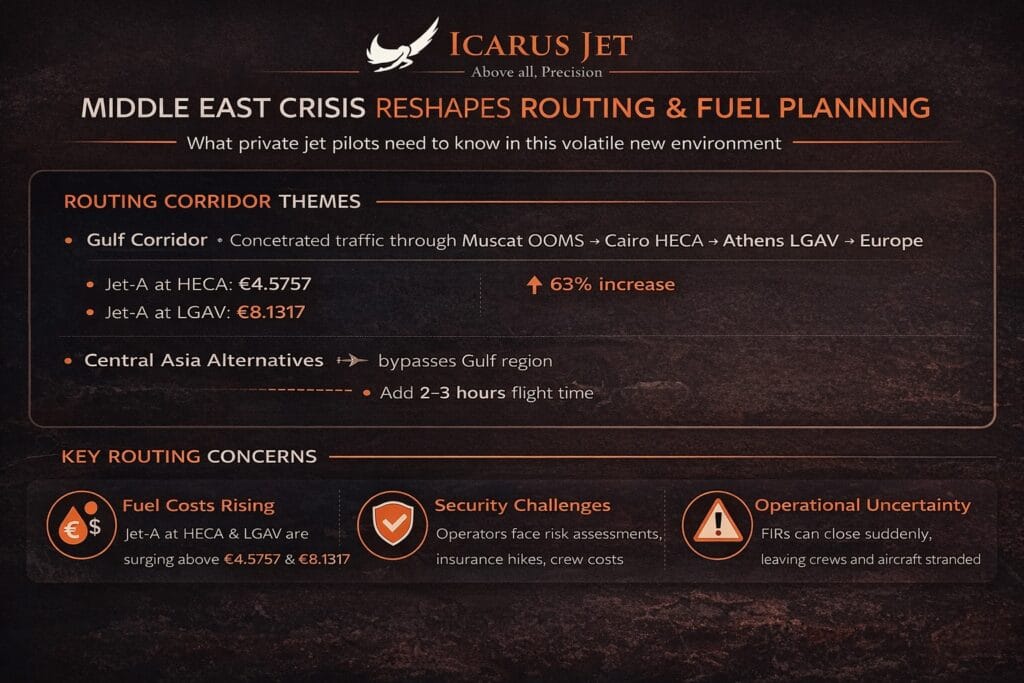
Gulf FIR closures have pushed Middle East to Europe traffic onto a corridor from Muscat (OOMS) via Cairo (HECA) to Athens (LGAV). Jet-A at Cairo rose from 2.8665 on 12 January 2026 to 4.5757, and Athens has reached 8.1317. Routing north via Almaty (UAAA) avoids the Gulf but adds two to three hours, forcing extra fuel stops for mid-range jets. Insurance, hazard pay and sudden FIR closures also drive mission cost.
However, in the current environment, the crisis in the Middle East has introduced an unpredictable factor into fuel planning for any private jet operating in this region.
In other words, fuel planning is no longer just an exercise in calculation and strategy. It is now an art that requires operational awareness, safety considerations, and constantly evolving routing strategies due to the regional crisis.
The new routing corridor to Europe
There are several airspaces in the Gulf region that are currently restricted, which means that operators from the Middle East bound for Europe are limited to only a handful of routing corridors.
One of the main corridors starts from Oman and usually begins from Muscat International Airport (OOMS). From there, it is common for aircraft to head to Cairo International Airport (HECA) in Egypt before continuing on to Athens International Airport (LGAV) and finally into Europe.
This is already proving to be one of the most reliable routes for operators from the Middle East bound for Europe during Gulf FIR closures.
The concentration of traffic on fewer airfields is bound to affect fuel prices and demand.
Cairo International Airport has already experienced significant variations in fuel prices over a relatively short period.
For example, Jet-A fuel in Cairo increased from 2.8665 on 12 January 2026 to 4.5757 currently, reflecting a sharp rise over a short period.
Athens International Airport, which remains a key part of this routing corridor, is now seeing significantly higher fuel pricing, with Jet-A reaching 8.1317, positioning it as one of the most expensive uplift points in the region.
These changes also point to the need to assess not only the viability of the route but also the volatility of fuel prices in planning these routes within the region.
The alternative route through Central Asia
One response to the crisis in the Middle East has been to avoid the region altogether. One of the main alternatives to the Gulf route is to go north through Central Asia.
This route takes a flight to Almaty International Airport (UAAA) in Almaty, Kazakhstan, before continuing westward to Europe.
From a security perspective, this route is more attractive because it avoids the Gulf region altogether. However, this route also has its own set of challenges.
The main difference in this route is the additional two to three hours in flight time.
This difference will not be significant for long-range aircraft such as the Gulfstream G650, Global 7500, or Global 6000. However, the additional fuel burn and the implications on duty time also need to be evaluated.
The extra flight time will be more significant for mid-range aircraft because it will require additional fuel stops, increasing the route’s complexity.
Many aircraft operators are now undertaking route comparisons before each flight to assess the additional flight time required to fly north through Central Asia against the operational challenges in the Middle East.
Fuel Prices: Just one factor to consider
When planning fuel amid the crisis in the Middle East, it is easy to get caught up in Jet-A prices in each region. However, it should be understood that fuel prices are just one factor to consider in planning these routes.
Flights near conflict zones may also require additional operational precautions, and these factors add up in terms of cost.
Many operators now conduct a safety and security assessment before approving flights in specific regions of the Middle East. These assessments may include company leadership, flight operations, security teams, and insurance companies.
Insurance costs may also vary significantly because flights in conflict zones may need additional insurance coverage. Crew costs are also a factor. Many operators now offer hazard pay when flying in volatile regions.
When you add these factors to fuel prices, you can see how a mission cost can vary significantly beyond a simple comparison of fuel prices.
For this reason, experienced operators consider the overall operation costs, not just fuel prices.
You might also like: What drives private jet charter prices during conflicts
The Risk of sudden FIR closures
The most difficult aspect of flying in an unpredictable region is possibly the sudden closure of airspace.
If a flight is on the ground when a security threat occurs, such as a missile strike or military action, aviation authorities may suddenly close the FIR.
Flights cannot depart when this occurs. The closure duration is entirely at the discretion of the aviation authorities in the region. In some cases, this closure may be short while in others it may be extended.
For private jet crews, this situation creates an additional layer of operational risk. The aircraft, passengers, and crew can remain grounded for longer periods than initially anticipated.
In light of this situation, many private jet operators now conduct additional risk assessments before committing to flights in these regions.
The importance of operational coordination
During periods of regional instability, trip support providers play a vital role in assisting flight crews.
Monitoring the status of FIRs, fuel arrangements, and alternate routes requires communication between ground staff and flight departments.
Accurate information on fuel pricing, airport congestion, and flight restrictions enables the crew to plan flights with confidence.
For long-range private jet flights, this communication is vital to ensure a smooth flight rather than a major operational hindrance.
The ongoing Middle East crisis has shown that the assumptions underlying flight planning can change quickly. The fuel planning, airspace, and security issues are now all connected.
Private jet pilots flying over this area should keep their routing strategies flexible while staying aware of the latest situation.
Questions
Fuel planning in the crisis: questions the desk gets
For the full operational picture this season, see our guide to what has changed for private jet flights to the Middle East in 2026.
How should pilots plan fuel during airspace disruptions?
Pilots should prioritize flexibility by carrying additional contingency fuel and identifying reliable alternate fuel stops in case rerouting or sudden FIR closures occur.
Why are Cairo and Athens becoming common fuel stops?
With airspaces over the Gulf closed due to the crisis, the route via Oman, Cairo, and Athens has become one of the most reliable links between the Middle East and Europe.
Why are some operators avoiding the Middle East route?
Operators prefer to take the Central Asian route via Almaty, a city in Kazakhstan, to avoid airspace being closed due to the Middle East crisis.
How much longer is the Central Asia route compared to the Middle East route?
Depending on the departure point and aircraft type, this route may increase flight time by two to three hours compared to the usual Middle East route.
What happens if the airspace closes while an aircraft is on the ground?
If an incident occurs that closes the airspace within a FIR, an aircraft may not be allowed to depart until the aviation authorities reopen it. The time it takes is up to the local authorities.
How does the desk plan fuel on a Gulf to Europe sector now?
It prices the uplift at each candidate stop on the Muscat, Cairo, Athens corridor against the aircraft range, files the permits for the stop it picks, and keeps an alternate stop in the plan in case a FIR closes on the day.
Where this sits
The guides around this one
Planning a Gulf to Europe sector? Filed from the desk
Send the dates, the aircraft and the stops. You get the permits filed, the routing checked against the current picture, handling confirmed, and a number you can hold us to.
Contact Us