Crews of private jets flying into Beijing Daxing International Airport (ZBAD) should be aware of a recent change that affects ground handling and the availability of parking spaces.
As a result of the updated security regulations, all self-taxi parking stands at ZBAD have been closed. Nevertheless, the airport is currently available for business aviation flights, and no other flight bans have been imposed. Consequently, the flexibility of the aprons has decreased, and parking space availability has become more competitive.
At the moment, it hasn’t been determined when the former stand configuration will be reinstated. Therefore, crews flying into Beijing Daxing International Airport should be conservative, request a parking spot early, and be prepared for alternatives, especially during peak times.
Changes to apron configuration at ZBAD
As a result of the closure of the self-taxi stands, aircraft are no longer allowed to taxi independently into the previously assigned GA parking spots. Instead, the aircraft’s movement has become more controlled, and its positioning requires more coordination.
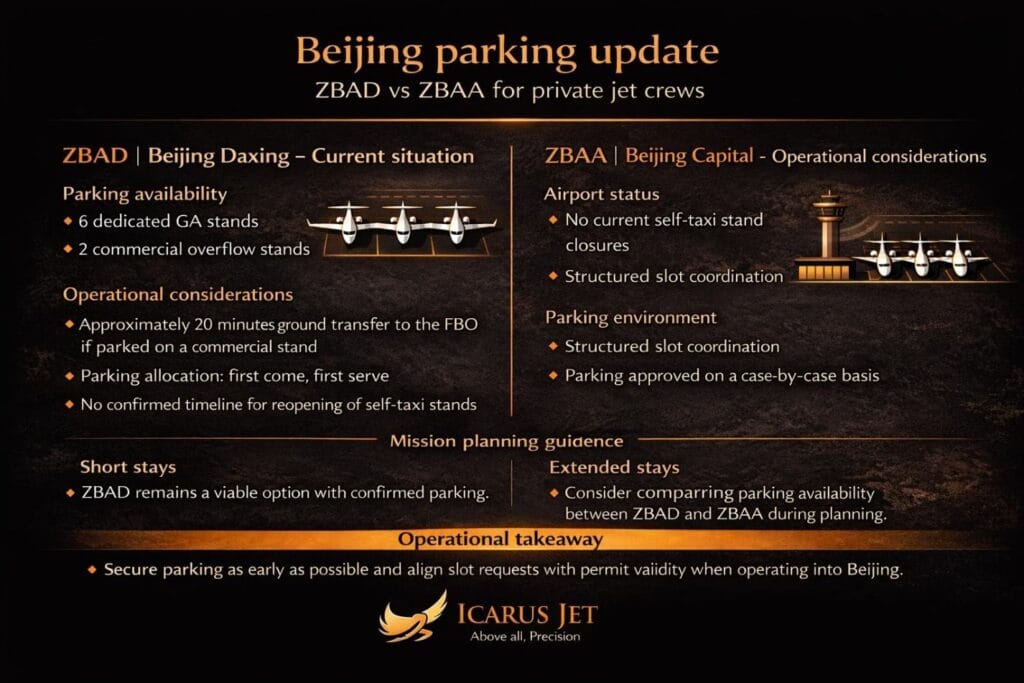
At the moment, six stands are available in the General Aviation Area. Additionally, two stands can be borrowed from the commercial flight area, subject to operational feasibility. This means that a total of eight stands are available, but only six are available for business aviation flights.
The two stands borrowed from the commercial flight area are about twenty minutes away by vehicle from the FBO. Although the stands are available for use, the distance creates additional challenges for the crews of private jets flying into Beijing Daxing International Airport ZBAD.
Stand allocation follows a strict first-come, first-served policy. There are no set GA reserves apart from the coordinated allocations. After the allocation of the stands, the flight may have to consider revising the parking duration or consider repositioning.
What this means for crew logistics and planning
What this means for flight crews is that the issue will be more logistical.
If allocated to a commercial area, the flight will have to factor in extra time for ground transport. Passengers will have to be coordinated earlier. Supervising the fuel uplift will require the flight to arrive at the ramp earlier. There will be a requirement to factor in extra time for the catering uplift.
For same-day flights, this will require the flight to block the time very conservatively. For multiple-day parking, this will require the flight to confirm early, especially when government meetings, trade expos, and seasonal business peaks are on at Beijing.
The main airports in China already operate under a structured parking regime. Long-term parking at the main airports can already be restricted. Given the limited flexibility at the ZBAD, the scope for last-minute parking requests will be limited.
You might also like: Private jet operations and parking in China: A pilot’s guide
Evaluating ZBAA within Beijing operations
Depending on the mission profile, the Beijing Capital International Airport may offer an alternative.
ZBAA is not subject to the same self-taxi limitations. Although slot allocation at ZBAA is restricted, apron allocation can be more predictable.
However, it is worth noting that parking restrictions at major airports in China are not unique. Business aviation is conducted under a highly structured regulatory environment governed by the Civil Aviation Administration of China. At busy airports like Beijing, commercial flights may be given priority during peak hours.
When the duration is extended or the flights are connected with a significant event impacting the Chinese government or economy, the evaluation of ZBAD and ZBAA at the start of the planning phase is a significant advantage.
Decisions on which airports to use must be based on the duration of the parking permits and the timing of the slots rather than habit or previous route.
Operating into China: permits, slots, and regulatory precision
While the adjustments at ZBAD do not change the overall regulatory structure for China flight permits, they do add precision to the overall procedure.
China landing permits must include complete documentation of aircraft registration, airworthiness certificates, worldwide insurance coverage, crew member licenses and medical certificates, and complete passenger information. Changes to the flight schedule or route may require changes to the landing permits. This may impact on the overall timing.
Slot approvals must be fully aligned with the validity window on the landing permits. Even small differences between the permitted landing times and slot approvals may necessitate re-coordinating the slots.
China does not offer the same level of flexibility with short-notice flights as other regions. Accuracy is vital while ground handling is also structured. CIQ clearance, ramp handling, fuel releases, catering, and crew identification also follow a structured path. When the apron space is limited, the handling must be precise. Making last-minute adjustments is not possible.
Crews should also ensure that dispatch teams are promptly notified of any schedule adjustments, so that slot and parking allocations are not jeopardized.
Planning conservatively under current ZBAD conditions
Unless otherwise advised by the airport authorities, crews should plan for the current apron configuration to remain the same at ZBAD.
Crews are advised to make early requests for parking and to build buffers into the schedule for the possibility of being assigned a commercial stand and additional ground transfers. Slot alignment must also be carefully validated to ensure permit validity.
For short missions, minimizing time parked at ZBAD might be advantageous, avoiding the competition issue. For longer stays, a side-by-side evaluation of ZBAD and ZBAA during the planning phase provides operational protection.
Again, these restrictions have no impact on private jet operations for ZBAD crews; they affect the aprons’ flexibility and the need for early coordination. Out trip support team is ready to assist during your next China operation.
FAQs
Is ZBAD still open for business aviation operations?
Yes, the airport is open to business aviation operations, and the change has no impact on crews' ability to operate at ZBAD.
How many stands are currently available for GA operations?
Six stands are available in the General Aviation Area, and two additional stands on the commercial side may be available, depending on the feasibility of the operation.
How are the available stands allocated for GA operations?
Stands are allocated on a first-come, first-served basis, and early requests are strongly advised.
What operational impact should crews expect if assigned to a commercial stand?
Approximately 20 minutes of ground transfer between the aircraft and the FBO should be considered for the operation.
Is there a confirmed timeline for reopening the self-taxi stands?
No. There is no confirmed date from airport authorities regarding the restoration of the previous apron configuration.