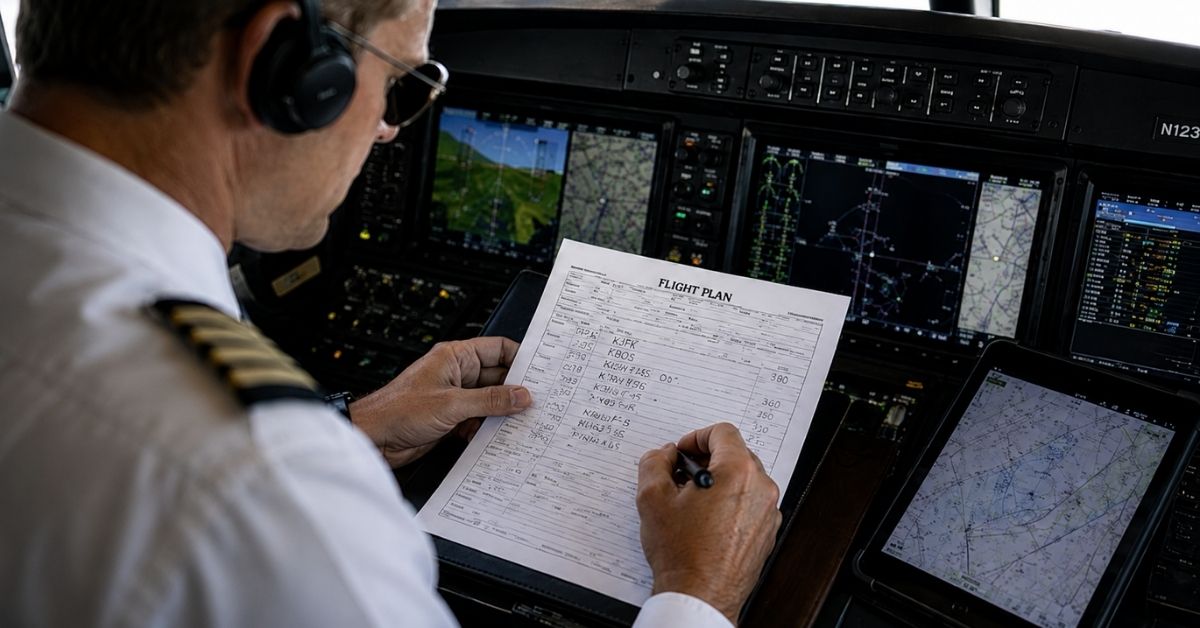

A computerized flight plan provides the route, fuel, winds, weights, and navigation data, but turning those numbers into a safe and executable flight requires an ongoing exchange between dispatch and the flight deck. Icarus Jet breaks down what each side sees when reviewing the same flight plan.
A flight plan is not a simple document. It includes complex data on the route, distance, estimated flight time, fuel, and other details. For the dispatcher and the Captain, however, those numbers trigger different questions.
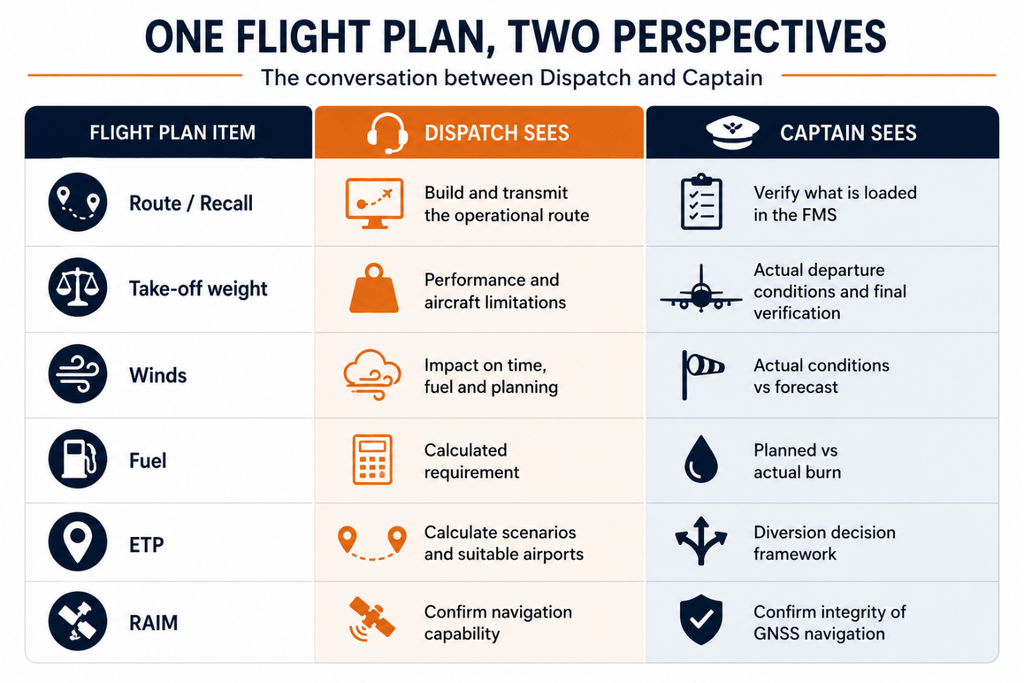
From the dispatcher’s side, these numbers let them check whether a flight can be performed safely and successfully according to the plan. From the flight deck, these numbers raise questions about how the plan will play out on the aircraft and in the air.
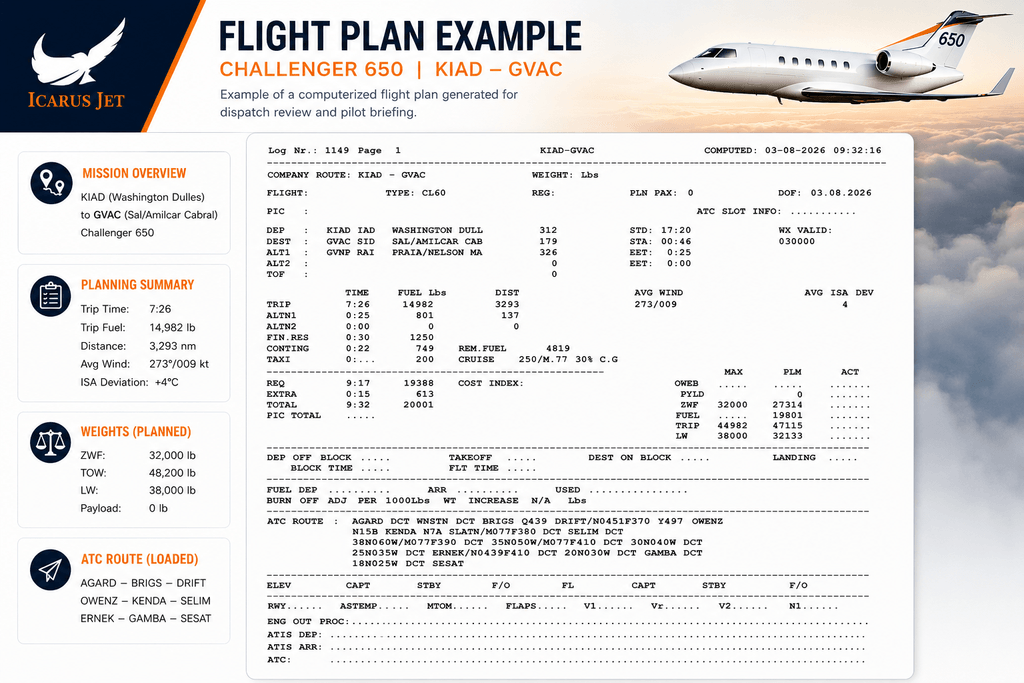
Using one of our recent flight plans, KIAD-GVAC on a Challenger 650, as an example, these differences become more apparent. This plan covered about 3,252 nm, requiring 7 hours and 19 minutes of flight time.
Dispatch: First, can we build an executable plan?
One of the first things in the flight plan is the recall number. Yet, before the flight plan ever reaches the aircraft’s FMS, considerable work has already taken place. Dispatch plans the flight with fuel requirements, weather, potential diversion alternates and aircraft performance in mind, bringing those elements together into the computerized flight plan.
That package is then sent to the Captain electronically, whether by email or through an application such as ForeFlight or ARINCDirect on an iPad. This creates an important review point well before the crew enters the recall number into the FMS. The Captain receives the computerized flight plan, reviews operational details, and approves the plan.
Only later, on the flight deck, does the recall number become relevant as the route is retrieved into the FMS and verified against the plan the Captain has already reviewed.
From the dispatcher’s perspective, this number links the flight plan to the aircraft. Operations procure this number, and the provider can send it as an ACARS uplink. The crew enters the number in the Flight Management System (FMS), and the FMS retrieves the associated route, airways, and waypoints.
However, retrieval of the route is not enough.
Captain: “Once it is in the FMS, we still need to verify that what has been loaded corresponds with the flight plan and clearance.”
In other words, the crew verifies the origin and destination, route, waypoints, airways, SID and STAR information, flight levels (if necessary), and navigation requirements.
This is the first example of the pattern that repeats throughout flight planning: while dispatch builds and validates the plan, the crew provides operational verification.
Dispatch: What does 07:19 actually mean?
According to the plan, the flight time is 07:19. Together with the planned departure time, this figure produces the planned arrival time.
The figure is based on the route, forecast winds, aircraft performance, cruise levels, expected speed, departure conditions, and potential ATC restrictions.
Dispatch: “07:19 is not a guarantee. It is a result of the operational calculation made with the information available at the moment of calculation of the plan.”
Wind and flight time can change in such a situation; a route change may also change fuel requirements. Different altitudes will change the aircraft performance from the initial plan.
Thus, the flight plan is not a prediction but an operational model that needs to be continuously validated.
Captain: Can we actually depart at the planned weight?
The planned take-off weight is approximately 46,840 lb.
The number in the flight plan raises several questions from the dispatcher’s perspective. Is the aircraft within its limitations? Is the runway suitable? How do the atmospheric conditions affect the performance of the aircraft? Are there any performance or MEL limitations? Does the required fuel create any payload limitations?
While the dispatcher can conduct the performance planning, final verification still belongs to the flight deck. The same thing applies to the landing weight.
Captain: “The flight plan provides us with planned numbers, but the conditions at departure ultimately decide whether these numbers are correct or not.”
Dispatch: The wind can change the plan
Another line in the flight plan shows AVG WND COMP P015.
P015 stands for an average 15-knot tailwind component. M015 would indicate a 15-knot headwind component. The plan also includes AVG WND 302/004, representing the average wind from 302 degrees at four knots, and the maximum wind shear of 06 at AGARD.
While it may seem like just a set of weather features for the dispatcher, winds can significantly affect ground speed, flight time, fuel consumption, and ETA. Wind can also affect diversions and Equal Time Point.
Captain: “At some point, we stop considering forecast winds and begin considering what the aircraft actually experiences.”
Comparing actual conditions with the forecast becomes very important when discussing fuel.
Captain: How accurate is the planned fuel?
According to the flight plan, the required trip fuel for KIAD-GVAC flight is 16,531 lb, 2,000 lb of reserve fuel, 712 lb for holding, 200 lb of taxi fuel, and 57 lb of extra fuel. Total planned fuel is 19,500 lb.
However, actual fuel consumption depends on aircraft weight, climb performance, cruise altitude, temperature, winds, speed, routing, and step climbs.
This is where fuel bias becomes especially important.
Fuel bias is the difference between the fuel consumption assumed by the flight planning system and the actual fuel consumption of a specific aircraft.
Captain: “What matters is whether the aircraft is burning the fuel it is expected to burn according to the plan. In general, the difference might be 2 to 4 percent, although sometimes we see a difference up to 6 percent.”
On 16,531 lb of planned trip fuel, even a relatively small percentage difference can be significant during a long flight. That is why the crew compares actual fuel consumption with planned fuel during the flight.
The dispatcher works from the calculated performance perspective, while the Captain sees how the aircraft follows the plan.
Dispatch: Where do we go if something happens?
Now we have come to one of the most important elements of long-range flight planning: the Equal Time Point, or ETP.
An ETP is the point between two suitable airports where the flying time to either is equal under the assumptions used for a particular scenario.
ETP is not the geographical midpoint of the route because of winds that may produce different ground speed in one or another direction and different aircraft performance under the emergency conditions.
ETPs can be calculated for different scenarios, including one engine inoperative, depressurization, and a medical emergency.
Dispatcher: “The ETP calculation is useful only in case airports on either side are really suitable.”
In short, this means considering operational suitability, runway suitability, weather, approaches, fuel, hours of operation, NOTAMs, handling, aircraft performance, emergency services availability, and customs or immigration if needed.
Captain: The ETP provides a decision framework
For the Captain, ETP becomes much clearer once the aircraft is airborne. Until you reach that point, one airport may provide a better diversion alternative, while after crossing it, another airport may become preferable under certain conditions.
However, the ETP does not necessarily tell you to divert to one airport or another. The weather may change. The airport may become unsuitable. The nature of the emergency may favor one alternative.
The ETP provides the decision-making framework, but the final decision still requires operational judgment.
RAIM: The detail pilots should not overlook
Another consideration in the flight planning process gets much less attention than fuel or ETP: RAIM.
Receiver Autonomous Integrity Monitoring is the feature of applicable GNSS navigation equipment that evaluates whether the satellite information provided can produce a trustworthy position solution and can identify certain integrity problems.
GPS navigation is not only the process of receiving information from satellites but also the question of position integrity, especially for approved RNAV/RNP navigation. It is important to mention that RAIM does not predict GNSS spoofing or jamming.
From the pilot’s perspective, RAIM is easy to overlook because it works automatically in normal conditions. However, it remains an important factor in navigation capabilities.
The computer calculates. Humans interrogate.
The modern flight planning system can calculate route, winds, fuel requirements, performance, flight time, diversion scenarios, and other parameters extremely fast. However, calculation is not the same thing as operational judgment.
Furthermore, the FMS can upload the flight-planned route, wind, and ISA data for each waypoint through the data link, which is populated using sources including ADS-B data from other aircraft and weather balloons. Once in the air, however, the aircraft sees the actual wind and ISA conditions through its Air Data Computers (ADCs), rather than the forecast conditions provided by the data link.
The dispatcher evaluates whether the route makes sense, whether airports are suitable, whether the fuel is correct, and whether the plan’s assumptions remain valid.
The Captain analyzes these numbers in terms of the aircraft. What if the actual fuel burn differs from the expected? What are the actual winds? What happens after crossing the ETP? Is the navigation capability as planned?
That is why the flight plan is not simply a document passed from dispatch to the cockpit.
The NAV LOG shows the numbers the computer produces. The dispatcher tells you why the plan was made. The pilot decides whether this plan can be executed.
That exchange turns a flight plan into an operational plan.
FAQs
What is a computerized flight plan?
A computerized flight plan includes numbers such as route, flight time, fuel requirements, aircraft weights, winds, navigation information, and more. Dispatchers and crew members still need to check and analyze the calculations.
What is a recall number in the flight plan?
A recall number lets you retrieve the flight plan electronically. Operations obtains the number and can send it via ACARS uplink to the provider. The crew uses this number in the FMS to retrieve the associated route, airways, and waypoints.
What is an ETP in aviation?
The Equal Time Point is a calculated point between two suitable airports where the flying time to either is equal according to a particular scenario. ETPs can be calculated for such situations as one engine inoperative, depressurization, or a medical emergency.
What is RAIM and why is it important?
RAIM is a feature of applicable GNSS navigation equipment. It checks the integrity of the satellite information received for navigation. It helps evaluate whether the received satellite information can be trusted for intended navigation operations.
What is fuel bias in flight planning?
The fuel bias is the difference between the fuel consumption predicted by the flight-planning system and the actual fuel consumption of an individual aircraft. In the experience described above, the difference is 2 to 4 percent, although 6 percent is also possible.
Why do pilots compare actual fuel burn with the flight plan?
The computerized flight plan assumes certain conditions, including winds, aircraft performance, altitude, routing, and many others. Comparing planned fuel with the actual fuel remaining in the tanks helps determine whether the aircraft is performing as planned. Furthermore, ETOPS and ETP differ, and most general and business aviation aircraft are not ETOPS certified.