

CBP's Reimbursable Services Program for Flight Departments
Using Miami-Opa Locka Executive Airport as an operational example, we look at how RSP can affect Customs planning, lead times and landing rights, and what corporate flight departments should confirm before departure.
Reviewed by Kevin Singh, Founder · Fact-checked against Icarus Jet fleet and airport operations data · Last updated 10 September 2026
The guide
An RSP agreement or eAPIS submission is not permission to land, and CBP acknowledging a request is not approval. One RSP application can cover up to 10 ports of entry, and agreements are evaluated in March, July and November. Officer time is estimated at about $180 to $210 per officer per hour, plus a possible 15% administrative fee at smaller airports. At KOPF, plan at least 72 hours' notice.
For corporate flight departments flying internationally into the United States, Customs planning is a familiar routine task. Information about the aircraft, passengers, and crew is sent through eAPIS, the correct CBP office is coordinated with, and landing rights are obtained.
However, for some airports and operations, corporate flight departments must also understand another level: CBP’s Reimbursable Services Program, or RSP.
Miami-Opa Locka Executive Airport (KOPF) is one such location. Using it as an example, we can examine how RSP affects Customs planning, lead times, and landing rights, and what corporate flight departments must do before departure.
What is the Reimbursable Services Program?
RSP is a public-private partnership that allows the private sector and government organizations to reimburse CBP for additional services.
For corporate flight departments, one key use of RSP is making CBP resources available when the operation requires services beyond what is normally available at that airport.
For example, an international flight may require CBP service during off hours, or the operation may require CBP resources not normally available at that airport.
RSP provides the mechanism for the approved participant to reimburse CBP for the cost of providing those services.
However, RSP is not merely an after-hours fee. Paying for additional CBP services does not automatically mean CBP provides resources beyond normal services at any time.
RSP, eAPIS, and landing rights are different steps
While RSP provides reimbursement for additional services, eAPIS provides the required advance information about the aircraft and passengers, and landing rights authorize the specific international arrival.
One does not imply the other, and all of these processes must be treated separately.
For example, the organization can have the RSP agreement in place but not receive permission for the particular operation. Conversely, having the eAPIS in place does not mean that the landing rights is in place.
That is why those processes should be kept apart internally as well. “Submitted”, “received”, “under review” and “approved” are not interchangeable terms when reporting on the status of an international arrival.
RSP should be established before it is needed
Corporate flight departments must consider two distinct timetables.
First, becoming an approved RSP partner and establishing an agreement with CBP. Second, requesting RSP services for a particular operation.
If corporate flight departments plan to obtain RSP coverage, the best course of action is to contact the local CBP office first. Corporate flight departments or organizations can explain their operations and whether they need RSP at that airport.
CBP provides official guidelines for establishing an RSP agreement here.
One application can cover up to 10 ports of entry, but CBP evaluates each airport individually from an operational standpoint.
Once selected, CBP must establish an agreement for each applicable port. The participant agrees to reimburse CBP for eligible costs, and CBP establishes the payment mechanism, generally through Pay.gov. Depending on the airport-specific agreement, advance funding may also be an option.
Corporate flight departments should not leave this to the last moment.
CBP does not provide a standard timeline for approving an RSP agreement. Agreements are evaluated three times a year – in March, July, and November. Organizations that need RSP coverage at a certain airport regularly should approach CBP proactively.
What does RSP cost?
There is no one figure for every RSP operation.
Depending on services provided, location, staffing, and agreements in place, costs can vary widely. As a rule of thumb, officer time may be estimated at approximately $180 to $210 per officer per hour. Smaller airports may also have a 15% administrative fee, transportation costs, and officer salaries/benefits.
Use this figure only as an estimate for operational budgeting; CBP must confirm the actual amount.
However, for many corporate flight departments, RSP cost is secondary to availability. Furthermore, being willing to pay CBP does not guarantee additional CBP coverage.
Every airport needs to be treated individually
RSP is a nationwide program, but its application can vary widely by airport.
Some airports can provide after-hours service, while others may refuse additional CBP service due to a lack of CBP resources at that airport.
CBP maintains an official list of participating partners in the Reimbursable Services Program here, which can be a good starting point for flight departments to learn about the program and its scope.
A particular airport's agreement does not mean a particular flight can use RSP there.
That is why communication with the local CBP office is crucial.
Corporate flight departments should not rely on the assumption that procedures that work for one U.S. airport will work for another, or that an airport that accepted a particular operation will be able to accept another one.
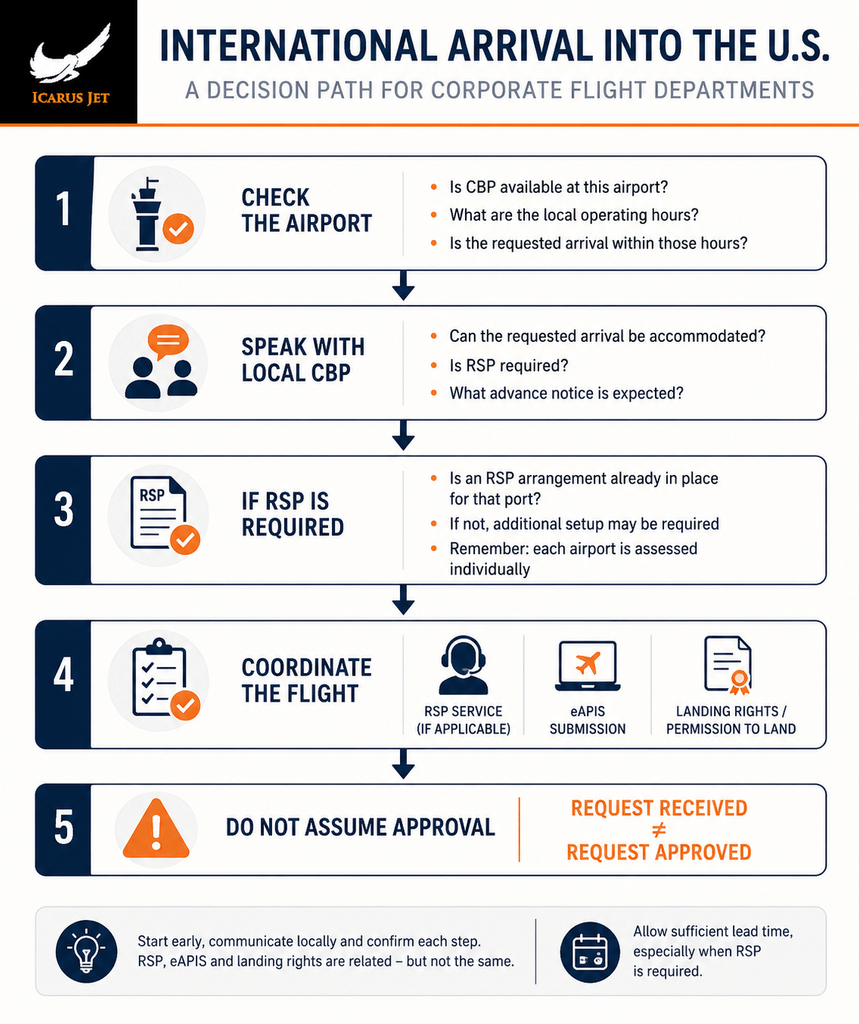
Start with the local CBP office. Corporate flight departments can check whether RSP is required for the planned operation, then coordinate the necessary services before proceeding with eAPIS and landing rights requirements.
Always follow official instructions first, but the process is simple: treat RSP, eAPIS, and landing rights separately.
Allow more time when RSP is involved
RSP may also change the lead time required for trip planning.
Before RSP was introduced, corporate flight departments probably concentrated primarily on filing eAPIS and requesting landing rights only once the schedule becomes firm. With RSP, that may be no longer enough time.
At KOPF, for example, the current operational experience suggests that corporate flight departments should provide at least 72 hours’ notice for RSP-supported service.
Take that only as a minimal planning figure. It does not guarantee approval.
Changes to the schedule should also be notified to CBP immediately, as shifting the arrival by several hours may require changing the CBP officer shifts and transportation.
KOPF shows why “received” does not mean “approved”
Recently, an operation at Miami-Opa Locka Executive showed how the process works in practice.
CBP said the operator’s request was in its system and asked corporate flight departments to plan accordingly. However, CBP did not provide immediate formal approval. That happened because operators made multiple cancellations, and CBP asked for confirmation on a specific date.
After that confirmation, the landing rights request could proceed.
This raises an important distinction.
The request could be in the system. CBP could be aware of the flight. The aircraft and crew could be planned. However, the operation has not been formally approved yet.
That becomes especially important for communication between trip support providers, pilots, and passenger service staff. “CBP has our request” could easily be misinterpreted as “CBP is confirmed”.
Flight departments should make sure it does not.
The example above also shows why speculative requests and cancellations could cause problems. If CBP is allocating officers, overtime, or transportation for a particular flight, cancellations could affect the resource allocation.
That is why requests should be based on credible schedules, and cancellations should be reported to CBP as soon as possible.
RSP needs to become part of U.S. international trip planning
Not every international corporate aviation flight into the United States will require RSP.
However, for flight departments that value flexibility, use executive airports, or fly outside CBP normal hours, understanding RSP is crucial to prevent serious problems.
The key lesson is to start locally and start early.
Determine whether RSP is required, whether the relevant agreement is in place, and allocate enough time to coordinate the service. Most importantly, don’t confuse the different parts of the Customs process.
An RSP arrangement is not permission to land. An eAPIS submission is not permission to land. And CBP acknowledging a request does not mean that request has been approved.
KOPF provides a useful example, but the lesson applies across the United States: Confirm Customs availability as part of initial trip planning, not as a final administrative step.
Questions
RSP and US customs: questions the desk gets
What is the Reimbursable Services Program?
RSP allows approved private-sector and government entities to reimburse CBP for additional services. For business aviation, it can be relevant when additional or after-hours CBP resources are required for an international arrival.
Is RSP only relevant at KOPF?
No. RSP is a nationwide program. Requirements and availability of additional services vary by port; therefore, flight departments should consult the local CBP office for the intended airport.
Does filing eAPIS mean the flight has landing rights?
No. eAPIS and landing rights are two different requirements. Do not consider international arrival Customs-approved until you receive permission.
How much notice is required for RSP?
No single lead time applies to every airport. At KOPF, the current operational experience suggests that at least 72 hours are needed when RSP-supported service is required. This does not guarantee approval.
How much does RSP cost?
Cost depends on the operation and agreement. Planning estimates may include approximately $180 to $210 per officer per hour, plus potential administrative and transportation costs.
What should the flight department do first if it may need RSP?
Contact the local CBP office early. Check whether RSP is required, whether the relevant agreement is in place, and how much notice is needed before proceeding with the remaining Customs and landing rights requirements. Use official application guidance and program information as a starting point when obtaining an RSP agreement.
When should a flight department set up RSP?
Before it is needed. Becoming an RSP partner is an agreement with CBP arranged through the local port, and only once that exists can services be requested for a particular flight. The desk treats the two as separate timetables and starts the first well ahead of the trip that will need it.
Where this sits
The guides around this one
Flying into the US? Customs filed from the desk
Send the dates, the aircraft and the stops. You get the permits filed, the routing checked against the current picture, handling confirmed, and a number you can hold us to.
Contact Us