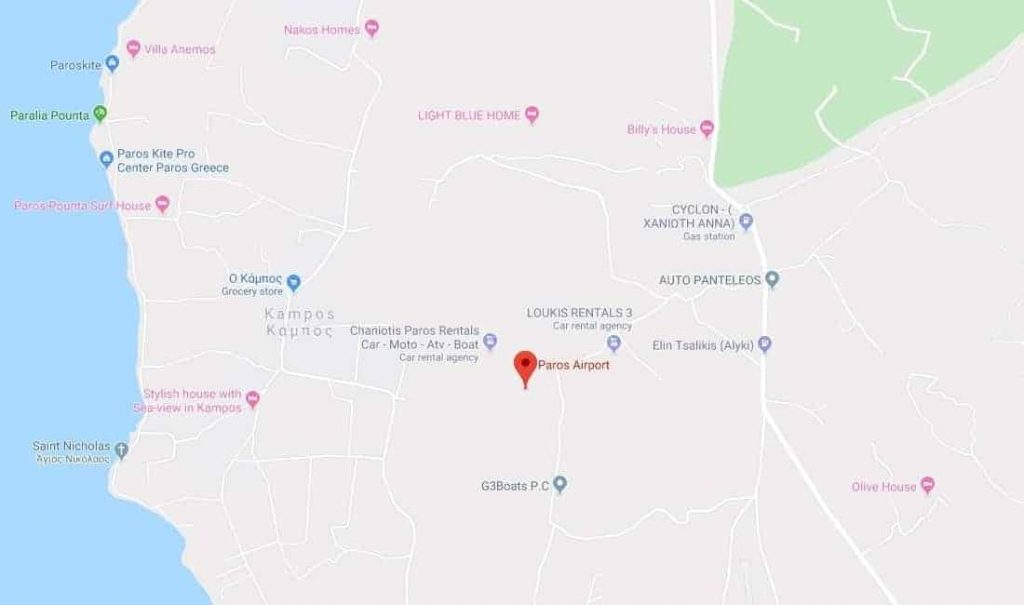
Paros national airport is located on the island of Paros in the Cyclades. The airport has no customs or immigration facility, and it is only open from sunrise to sunset as it lacks and let-down approach for aircraft, and it is classified as a VFR airport only. Paros national airport has no SLOT requirements, but there is no overnight parking available for any aircraft. There is no Jet-Fuel available at Paros domestic airport.
History of Paros international airport
Paros national airport was established in 2016. The largest aircraft it serves is Boeing 737.
Paros Airport Terminals
Paros national airport has one small terminal, which is divided into departure and arrival halls. After deplaning the private jet in Paros, one has to walk to the terminal. The ground handler will arrange for the luggage to be transported to the terminal.
Information And Restrictions Paros national Airport
Paros is straightforward to fly into and demanding to plan around. Four characteristics
shape every trip: it is VFR only, it has no customs or immigration, it has no jet fuel, and
it offers no overnight parking. None of these is a problem on its own. Together they decide
your aircraft, your timings and often your routing.
Daylight operations only
There is no instrument let-down at Paros, so arrivals and departures are flown visually
in daylight. In practice that means the operating window runs from sunrise to sunset and
narrows considerably in winter. It also means the weather has to cooperate: with no
instrument approach available, deteriorating visibility or a low cloud base does not delay
an arrival, it diverts it. Build the alternate into the plan rather than treating it as a
contingency — on the Cyclades the meltemi can close a visual approach with little warning.
Fuel has to come from somewhere else
No jet fuel is available at Paros. Every trip is therefore planned either with enough
fuel tankered in for the return sector, or with a fuel stop built into the routing. For a
light jet on a short European sector this is usually a non-issue. For anything longer, or
for a heavier aircraft, it changes the payload and range calculation, and it needs settling
at the quotation stage rather than on the day.
Paros cannot be your point of entry
With no customs or immigration facility, Paros cannot serve as the first point of entry
into the Schengen area, and it cannot be the last point of departure from it. Arrivals from
outside Schengen must clear elsewhere first — Mykonos and Santorini are the usual choices, and Athens
if the routing suits. This catches out charter clients who assume an island arrival works
the same way as a mainland one. It does not, and the clearance stop needs to sit in the
schedule from the beginning.
The aircraft cannot stay
There is no overnight parking at Paros. An aircraft that brings passengers in has to go
somewhere else until it is needed again, which means positioning legs, crew duty time and
often crew accommodation on another island or on the mainland. For a day trip this is
invisible. For a week's stay it is a material part of the cost, and it is the single thing
most often missed when clients compare quotes for Greek island charter.
Choosing between Paros and its neighbours
Paros is the right answer when the destination genuinely is Paros or Antiparos and the
aircraft suits the field. Where the group is larger, the aircraft heavier, or the arrival is
coming in from outside Schengen, a neighbouring island frequently produces a better trip
even after the boat or road transfer.
Mykonos (LGMK) — longer runway, full handling, and the busiest private traffic in the Cyclades
Santorini (LGSR) — instrument approaches and customs, useful when the arrival is international or the weather is marginal
Paros itself has no slot requirement. That does not mean nothing needs arranging: overflight
and landing permissions still apply according to the aircraft's registration and the countries
crossed en route, and those lead times are what drive the schedule on a Greek island trip, not
the airport. Our flight permits page sets out how those timelines work and what changes them.
Common questions
Can a private jet land at Paros at night?
No. Paros has no instrument approach and operates under visual flight rules, so movements
are daylight only. A late arrival that slips past sunset has to divert or reschedule, which is
why departure timings on the inbound sector matter more here than at most airports.
Is there jet fuel at Paros?
No. Fuel is either tankered in for the round trip or uplifted at another airport. This is
worth confirming before the aircraft is selected, because it affects both range and payload.
Can we clear customs at Paros?
No. There are no customs or immigration facilities. Flights arriving from outside the
Schengen area must clear at an airport that has them before continuing to Paros.
Can the aircraft wait at Paros while we stay on the island?
No overnight parking is available. The aircraft will reposition and return for the outbound
sector. That positioning is normal for island charter and should be reflected in the quotation
you are given.
Flying to Paros
Icarus Jet arranges handling, permits, fuel planning and crew logistics for Paros and the
wider Cyclades, including the clearance stop and positioning that an island trip usually needs.
Call +1 888 277 7203, available 24 hours, or contact us online for a quotation
that accounts for all of it.
Author:
Kevin Singh is the Founder and CEO of Icarus Jet and an active Bombardier Global captain with over 30 years of experience in private aviation. He has flown the Hawker 400xp, 800, Challenger 600, and he is an Instructor on the Global 5000/6000 series and has managed aviation operations across Dallas, Dubai, London, Egypt and Nairobi.
Summer is the most active season for private flights in Greece. Helicopters, private jets, and yachts gather on this small island. Passengers need fast transport between destinations such as airports, hotels, villas, beach clubs, and yachts. Helicopter transfers can...
A computerized flight plan provides the route, fuel, winds, weights, and navigation data, but turning those numbers into a safe and executable flight requires an ongoing exchange between dispatch and the flight deck. Icarus Jet breaks down what each side sees when...
A CTOT (Calculated Take-Off Time) is a departure time assigned to a regulated flight by EUROCONTROL's network manager when demand exceeds capacity somewhere along the route. It is not a punishment and usually has nothing to do with your departure airport. The worst...