
Aircraft weight alone does not determine whether a business jet can use an airport pavement. Understanding ACN/PCN and the newer ACR/PCR methodology is particularly important at airports such as Naples, Florida, where large-cabin jets operate within specific pavement and weight limitations.
When choosing an airport for a business jet, pilots need to consider more than just runway length.
The aircraft should use runways, taxiways, and aprons that can withstand the loads it generates. The ACN/PCN and the new ACR/PCR methodologies assess this interaction. The ICAO introduced the ACR/PCR methodology on November 28, 2024.
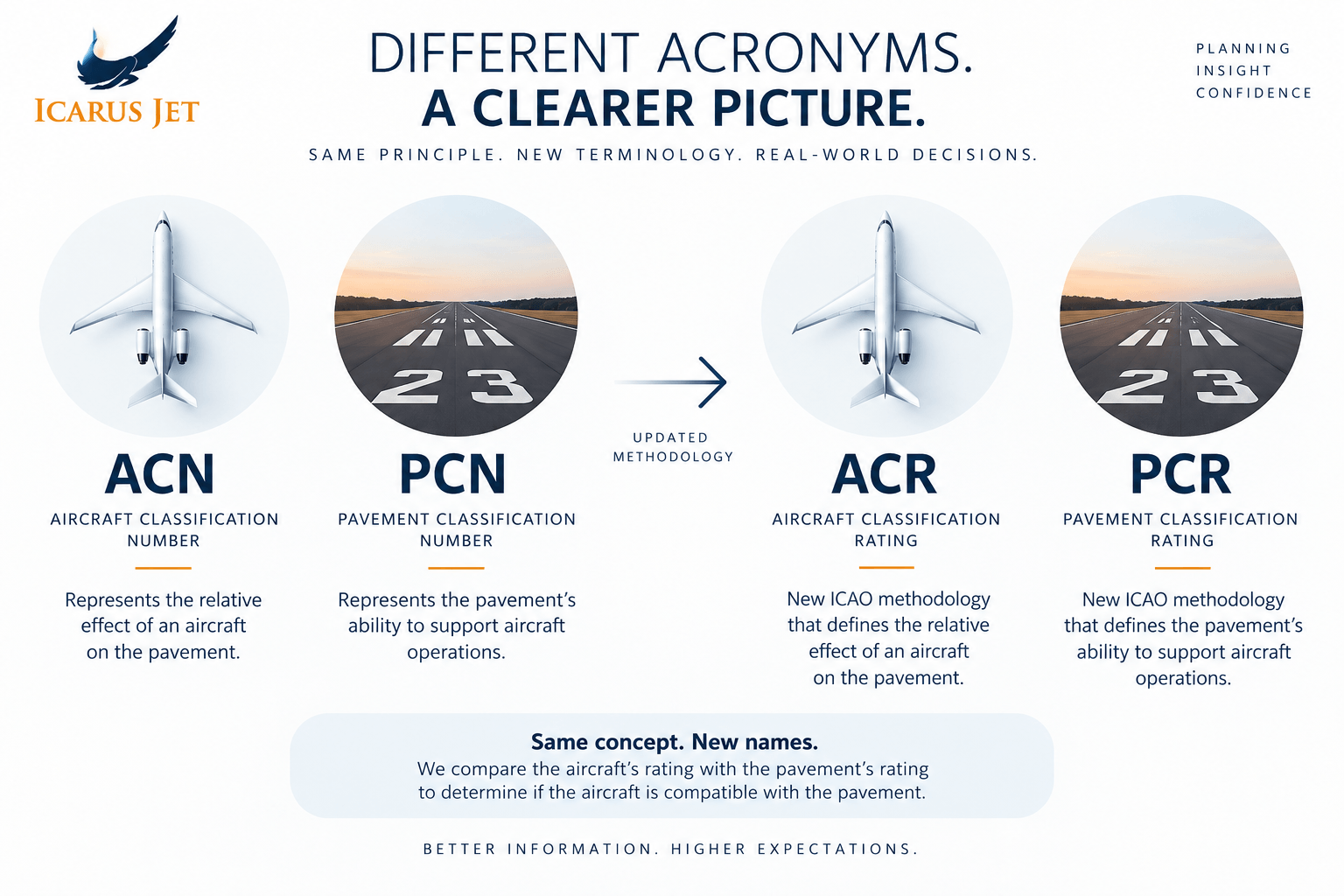
For decades, this relationship was assessed through the Aircraft Classification Number (ACN) and Pavement Classification Number (PCN) system. ICAO has now transitioned to Aircraft Classification Rating (ACR) and Pavement Classification Rating (PCR), with the new methodology applicable from November 28, 2024.
For business pilots, the main idea is this: one number characterizes the aircraft's effect on the pavement, and another characterizes the pavement's capacity to support aircraft operations.
What are ACN and PCN?
Under this methodology, ACN represents the relative effect of an aircraft on the pavement for a specified subgrade strength. PCN represents the pavement’s bearing strength for unrestricted operations.
In simple words, ACN means aircraft and PCN means pavement.
Usually, when an aircraft’s ACN was equal to or lower than the PCN of the pavement, the aircraft was considered pavement compatible.
This was never only a runway issue. Taxiways and aprons also mattered because the aircraft needed a suitable pavement route from parking to the runway and back.
Why aircraft weight does not tell the whole story
It seems obvious that an 80,000-pound aircraft would generate more pavement load than a 70,000-pound aircraft. However, pavement loading is not so simple and depends on more than the aircraft’s gross weight.
The aircraft weight transfers to the pavement through its landing gear and tires. Their configuration, arrangement, pressure, pavement construction, and subgrade affect the pavement loading the aircraft generates.
Furthermore, operating weight is also important.
The same Gulfstream or Global could have significantly different take-off weights due to the number of passengers, baggage, fuel amount, and length of the planned flight. For instance, a short domestic route may require substantially less fuel than an intercontinental flight.
That’s why pavement compatibility cannot be determined just by comparing an aircraft maximum take-off weight.
From ACN/PCN to ACR/PCR
Nowadays, ACN/PCN terminology and calculations have been replaced with a new methodology called ACR/PCR.
- ACR means Aircraft Classification Rating.
- PCR means Pavement Classification Rating.
According to FAA Advisory Circular 150/5335-5D, the new methodology, based on the standardized ICAO approach, can be used to report the strength of airport pavements, including runways, taxiways, and aprons. It also describes how to calculate ACR and PCR values using the FAA pavement design and analysis software, FAARFIELD.
For pilots and dispatchers, the comparison method differed slightly.
Generally, when an aircraft’s ACR was equal to or lower than a pavement’s PCR, the pavement was considered capable of supporting the aircraft from the pavement strength perspective.
The engineering methodology has changed, but the main operational question remains the same: is this aircraft, at this weight, compatible with this pavement?
Why Naples is a useful example
The case of Naples Airport (KAPF/APF) in Florida is a good example of ACN/PCN vs. ACR/PCR methodology application in business aviation.
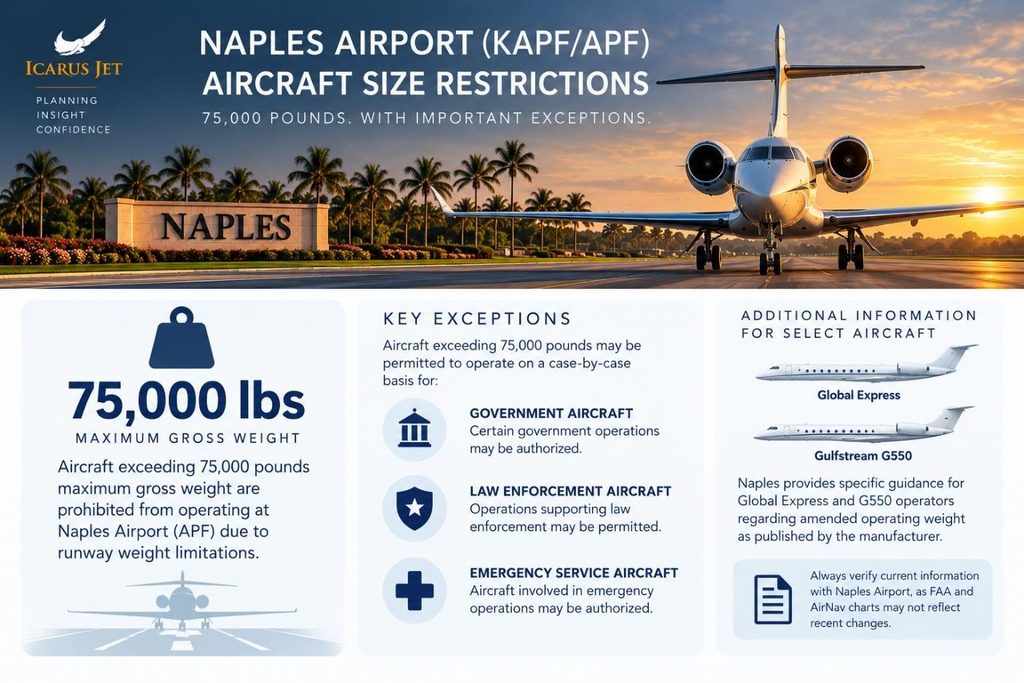
APF limits gross weight to 75,000 pounds because of runway weight limitations. This airport states that aircraft exceeding this limit cannot use it except in rare situations involving certain government, law enforcement, or emergency operations.
At first glance, this could mean some Gulfstream and Global aircraft could not use APF because their maximum weights exceed 75,000 pounds.
However, larger Gulfstream and Global aircraft can operate at Naples.
The main point is that crews cannot assess whether a particular aircraft can use APF based solely on its maximum take-off weight.
Naples also provides information on amendments to the operating weight of certain Global Express and G550 aircraft, according to procedures published by the manufacturer.
This point is crucial for understanding the Naples example.
How Gulfstreams and Globals fit into the picture
Several numbers can be used to assess a large-cabin aircraft’s suitability for an airport with weight restrictions.
An aircraft’s maximum weight is stated in its certificate. There is an approved operating weight of the aircraft according to its documentation. The aircraft also has an actual weight for a particular flight. And there is its ACN or, according to the new methodology, ACR.
These numbers should not be mixed.
As mentioned earlier, APF provides information for certain Gulfstream and Global Express and G550 operators based on manufacturer information about amended operating weight.
This means that the question could not be reduced to the maximum weight of the model aircraft.
Once the aircraft’s actual configuration and weight are identified, pavement compatibility should be assessed. Under the traditional methodology, the aircraft's ACN was compared with the pavement's PCN. Today, the equivalent assessment is made using ACR and PCR.
This is where the actual operating scenario becomes relevant. The same aircraft operating at a lighter weight will not necessarily have the same pavement effect as when it is operating at a higher weight.
Pavement compatibility does not equal airport approval
A positive pavement calculation does not automatically override the airport restriction.
The 75,000-pound weight restriction at Naples should be taken into account according to the aircraft documentation. Pilots should not interpret a positive ACN/PCN or ACR/PCR calculation as the exemption of this restriction.
On the contrary, compliance with an airport restriction does not mean that all pavements could be used.
An aircraft may be pavement-compatible with the runway but limited in its use of certain taxiways or aprons. Other factors, such as runway performance, wingspan, parking restrictions, and NOTAMs, remain relevant.
Pavement classification answers one important question within a much broader airport feasibility assessment.
What should pilots and dispatchers check?
Crews should first establish the aircraft’s actual operating and certificated weight. Then identify the appropriate pavement rating for the runway, taxiways, and apron that will actually be used.
The aircraft’s ACR can be compared with the PCR.
If the aircraft’s ACR is equal to or lower than the pavement’s PCR, the aircraft is generally compatible with the pavement. If the ACR is higher, some additional actions are required instead of assuming a small exceedance is acceptable.
Finally, check the airport specific limitations separately.
This is particularly important for Naples because APF gives its 75,000-pound restriction and additional information for certain Gulfstream and Global operations.
Why is this important for trip support?
For trip support providers like Icarus Jet, airport feasibility cannot be assessed by checking runway length alone.
Considering performance, pavement strength, operating weight, pavement compatibility of taxiways and aprons, NOTAMs, and other airport restrictions simultaneously is paramount.
The transition from ACN/PCN to ACR/PCR makes knowledge of pavement classification important today. Pilots may encounter older operational material using ACN and PCN alongside newer airport information using ACR and PCR.
Naples shows that the presence of other Gulfstream and Global aircraft at an airport does not mean your aircraft can use it under the same conditions.
All aircraft, their approved documentation, operating weight, pavement compatibility, and current airport requirements matter.
In general, ACN/PCN and ACR/PCR help to answer one simple question: can this aircraft, at the applicable weight, use this pavement?
The answer is an important part of flight planning, but it must always be considered alongside the restrictions governing the airport itself.
FAQs
What is the difference between ACN and PCN?
ACN represents an aircraft’s effect on pavement, while PCN represents pavement bearing strength. Comparing these numbers helps assess pavement compatibility.
What are ACR and PCR?
ACR means Aircraft Classification Rating, and PCR means Pavement Classification Rating. They form the new ICAO methodology replacing ACN/PCN for reporting pavement strength.
How are ACR and PCR compared?
Generally, when the aircraft’s ACR is equal to or lower than the pavement’s PCR, the aircraft is considered compatible with that pavement from a pavement strength perspective.
How can Gulfstream and Global aircraft operate at Naples with its 75,000-pound restriction?
It depends on the particular aircraft and its approved documentation. Naples specifically directs Global Express and G550 operators to follow manufacturer information concerning amended operating weight. The model’s maximum weight does not mean the aircraft can operate at APF.
Does a favorable ACR/PCR comparison override Naples’ weight restriction?
No. Pavement compatibility and airport restrictions are separate considerations. Both must be met to proceed with the operation.
Why should taxiways and aprons be considered?
Because the aircraft requires suitable pavement during all its movements. FAA ACR/PCR methodology covers runways, taxiways, and aprons, not only runways.